
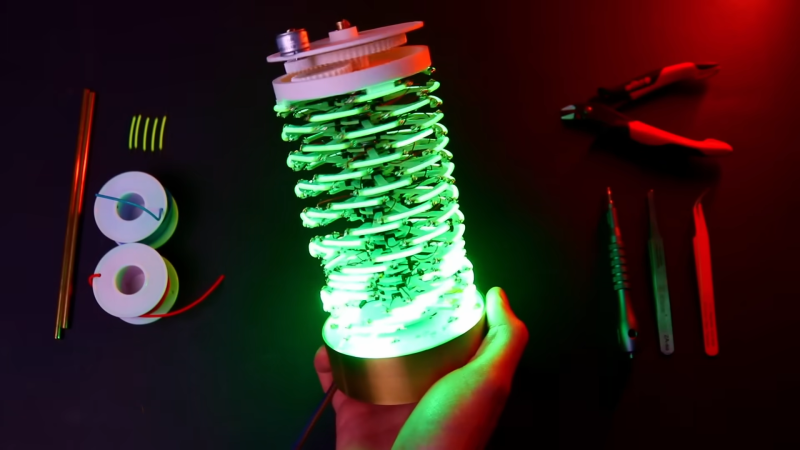
[Nick Electronics] had an idea to build a stylish lamp that could transform its shape while lit. This goal was achieved beautifully with the aid of many, many filament LEDs.
If you’re unfamiliar with filament LEDs, they’re basically thin plastic filaments stuffed with lots of individual LEDs that are very close together. This effectively creates a continuous, flexible, glowing string that can be used for all sorts of creative purposes.
[Nick] packed the lights into an interlocking stack of PCBs that make up the lamp’s structure. Each PCB layer hosts four filaments mounted around the outer edge, and has a pin that locks into a groove in the next layer to allow them to tug each other around as they turn. The PCBs rotate around a central shaft, with power passed from one to the other via interlinking wires. Drive is via a stepper motor on top of the lamp, controlled by an A4988 driver. There’s also an ATmega48 microcontroller onboard, which is the brains of the operation. A DC-DC converter onboard steps up the 5 V input voltage from USB-C to 10 volts for the stepper motor.
It’s neat to watch the lamp in action, glowing and slowly shifting in patterns as the layers catch and rotate in and out of alignment. We’ve seen interesting builds in this vein before, like this fantastic origami lamp from a few years ago.












Ii is nice but overcomplicated. One could have a single source of light inside, and rotating masks. And even maybe zero electronic parts.
They’re an artist and the effect was more important? Which is nice too. This lamp has zero practicability over a regular lamp anyway.
Speaking of which, i just thought of two simple mechanic ways, with the middle wheel fixed to the axis and the top and lowest one to the lid and base.
I don’t think that’s a very interesting lamp. It’s ‘sorta… blah. And the design has some issues, it really needs a V2.0.
But I like the article and video a lot. Someone had an idea, executed it, shows all the problems encountered, and the idea… didn’t work very well.
I have employees now and we do a lot of experimentation on things and my vavorite saying is: “It was a great idea, it just doesn’t work.”
So, yeah: good to see that people are creatively trying out things just to see.
Make it work, if the budget and value match the goal.
For those of you who would like to do something similar, note that you can get a slip ring for thin money on eBay or amazon.
A slip ring would replace the home-built first section contacts of his project, allowing for a more reliable operation.
(I got a slip ring to put on the headstock of my lathe, so that I can turn down the horn on the end of a transducer while simultaneously measuring the resonant frequency.)
Also, since each rotating section is a PCB he could have had a higher bus voltage given to each board and a voltage regulator on each board to drive the LEDs (and current limiting?). That way all LEDs will have the same voltage and the higher ones won’t be as dim.
(Also a V2.0 change.)
Also also, I wonder if he could have used the central core as ground (brass rod with steel bearings), making it so that he only needed 1 wire (V+) going to all the boards. He could reduce resistance by simply running copper wire down the inside of the brass tube.
Using wire between the rotating sections is a good idea. Simple and elegant.
Solid core wire won’t withstand the repeated bending and will eventually snap.
Stranded wire will fare better, but it still might snap.
The flexible wire used in wired earbuds is made for that sort of bending abuse, and will give you a lot more reliability.
I have a pile of the cheap earbuds they hand out for long plane trips, and whenever I need wires going through, for example, a costume I use that style of wire. It lasts a long time in a “bendy” environment such as going up the arm and through the shoulder of a shirt.
Furthermore, all wires going to circuit boards should either end in connectors or have strain relief.
He’s not using connectors (a good choice), so an easy way to give them strain relief is to put a dab of hot glue where the wire is soldered to the board. Makes the connection much more reliable.
(In my professional career, whenever I got a hardware board from a client I always went over it and put a drop of hot glue on every wire coming out of the PCB. This has helped out immeasurably, because my dev boards didn’t fail, while the ones the hardware engineers used almost always had one or more intermittent connections.)
Litz wire. Don’t plan for much current.