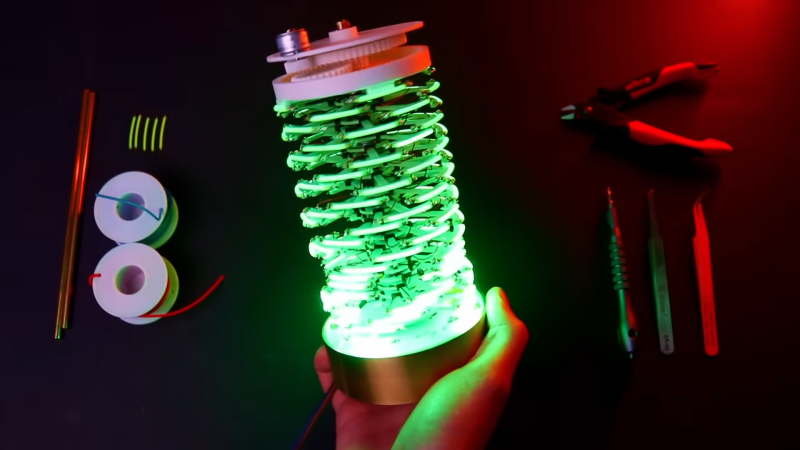
[Nick Electronics] had an idea to build a stylish lamp that could transform its shape while lit. This goal was achieved beautifully with the aid of many, many filament LEDs.
If you’re unfamiliar with filament LEDs, they’re basically thin plastic filaments stuffed with lots of individual LEDs that are very close together. This effectively creates a continuous, flexible, glowing string that can be used for all sorts of creative purposes.
[Nick] packed the lights into an interlocking stack of PCBs that make up the lamp’s structure. Each PCB layer hosts four filaments mounted around the outer edge, and has a pin that locks into a groove in the next layer to allow them to tug each other around as they turn. The PCBs rotate around a central shaft, with power passed from one to the other via interlinking wires. Drive is via a stepper motor on top of the lamp, controlled by an A4988 driver. There’s also an ATmega48 microcontroller onboard, which is the brains of the operation. A DC-DC converter onboard steps up the 5 V input voltage from USB-C to 10 volts for the stepper motor.
It’s neat to watch the lamp in action, glowing and slowly shifting in patterns as the layers catch and rotate in and out of alignment. We’ve seen interesting builds in this vein before, like this fantastic origami lamp from a few years ago.
Continue reading “Transforming Lamp Built With LED Filaments”