
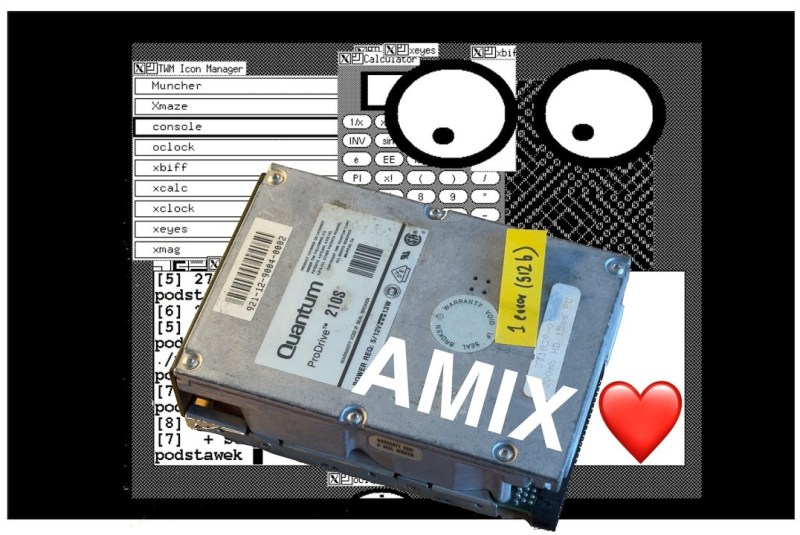
Some of you may know there’s a version of UNIX for the Commodore Amiga, aptly called Amiga Unix or AMIX. There is an almost complete record of versions from 1.0 to 2.03, but 2.02 was lost media–until [Forgotten Computer] found it on an old Amiga.
It starts with an auction held for the 40 year anniversary of the Free Software Foundation where, by just one second, the highest bidder was too late. What do you do first with an artifact as valuable as an old FSF computer? You image the hard drive. Then you make several copies, including on different computers–after all, you wouldn’t want to lose the data on it. Preservation secured, the natural next thing is to boot it–and that’s when we see the magic 2.02c version number.
According to thorough digging by [Forgotten Computer], this version was–until now–lost.
In the video after the break, [Forgotten Computer] goes over what Amiga Unix is, the discovery process, and explores what’s on the disk–including FSF staples like GCC, G++ and core utilities like GNU less.
Thanks to [Stephen Walters] for the tip!












Ooooo yes that amazing amiga 3000 UX! I only heard about it a year ago, but I’ve never seen it in person…
https://www.tumblr.com/ui-alcoholic/808730507508580353/commodore-amiga-3000ux
The cs dept at the next university over required all students to have an Amiga with Unix. I was so jealous. I had to settle for using my Amiga to modem into a DEC mainframe and going into the lab to use the big Sun workstations. They all had 25 inch screens so life wasn’t too bad.
Using the Hedley Hi-Res monochrome monitor for this OS was also pretty cool.
But until they have it, they (and you) wouldn’t know. Plus, if you don’t care about it, why’re you posting here and complaining about it?
I don’t care anyway.
Some of us never heard of a Unix for Amiga, and wouldn’t know of 1.0 to whatever, or that someone made a video about it, however humble. Now I know it exists, I can renew my interest in Amiga, even if only through emulators. It’s also from the Free Software Foundation, so I imagine there are interesting historical files in there, and unlikely to have personal junk, although you never know! I’d argue it’s possible hacker history at any rate.
if you don’t care about it, why’re you posting here? I’ve used this line myself in many forums. Your case is slightly more legitimate than others, yet still, the answer is that you are trying to steer the editorial decisions, maybe subconsciously, but that’s what public shaming is about, isn’t it? If that’s not the reason, than why post TWICE? If you really want to make your opinion heard, though, it would help if you were less troll-ish.
I post because I can. If you disagree then simply don’t ready my posts 🙃
I purchased the Amiga UNIX option for my Amiga 3000 when it came out so I could do OSF/Motif development. I still have the whole setup with the SCSI QIC tape drive and the original QIC tape with the Amiga UNIX 2.01 distribution.
In other but related news, a Commodore 900 unix machine was recently found and a web-site published about it by the Danish Data Museum (in Danish): https://datamuseum.dk/wiki/Commodore_900
Never installed it. https://archive.org/details/commodore-amiga-operating-systems-amix