
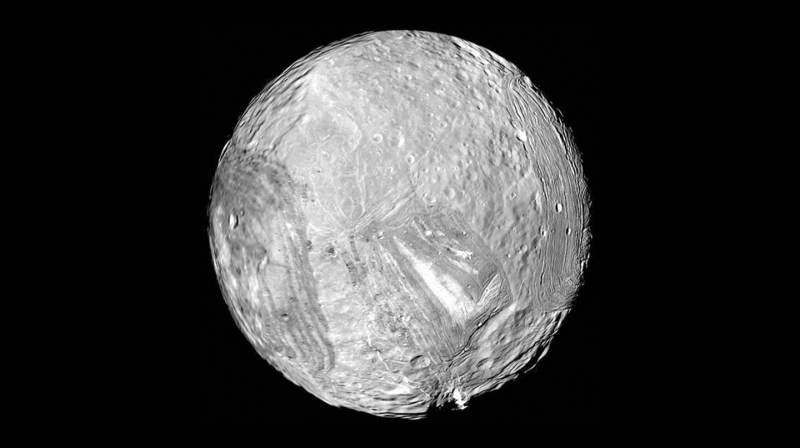
If you’re interested in extraterrestrial life, these past few years have given an embarrassment of places to look, even in our own solar system. Mars has been an obvious choice since before the Space Age; in the orbit of Jupiter, Europa’s oceans have been of interest since Voyager’s day; the geysers of Enceladus give Saturn two moons of interest, if you count the possibility of a methane-based chemistry on Titan. Even faraway Neptune’s giant moon Triton probably has an ocean layer deep inside. Now the planet Uranus is getting in on the act, offering its moon Miranda for consideration in a kinda-recent study in the Planetary Science Journal.

Photomontage credit NASA.
Even if you’re into astronomy, it may seem like this is coming out of left field. “Miranda, really? What new data could we possibly have on a moon of Uranus nobody’s visited since the 1980s?” Well, none, really. This study relies on reexamining the data collected during the Voyager 2 encounter and trying to make sense of the chaotic, icy world that the space probe revealed.
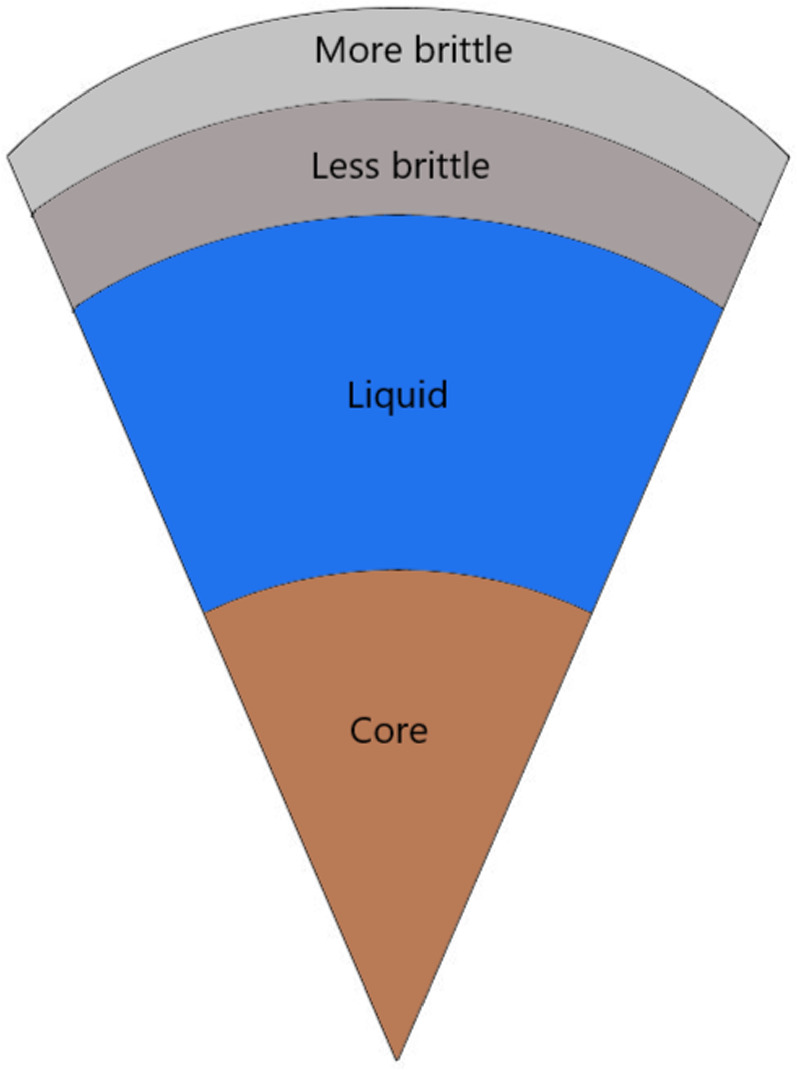
The faults and other features on Miranda indicated it was geologically active at some point; this study tries to recreate the moon’s history through computer modelling to find that Miranda probably had a ≥100 km thick ocean sometime in the last 100-500 million years, and that while some of it has likely frozen since, tidal heating could very well keep a layer of liquid water within the moon’s interior. Since the moon itself is only 470 km (290 mi) in diameter, a 100km deep ocean layer would actually be a huge proportion of its volume.
Right now, the over-optimistic thinking is that “water means life”, since that’s how it seems to work on Earth. It remains to be seen if Miranda, or indeed any of the icy moons, ever evolved so much as a microbe. Aside from the supposed presence of liquid dihydrogen monoxide, there’s nothing to suggest they have. Finding out is going to take a while: even with boots — er, robots — on the ground, Mars isn’t giving up that secret easily. Still, if we’re able to discover irrefutable evidence for such extraterrestrial life, it will provide an important constraint on one term of The Drake Equation: what fraction of worlds develop life. That by itself won’t tell us “are we alone,” but it will be interesting.
Of course, even if all these worlds are barren now, they might not be for long, once our probes start visiting.
Story via Earth.com
Header image: Miranda, imaged by Voyager 2. Credit NASA/JPL-Caltech












I’ll be the first.
Only if you’re lucky.
Today is your lucky day!!
https://www.youtube.com/watch?v=0uUGJ6rCK10&list=PLVTrQ4rcysNnLt2FJM_hmjfa_rWCuyINZ
…
“Phrasing!”
Everyone, please pretend you speak Greek: Ooo-ran-us!
It’s not like the English language really bothers to pretend its pronunciation has anything to do with spelling, anyway.
“Urrectum”
Lol
damn near killed-um
Things are evidently much more exciting for those who are blissfully ignorant of how much complexity is involved in the existence of life. It seems almost cruel to point out to them that, based on everything science has learned so far, the odds against life forming on its own involve a number much, much larger than the number of atoms in the known universe. The real question they should be asking is, given that we truly shouldn’t exist from a scientific standpoint, how and why did we come to be?
You might be putting it a bit strongly; while my gut agrees with the Rare Earth Hypothesis, it’s pretty hard to draw conclusions from a dataset with one point.
If we do find life in our solar system, unless it’s very novel chemically (like doesn’t use DNA or has different base pairs) I’m going to take it as evidence of panspermia and start quoting Battlestar Galactica endlessly: “Life here began out there…”
Also, complexity isn’t magic. It happens whenever there’s excess energy and some non-linear process. And the universe doesn’t lack for either.
Stealing this. It perfectly describes almost all my past relationships.
Does complexity imply processes that control local entropy?
Maybe it’s a bit of the reverse, “Life out there began here.” What I mean is we know Earth has life, intelligence is still up for debate, we know life is tenacious and we know parts of planets transfer from one planet to another (mars rocks on earth). So if we put these all together, considering that life has existed here for about 3.5 billion years the odds that Earth life has “contaminated” any reasonably hospitable environments in the solar system are pretty good. If we fine life somewhere else in the solar system I’d be willing to bet if we do a DNA sequence on it that life will turn out to be a distant cousin.
If we are alone there will always be only one data point.
“based on everything science has learned so far, the odds against life forming on its own involve a number much, much larger than the number of atoms in the known universe”
I’m not sure who’s saying that or what they’re basing it on. From the available evidence, given the conditions in which life appeared on Earth, the probability of life appearing is 1.
Not that there’s enough available evidence to support any firm conclusion. But the absence of knowledge doesn’t mean speculation gets promoted to truth. Even when scientists do it, speculation isn’t science.
If it forms once, it’ll form a billion times. Having it form only once is the unlikeliest scenario.
yet here we are
I am old enough to remember seeing the first images of this moon…a special, I think it was. Carl Sagan was seated…watching images come in.
Arthur C. Clarke’s Mysterious World featured Super-8 footage of the Great Daylight Fireball of 1972 (the Teton Event).
That fireball went from horizon to horizon…smooth…steady…like the Stardust capsule…or Leonov aerobraking over Jupiter in the movie 2010.
But nothing ever spooked me like the first images of Miranda—with my first thought being-
“It looks strip-mined.”
It has since been assumed that an impact event did that—but Mimas doesn’t. A larger impact should have had shards and cracks every which way.
Instead, we get something that looks like a quarry.
I suspect it may indeed be a quarry excavated by the Vogons. I hear they are constructing a hyperspace bypass somewhere ’round here.
I think our current expectations about the possiblity of life on other worlds has been tainted by a misquote from H. G. Wells’ War of the Worlds In Jeff Waynes’ adaptation, which helped repopularise the story, the narrator quotes the astronomer, Ogilvy, as saying “The chances of anything coming from Mars, is a million to one.”, when in fact, the book tells us he says ” The chances of anything like us coming from Mars…”
So, there could be plenty of life out there, but we just do not recognise it, as we are lookinng for familiar signatures.
I also think Ogilvy needs a formal redemption.
UUUUUULAAH!
I have never understood why humans think that “life” has to be like us to be “life.” We seem to think that “life” needs water, breathable air, be carbon based… When extraterrestrial life IS proven, chances are good that it will look NOTHING like us.
When man first encounters alien life we’ll probably be wiping it off our shoes.
“Now the planet Uranus is getting in on the act, offering its moon Miranda for consideration”
“Miranda, really? What new data could we possibly have on a moon of Neptune nobody’s visited since the 1980s?”
I’m more impressed by Miranda’s ability to move between the planets, maybe the lifeforms use it as a spaceship.
That’s just a figment of your imagination. Look into the red dot, that’s right. There are no aliens. It was swamp gas and weather balloons that made you think it said “Neptune”.
Be honest- who ELSE read the title, and thought of Hecklefish?
😁👍
Life Needs More Than Water: The Missing Clue Scientists Just Discovered
February 11, 2026
https://scitechdaily.com/life-needs-more-than-water-the-missing-clue-scientists-just-discovered/
ew…