
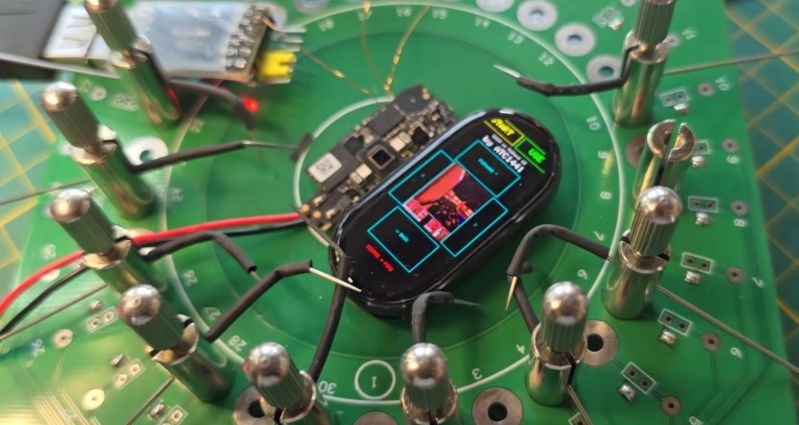
In between playing Doom on the most ergonomically challenged devices, [Aaron Christophel] likes to take a relaxing break with reverse-engineering Xiaomi Mi Band fitness trackers and writing custom firmware for them. Also so that he can play more Doom on those, natch. The latest subject comes in the form of the Mi Band 10, which features a BES2700iMP SoC, known internally at the manufacturer Bestechnic as the BEST1503. This is all documented on the GitHub project.
In the accompanying video we get some more details on this project, with the main challenge being that for this Mi Band 10 there’s no public SDK for its SoC. This was a major bummer until [Aaron] realized that the BEST1306 (BES2700IHC) is effectively the same SoC, but with a leaked SDK available via apparently audio-focused development kits. From there a BEST1503-compatible SDK could be assembled.
Naturally, to check that all of this was working correctly Doom was ported to the device courtesy of the GBADoom project. This mostly works aside from the display running in single-bit SPI mode instead of quad-SPI that it should be capable of, along with limited color depth. Despite burning all the tokens on the Claude, this provided little help, probably because the required information hasn’t leaked out of Bestechnic yet and ended up in the training data set.
Since the Mi Band 9 uses the same SoC, it’s expected that this reverse-engineered SDK will also work for that fitness band, though that hasn’t been tested yet.












Is there any way to get really cheap BLE compatible MCUs with decent sleep current? I use Nordic but their MCUs can get expensive for low quantities. Does anyone have experience with Chinese BLE MCUs? There were some crazy SO-8 BLE MCUs iirc, some were even 8051 cores.
Anyone tried non western BLE stuff?
Have a look at BL602/604 RISC-V MCU, which was even featured here on HAD some time ago:
https://hackaday.com/2020/11/20/new-part-day-bouffalo-labs-bl602-risc-v-wi-fi-bluetooth-soc/
There is documentation and dev-boards available by Pine64: https://pine64.github.io/bl602-docs/
Lup Yuen LEE has summarized his reverse engineering: https://github.com/lupyuen/lupyuen.github.io/blob/master/src/book.md
TBH, I have not checked exact sleep current, but it seems to be not that high :)
additional thought: The new Pebble watch uses SF32LB52J, the founder has written about that RISC-V MCU with BLE here: https://ericmigi.com/blog/how-to-build-a-smartwatch-picking-a-chip/
What type of pricing are you looking for ?
nRF51822 Modules in single quantities cost around 2.50 Euro, well within reach of every hobbyist. Is that too expensive ?
WCH CH592 Series RISC-V MCU are around $0.60-$0.90 depending on the letter.
Works decently well.
So, a vibe-reverser?
They all are crap at sleep tracking, tho
Are they? I have owned an Mi Band 4, Mi Band 6, and currently own a Huawei Band 10. They have all been pretty good. I have a very bad sleeping schedule, some days I sleep at 1am, some days I stay up until 8am, and then sleep until 5pm. All the band that I owned still did remarkably well to detect my sleep pattern and all the other stats. Of course I haven’t ever owned an Apple Watch or other top end fitness trackers, nor have I gone through a proper sleep study with doctors around, so I have no benchmark to compare to.
Work from home has thoroughly spoiled me, and any sort of normal social participation seems very difficult because of my lifestyle.
It’s not your lifestyle…
I had a Mi Band 4 which did great sleep tracking till the battery died. Replaced it with a Mi Band 9 which is hopeless – it’s almost as accurate when I leave it on the bedside cabinet as it is when I wear it.
They can only measure movement and possibly heart rate – neither of which directly measure sleep or sleep phase. You can’t really measure when someone is in a certain phase without some serious equipment – so they aren’t meant to actually track/measure sleep, its more of a curiosity, that has made people believe it is based in real science. A bit like heart-rate variability – sure it has its uses, but the idea that it measures “stress” or other vague states is pretty much speculation. Wearable manufacturers want to give their customers reasons to buy – doesn’t mean to say it is reliable (they don’t claim it is, but people just assume so). The most important thing a doctor will want to know about your sleep is when you go to bed, and when you wake up.