
Many of us remember back in our school days taking tests and filling out answers on a Scantron sheet, those long rows of A, B, C, D, and E that had to be filled in with a #2 pencil. Ever wonder why it needed a #2 pencil, or what the point of using a Scantron was at all? That question is answered in the latest video from [SimonRetro], where he takes a look at the Scantron and how it works.
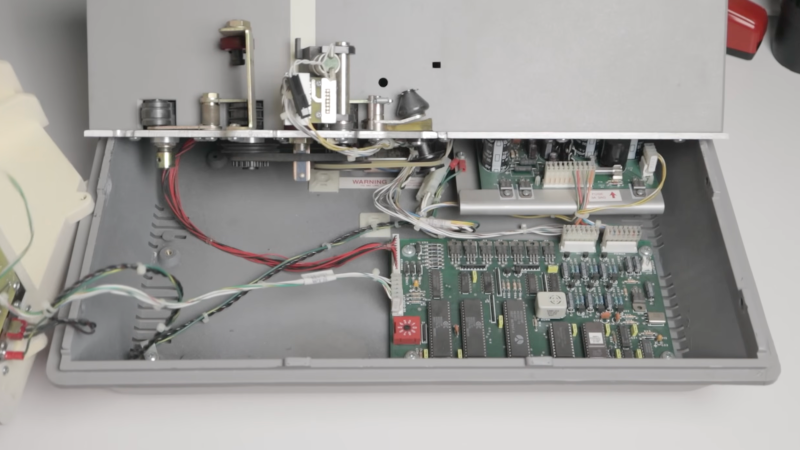
One of the more interesting things about the Scantron is that it’s such a standalone device. No software needed, no keypad to mess with just two rocker switches. The on/off switch is also the way you tell it to forget the last answer sheet and allow you to program in a new test. Upon booting, you feed in a Scantron sheet with some specific boxes filled in, and then it’s programmed and ready to take in and grade all the students’ answers. Opening up the Scantron reveals it’s pretty interesting inside: one control board with early-’90s-era chips. There’s also a lightbulb (no LEDs) shining through the six reading sections of the card, as well as an arrangement of belts and motors to move the card through the machine. The printer is a seven-pin printer used in conjunction with a pair of ink rollers to print out the results on the cards.
[SimonRetro] also went ahead and tried different ways to mark the sheets including pens, Sharpies, colored pencils, and different thicknesses of pencils besides the #2 to see which would and wouldn’t work in the Scantron. Thanks [SimonRetro] for exploring this machine from many of our childhoods and sharing its inner workings. Be sure to check out some of our other reverse engineering articles that explore how classic devices work.












things are always better with “tron” at the end. i made a “Disturbatron” — check it out here:
https://github.com/judasgutenberg/Disturbatron
Somewhere .. a Kurt Vonnegut novel? Douglas Adams? … I remember a bit about “never invest in a stock of a company whose name name ends in ‘-dyne’ or ‘-tron’.”
Or maybe it was “only invest in…”, in which case I would presumably be a bazillionaire by now.
True. We need to return to naming things after Greek mythology or “Collosodyne Electron.” No more of these numbers and acronyms.
The patent on the Scantron is from 1972, so I must have encountered the very early ones in the mid ’70s. I wonder what was in the ones from before microprocessors?
The College where I work in IT used them up until the early ’00s, I got stuck with supporting a really janky app that performed some specific statistics on the test results one Prof required. And cleaning and replacing those rubber feed rollers. I was SOOO happy to consign them to Surplus when the time came for the College to move to Examsoft. (which brought it’s own IT nightmare).
Another wear item was the drive belts. I was a lucky enough to find a sewing-machine store that carried the exact size.
Macroprocessors, of course
Even as a Junior high student I figured out that if you made the end of form bar at the first question it would just spent the thing out without grading it which made you very popular with the teachers go ahead to manually grade it
Yeah, in 1969 I worked for National Computer systems in Minneapolis. Our “Scantron” (we never called it that) was running on 3 computers; a CDC 160A, a CDC 160G, and we were beginning to run it on a CDC 1604. The thing weighed a ton! It was about 4 feet high, over 8 feet long, and had a huge variety of hoses, vacuum connections, light bars, rollers and collators., all attached to the computer running the system. Programs were fed in through paper tape using a high-speed light-activated reader, and patches were entered through switches on the front panel in an octal BCD. We scored surveys for the OEO, tests such as the MMPI and the Strong Vocational Interest Blank (SVIB, which became the Strong-Campbell Vocational Interest Blank because we were scoring David Campbell’s research}, and a half-dozen other research projects and psychometric tests. When NCS bought United Mailing and moved to a suburb, I couldn’t afford to work for them anymore because of transportation problems. (I started out as a computer operator, but never got established as a programmer. I was an assembly language programmer, but we were developing a little language of our own called “VALTRAN”, and I never got past the beginnings.) Interestingly, the President of United Mailing had the same name I did. We ended up with hundreds of feet of re-positional Heidelberg press equipment that started off with blank rolls of paper and ended up as stapled and collated books after a couple hundred feet.
The best part of my experience there was working with Glen Anderson, who, coincidentally, pretty much developed the UNIVAC 1.
The #2 refers to how hard the lead is in the pencil, not to how thick it is.
Pencil hardness scale:
https://en.wikipedia.org/wiki/Pencil#Grading_and_classification
How hard it is dictates how dark it is. Softer = darker. #2 is sort of medium hard, so not completely dark like pure graphite but also not light gray like a really hard mixture of graphite and clay.
Pure graphite is much harder than pure clay.
Yeah, I think Matt confused them with mechanical pencils, which ARE sold by the thickness of the “lead”s they dispense (0.5mm, 0.7mm, etc.).
In the 90s when I encountered these, I always wanted to film a short, of two students, side by side, filling out a scantron sheet to the music of duelling banjos.
Probably still in a storage bin somewhere, I have two extra scantron sheets I took for this purpose. But have yet to get around to it…
They were fairly robust machines, only really needed cleaning due to the paper dust and a couple of squirts of WD40 on the rollers. Fun fact: Scantron spun it’s repair staff off into their own company which fixed these, 3rd part IT services, and laserjet / dot-matrix printer repair.
Another class of self-contained, surprisingly robust machines, though devoid of all electronics, were Scantron’s immediate predecessor in the education sector: The mimeograph duplicator.
Most were tabletop units, occasionally motorized but just as frequently hand-cranked, and shockingly cheap to operate compared to the photocopiers of the time — plus, they were both faster and more reliable right up until they weren’t. (And then they disappeared forever.) The duplication quality was decidedly poor, but it hit the sweet spot of “just barely good enough for classroom use, and not one iota better”.