
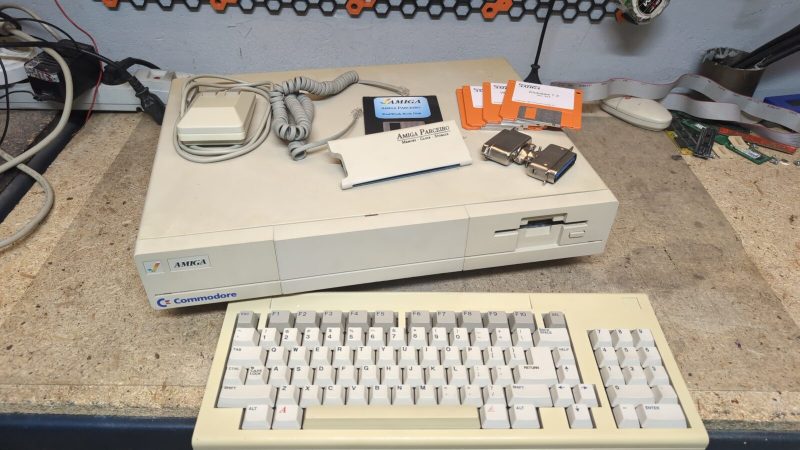
Recently [Drygol] had an Amiga 1000 system over for some repairs as well as maintenance and general TLC. This is a Motorola 68000-based home computer from 1985 that also has the distinction of being the first Amiga system to be released by Commodore. At a time when the IBM PC was still strutting its monochrome and EGA graphics alongside PC speaker beeps, the Amiga 1000 featured relatively high-res graphics and advanced stereo audio courtesy of special accelerator chips.
Overall the system was in a pretty good condition, even coming with the very nifty modern Parceiro expansion that adds 8 MB of fast RAM, an SD card slot and RTC. This thus meant that they mostly just had to perform the typical maintenance task, such as recapping the PSU and mainboard, as well as recapping and lubing up the floppy drive. The original 230 VAC fan in the PSU also got swapped with a 12V unit that was much quieter.
After disassembling the keyboard for some deep cleaning and retr0brighting, a little glitch in the form of the use of a too long screw by a previous owner was addressed, as well as a broken plastic clip. With how little attention the Amiga 1000 received after its release it’s good to see some of these units still kicking.












Maybe I’m turning into a grumpy old man but I’m not convinced recapping qualifies as “casual”…
To fans of vintage computers it’s a required skill, I guess.
Also, to my understanding, the soldering iron wasn’t unknown to home computer users of the 80s and early 90s.
Back then, building an EPROM programmer wasn’t too uncommon, I think.
Computer magazines were full of do-it-yourself projects and circuits.
So there must been, um, enough “advanced” users being part of the audience to justify that.
Especially in the Commodore crowd with all their various accessories.
It wasn’t until mid-late 90s when that fell out of fashion, I assume.
Back in the 1980s the soldering iron was a necessity for computer users. Computer hardware wasn’t cheap and often the stuff you wanted wasn’t available off the shelf. A professional desktop computer was in the same price range as a used car in good condition and better toy (or “home”) computers were priced like mopeds. If you didn’t have a rich dad, DIYing as much as possible was the only option.
This all changed around 1990 when cheap standardized hardware from Asia hit the stores.
+1
Personally, on DOS PCs in the 90s I built small things using a soldering iron, such as Covox plugs or null modem cables..
By contrast, C64 or ZX Spectrum users still built real devices for user port or so I think at least.
I also noticed that things that used to be affordable, -such as aforementioned EPROM programmers-,
became very expensive on PC platform in the 90s.
I’m thinking of the professional Willem models for LPT port..
Back then I was shocked how much it did cost to program a simple 2764 or 27C64 EPROM.
From my point of view, it took a few years until modern microcontrollers such as PIC 16C84 or 16F84(A) became more popular among the average electronic hobbyist.
They had a simple serial programming protocol that didn’t need an expensive programmer or an EPROM.
By early 2000s the PICs became better known, I think.
Anyway, just saying.. I don’t mean to be unfair to PC users/platform, also.
I think there were a few DIY i/o cards for the plain 8-Bit ISA bus (PC bus).
Some shipped with books on the inside of the cover (such as PC-Bastelbuch ca. ’89/90).
But that faded away in the 90s, I think.
I guess that’s because PC/XT class computers nolonger were high-end by late 80s,
so they could be tinkered with for a short moment in time?
About that time, 8-Bit chips could be integrated rather well and no-name PC/XT mainboards from Taiwan, Hong Kong etc. which were readily available.
And since XTs had most things on expansions cards, a damaged parallel or serial port could be replaced/fixed.
The older 80s era LPT cards were less fragile, also, I vaguelly remember.
They used TTL or NMOS rather than CMOS for driving.
But maybe I’m misremembering things, also. It’s been a while.
Anyway, I would draw the line with the advent of ATX mainboards, roughly.
They had started to have integtrated devices and introduced that metal plate on the rear side of the chassis.
Though again, some standard 486 and 586 boards had integrated i/o already.
They used pin headers for serial, parallel and PS/2 mouse..
So multi-i/o and other replaceable/fixable ISA cards were nolonger in fashion.
Instead, a SuperIO chip on motherboard was doing it all and breaking it meant a defective board (parallel port was sensitive to shorts, V.24 had protective diodes).
That being said, relays cards and other interfaces for parallel port were still sold in the 90s.
Kemo solds such stuff, I vaguely remember.
They had some kits and interface cards with control software written in Visual Basic? Not sure.
Sorry for the long comment! I hope it wasn’t that annoying. 🙁
It’s just that the parallel port was the closest the PC platform had compared to an user port.
Simple ISA devices such as AdLib card could be ported to LPT port, for example.
In Europe, the PIC16x84 and his relatives became popular for DIY ISO 7816 smart cards, not so much for other purposes. Tinkerers preferred the 8031/8051 because software development was easier and those chips were practically free if you knew where to harvest them.
^Ah, I see, thanks! I think I do remember those telephone card sized SmartCards.
Personally, I’ve used the DIP version, since there were ham radio projects using an 1684 (morse beacons, decoders etc).
That was when sharing .hex files of projects was still common on websites. Ca. 1998 to 2004, I think.
I’ve used programming tools such as PonyProg or PICprog.
They used V.24 port to talk to the PIC, even ran on young Win XP..
By using a dedicated 9v (?), the programming was more reliable than powering it via serial port.
I was there. I have the skills. That doesn’t keep it from being an uninspiring task lurking at the bottom of my project list.
This. Though that colorful box in the garage keeps tempting me from time to time….
I bought the Amiga 1000 when it first came out. In the first month that I owned it, I found an article that showed how to double the on-board memory by clipping a pin on each memory chip and soldering on an additional memory chip on top of the original memory chips. When I first booted, no joy! Found a solder ball bridging pins on one of the chips I soldered. Fixed that and there you go, a good boot with double the memory. I miss my Amiga.
I got an A1000 at some point. But it came with only 256KB ram in its base form. I was able to procure a 256KB expansion box for in the slot on the front. But 512KB was still not enough.
So, I got another 512KB of ram chips (41256’s), and piggybacked ram on the mainboard and the expansion box. So I had a total of 1MB, which meant 512KB chip ram and 512KB of slow ram.
Piggy backing the ram was simple in the A1000, you didn’t even need any extra ICs. However, it didn’t place the extra 512KB at address $C00000 but I think it was at $100000, which could give some incompatibility issues with certain games. With a few extra ICs, you could place the ram at $C00000, but I never bothered.
Feels strange to see the output on a small flatscreen. And 8MB, wow, Amiga 8000 :)
TechTangents did a video on some accidental retrobrighting tests he did. There’s a big of plastic he retrobrighted many years ago, and areas of the plastic that were spared retrobrigting by being under some tape are now less yellow than the immediately adjacent areas that got the “treatment.”
You’re probably better off just spray painting this stuff, and it’ll last longer too.
From 1985 to 2005 PC gaming went from Alley Cat to Half Life 2, Doom III and Postal 2.
From 1985 to 2005 Amiga gaming went from Lemmings to Lemmings.
’nuff siad.
https://youtu.be/eGIIvR190Jw
Fujitsu FM Townes.
Hi, point of view is probably because Amiga users usually got their software via trade (local), I guess.
So the mainstream titles/classics had better, err, distribution.
PC users also did exchange software, but their user base
perhaps consisted of more adult users and thus had higher buying power.
After all, a PC had been used for both entertainment and productivity software.
That being said, I think there had been nice text-adventures, graphics adventures and point&click adventures on both of them, though.
For example, “Universe” (famous for its color depth) or “Flight of The Amazon Queen” or “Beneath a Steel Sky”.
By about 1994/1995, the Amiga was the last big, non-PC platform left over here in Germany, thanks to its user base.
Advertising games such as “Telekommando” 1&2, “Bifi 2 – Action in Hollywood”, “Dunkle Schatten” or “Helicopter Mission” merely had an Amiga port besides the PC DOS version.
Some of the weird 90s games such as “Alfred Chicken” (OCS/ECS and AGA)
were not released on PC at all, but only Amiga and game consoles.
So depending on the genre, the Amiga had some notable last releases.
It’s maybe comparable to the NES/Famicom, which still saw impressive games close to its final days.
That being said, I never understood the rivalry back then. PC vs Amiga, Mega Drive vs SNES..
Someone should think that diversity is good and being seen positive.
Last but not least, jump&runs aka platformers often were more smooth on Amiga than VGA PCs.
The game “Lion King” comes to mind. It also was available on consoles.
Here, the Amiga and Mega Drive had less colors (compensated via dithering) than SNES but featured hardware-assisted parallax scrolling.
“Earth Worm Jim” is another such title, maybe.
2026 – PC user still somehow butthurt about the Amiga Vs PC thing