
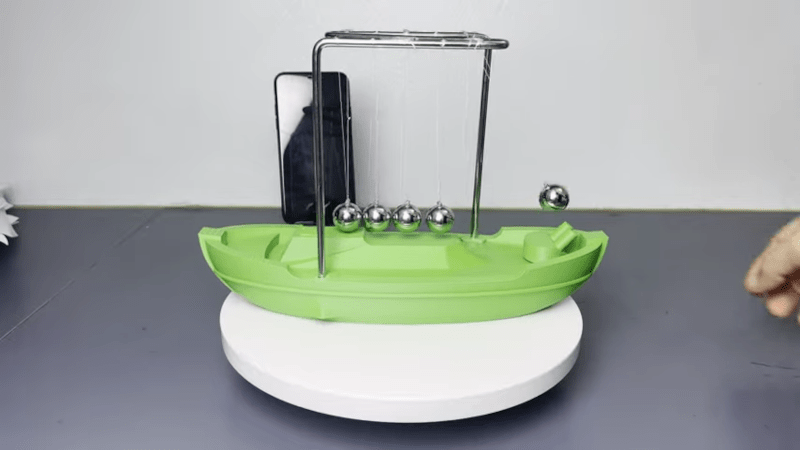
If any astute Hackaday reader saw [dongvua90]’s Newton’s cradle go on without human intervention all day long, they’d probably suspect the truth: there’s a battery and a magnet involved. But it is a nice desk piece, and you might be able to fool your less enlightened friends that you’ve discovered perpetual motion. Watch the resulting faux perpetual motion machine in action in the video below.
The trick is to sense the ball’s travel and inject a little electromagnetic pulse at just the right time. No problem for an ESP32 and a proximity sensor like the ones you find on some 3D printers. In fact, there’s very little custom circuitry. Everything is a module, and even the Newton’s cradle is cut out of a premade toy. A printed case and some software are really the heart of the design.
We can imagine this might be an interesting science demonstrator. Show the class the cradle with the electronics turned off, then subtly turn it on and ask the class what changed. You could even make the point by having students do it normally, while only you can get it to keep going forever, and challenge them to deduce what’s going on.
You might correctly imagine that this isn’t the first one of these we’ve seen. You can also build one that is sort of simulated.












I’ll just leave this here… http://www.sparkbangbuzz.com/els/magkick-el.htm
I was going to say: You need a “ESP32 for this?”
Then I saw the ‘tuber’s thumbnail image.
Yeesh.
Ya, it’s an ai generated cutaway view 🙄
Damn. The only reason I clicked it was to find out what that brass gear thing was.
Spending weeks maybe even months on a project, making a nice video about it. It’s truly an interesting topic but why slam on a no-effort crap AI-thumbnail on it (with the classic bad acting “surprised” look), why? WHY! I just don’t get it.
It also sounds like the narration is AI.
You also missed the Instructables article filled with Aliexpress affiliate links.
The Github account containing “his” code also points to a Vietnamese account “dongvua90”.
All that points to one idea: this “hack” was copied from an existing solution from someone else’s youtube video, and this video was made by working backwards from that solution, adding AI generated clips for filler.
Also note the other videos: any time there’s a person’s face visible, it’s a different person. Otherwise we never see anything but the author’s hands, and hear an AI generated voice.
This is a fake channel.
Why is it fake? The “ElectroInventor1990” channel claims to be from the US and none of the people in the videos look anything like dongvua90 in the Instructables or GitHub accounts.
So why would you hide the fact that you’re from Vietnam and fake the videos using AI? Because it’s following the pattern of east Asian “hack” videos that recycle fake content and get dropped by Youtube for being simple click farms.
tldr: even a 555 would be overkill :)
Let me know how that’s going to actually work.
It requires the thing being kept in motion has or is a magnet, not that it is ferrous.
The Newtons Cradle won’t trigger the circuit; and if you change out the metal balls with magnets you’ll have issues with the rest of the setup. (Because the balls will attract or repel each other).
Even without watching the video it’s rather obvious, no ?
Triggering it only requires a large enough change in the magnetic field through the coil. That means you can put the permanent magnet in the coil, and some ferrous metal moving past will trigger the circuit – like how a guitar pickup works.
The swinging steel ball is attracted to the magnet both ways in and out, giving you net zero energy gain. But, if the circuit is triggered when the ball is swinging away from the magnet, the coil cancels the permanent magnet briefly and lets the ball escape with more energy.
I’d like to see you, using the circuit described in the parent comment to actually work with this setup.
I don’t think it will be sufficient to trigger the circuit, and I don’t think tuning the coil or components as opposed to redesigning the circuit will be enough.
I do think an analog circuit would be enough, I just think the flippant answer and pointing to a method that works well with a much stronger magnetic field is not the answer.
is there anything AI can’t do?
Why use a separate sensor? When the steel ball passes over the electromagnet, it creates a pulse in the electromagnet’s coil that can be used to fire the next pulse to the coil. All that’s needed is a delay circuit that is triggered by the ball’s passing, and discharges a capacitor to yank the ball. No microcomputer needed., though an additional magnet might be needed under the coil to increase the initial pulse.
This is a similar circuit to that in perpetual pendulums, such as at https://www.sciencetronics.com/geocities/electronics/projects/pendulum.html .
While additional complexity demonstrates understanding of electronics, to me, it’s less satisfying.
“A small permanent magnet has to be mounted at the end of the pendulum”
Another magnet just like the other three that was added, would induce magnetism in the first steel ball. It does not need to be a permanent magnet, and three other magnets are alre4ady in use.
For me the more interesting question is:
Why is his original Newton’s cradle so bad?
I don’t expect perpetual motion from a Newton’s cradle, but his died after two or three cycles, it’s like watching a basketball just drop to the ground and stay there, it’s weird.
Moving 2 balls instead of 1 will reveal the forgery. You’ll need to use only electromagnets.
Hi everyone, I’m the creator of this project.
I just wanted to clarify a few things. Yes, the YouTube thumbnail was AI-generated. The project itself is completely real—I designed and built it myself. I used an AI thumbnail because a normal photo of the finished Newton’s cradle looks just like any other one, and I wanted to hint that it contains hidden electronics. I didn’t realize it could make the project seem fake. Thanks for pointing that out—I won’t do that again.
I’m also from Vietnam. My channel is in English because I want to share my projects with an international audience, and I use AI voice narration because my spoken English isn’t good enough yet.
As for the AliExpress links on Instructables, that was my first post there. I don’t normally buy my parts from AliExpress—I just linked to similar components so people could find them more easily. They are not affiliate links, and I don’t earn any commission from them.
Thanks for the feedback, and I’m happy to answer any technical questions about the project.