
Newton’s Cradle Isn’t Really Perpetual

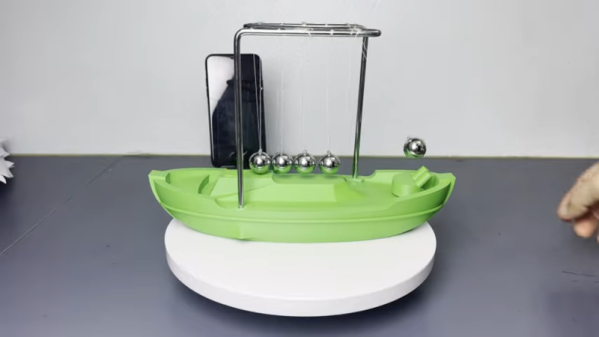
If any astute Hackaday reader saw [dongvua90]’s Newton’s cradle go on without human intervention all day long, they’d probably suspect the truth: there’s a battery and a magnet involved. But it is a nice desk piece, and you might be able to fool your less enlightened friends that you’ve discovered perpetual motion. Watch the resulting faux perpetual motion machine in action in the video below.

The trick is to sense the ball’s travel and inject a little electromagnetic pulse at just the right time. No problem for an ESP32 and a proximity sensor like the ones you find on some 3D printers. In fact, there’s very little custom circuitry. Everything is a module, and even the Newton’s cradle is cut out of a premade toy. A printed case and some software are really the heart of the design.

We can imagine this might be an interesting science demonstrator. Show the class the cradle with the electronics turned off, then subtly turn it on and ask the class what changed. You could even make the point by having students do it normally, while only you can get it to keep going forever, and challenge them to deduce what’s going on.

You might correctly imagine that this isn’t the first one of these we’ve seen. You can also build one that is sort of simulated.

Continue reading “Newton’s Cradle Isn’t Really Perpetual”

Simulated Newton’s Cradle Makes A Flashy Desk Toy

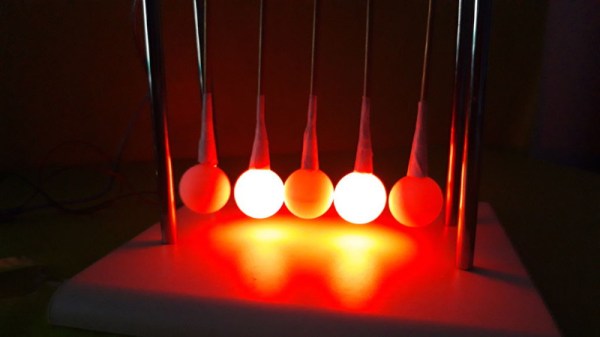
Newton’s Cradle was once upon a time, a popular desk toy in offices around the world. For [TecnoProfesor], however, it wasn’t quite flashy enough. Instead, they built a simulated version with flashing LEDs. As you do.

Rather than relying on the basic principles of the cradle to make it work, this relies on two servo motors to move the balls on the ends, with the ones in the middle remaining stationary. Each ball is fitted with an RGB LED, which flashes with the simulated “motion” of the cradle. By using ping pong balls, the light from the LEDs is nicely diffused. The frame is built from wooden dowels, metal rods, and acrylic.

It’s a project that is sure to confuse at first glance, but it’s a great way to learn basic microcontroller skills like interfacing with LEDs and servomotors. We’d love to see a version that works like a real Newton’s Cradle, flashing the LEDs as they are hit by their neighbours. We’ve even seen them automated, for the truly lazy among us.  Alternatively, one could go completely ridiculous and have such a device tweet on every hit, though you might run afoul of the API’s spam restrictions. If you give it a go, drop us a line.

Newton’s Cradle For Those Too Lazy To Procrastinate

Desk toys are perfect for when you don’t want to work. There’s a particularly old desk toy called the Newton’s cradle. If you don’t know the name, you’d still recognize the toy. It is some ball bearings suspended in midair on strings. If you pull back, say, two balls and let them swing to impact the other balls, the same number of balls on the other side will fly out. When they return, the same number will move on the other side and this repeats until friction wears it all down.

We think [JimRD] might be carried away on procrastination. You see, he not only has a Newton’s cradle, he has automated it with an Arduino. According to [Jim], this is his third attempt at doing so. You can see the current incarnation in the video, below.

Continue reading “Newton’s Cradle For Those Too Lazy To Procrastinate”









