
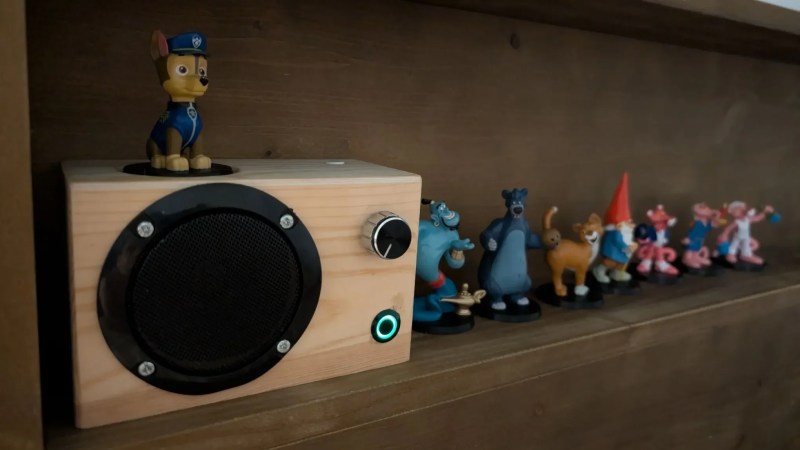
[David] has a young child who is clever enough to use a computer to play music, but he doesn’t quite want to hand over the mouse just yet. Thus, he set about building an electronic music player that could be operated in an altogether simpler fashion.
The build is based around an Arduino Nano — its job is to read RFID tags via an RC522 reader, with the tags themselves embedded in a series of small dolls belonging to [David]’s daughter. Upon reading the tag, the Arduino Nano chats over serial with a DFPlayer Mini module, which reads a playlist of MP3 files off of an SD card and plays them over a small 4 ohm speaker that [David] had laying around. It’s a simple build, with the components all neatly wrapped up in a handsome wooden case with a volume control and a skip button for if any one song becomes too annoying for a repeat listen.
We’ve featured other builds in this vein before, too. There’s something satisfying about a music player with such a simple interface—no delicate media to fiddle with, just pop the toy on top and get the playlist you were looking for. If you’re creating your own little musical builds at home, we’d love to see them on the tipsline.












Or you could simply buy a cheap CD player and record some CD-Rs.
1.This is hackaday not buyaday
2. CDs aren’t very durable
The key word is child-friendly.
This is basically a DIY Toniebox (very popular in Germany, expanding to the US recently)
My son was able to operate that successfully before he turned 1 year old.
DIY tonie box. Cool
Considering the commercial offerings along these lines always seem to be cloud-based, and inevitably get bricked when the company either shuts down the service or goes out of business, a DIY solution that keeps all of the data local is nice.
Tonies boxes have been about for decades now, don’t require the app to play or register new tunes (you can just lob them on the box and it downloads/plays them). The app allows access to see what ones you have registered and allows you to record your own stories onto one. I was pretty impressed with how easy to use they are, including the charging system and the fact that the box is entirely childproof but also child controllable. A genuinely good product.
Similar effect to the Zaparoo project for MiSTer FPGA, which also supports use on regular PC; you can use the NFC tags to even boot Steam games.
Thats a nice build. Still I’m wonderinge why the Tonuino Box isn’t mentioned:
https://www.tonuino.de/TNG/
It uses exactly the same hardware.
my kids were gifted a toy that had 10 tiles, each representing half of an animal, and a receptacle for two of them. if you put the animal together correctly, it would play a little song about the animal. if you put it together wrong, it would say something like “a cat pig?? hah hah!! that’s funny!! me-OINK!” as a parent, i hated it, of course.
but its function was very clear. each of the two receptacles had 3 or 4 little push buttons at the base, and the tiles had fingers on the back to push the buttons. so a kid had something to hack. he could observe the pattern and then depress the buttons with his fingers, without using the tile. he could enumerate the combinations and see if there are any undocumented animal types (i don’t think there were). he could tape one of the buttons down and break it so his brother can’t do it right anymore.
kid hacks should give the kid something to hack. giving dad something to do other than playing with the kid is kind of meh as hacks go. imo.
the espuinio is much much better and not much more expensive
https://github.com/biologist79/ESPuino