
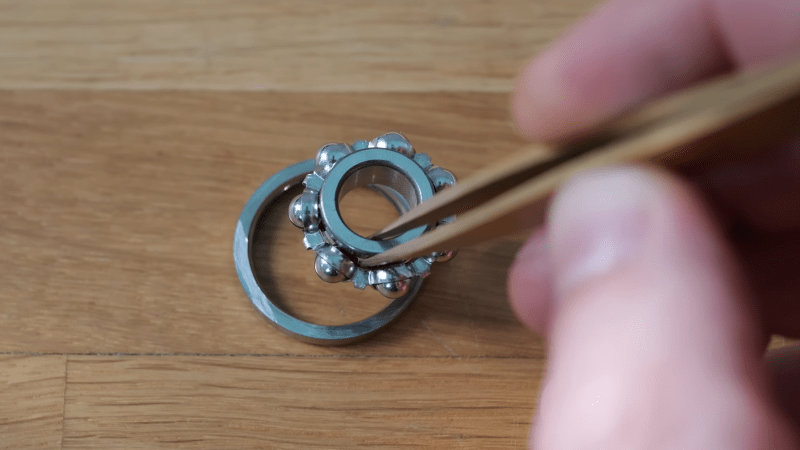
Gears are usually the biggest contributors to backlash in a mechanical system, but they’re far from the only culprits. Ball bearings are a less obvious source of imprecision, since any gaps between the balls and the races can lead to axial wobble. Precision mechanisms can eliminate this by pairing two ball bearings, holding the outer races fixed, and applying a preload force to the inner traces. [Chronova Engineering], however, has a different solution, for which he split a ball bearing in half.
Besides taking up more room, thermal expansion also means that it’s difficult to apply a consistent preload force between two ball bearings. Instead, to make a self-contained preloaded bearing, [Chronova Engineering] first disassembled a single ball bearing. The most difficult part of this is taking apart the ball cage; the two parts of this are normally riveted together, but he managed to find a crimped cage and pry it apart. After taking the bearing completely apart, he cut the outer trace in half along the circumference, then reassembled the bearing. The split outer trace makes it possible to press the two halves together, preloading it and removing slop.
To see how well this worked, [Chronova Engineering] replaced the the ball bearing supporting one end of the feed screw for a milling machine with this new bearing. Before the replacement, it had a backlash of 0.1 to 0.2 millimeters; after the modification, it dropped to 30 to 40 microns. This kind of bearing is already known in the machining world – four-point-contact bearings use a very similar principle – but they don’t seem to be well known.
For more about these common yet remarkable rotary mechanisms, check out our article on bearings. If, on the other hard, precision isn’t a priority, you can always 3D print ball bearings.












There’s a reason ball bearings are always designed to make contact with the races at a pair of directly opposite points, not three points.
Even in the case of four-point contact bearings, there are two such pairs of contact points, and the bearing must be loaded such that one or the other takes the load. (Specifically, the load should be primarily axial in either direction; a large radial load without axial load will force contact at all four points simultaneously. See e.g. https://www.skf.com/group/products/rolling-bearings/ball-bearings/angular-contact-ball-bearings/four-point-contact-ball-bearings/design-considerations for specific ratios.)
Loaded contact at three points as provided by this bizarre experiment, or at all four points of a misapplied four-point bearing, replaces rolling contact with some degree of scrubbing.
Sounds like a lot of work.
Other options are:
Taper roller bearing, maybe add a belleville washer for variable preload.
Roller thrust bearing, maybe add a belleville washer to help preload.
Bearing without any backlash would simply seize due to phenomenons such as galling and slip-stick friction.
No. Bearing constructions with preload are a valid option for high stiffness applications. Hardened steel on hardened steel is a combination that works (within limits of course).
Yes, preloaded bearings are extremely common in industry. You lose marginal theoretical bearing life in exchange for a smidge more cost (and the cost of being limited to reputable mfgs/supply chains, though in industry that’s a requirement regardless) and not needing to worry (as much) about shock effects or reversing loads.
There are lots of ways to get precision / accuracy out of bearings, but this is not it.
One way is to use tapered roller bearings as Charles already mentioned and then adjust them to each other. For more precision, use angular contact bearings. The more accurate versions come inclusive with distance rings so everything can be pressed together for a specified preload. This is used in (mill) spindle bearings, and that is not the cheapest option, but if you want to have accuracy, you can’t have too much cheapness.
The most common deep groove ball bearings can have some radial load, but you always have to use them in pairs. The raceways are not designed to be loaded in the same way as a four way bearing. (Check out “cross roller bearings”, those are a nifty design in a compact package.
For another variant that can be both cheap and low backlash (or even have preload) check out “wire race ball bearing”
https://duckduckgo.com/?q=wire+race+ball+bearing&iar=images&t=h_
You can even DIY these with a lathe. First make a form to hold the wire in (approximately) the right diameter, then bend some piano wire, put it in the form and grind some of off it and polish the raceway pat afterwards. 3D printing probably also (sort of) works, but with reduced accuracy and you have to be careful the wire does not get too hot during grinding. But it’s very likely a lot better then just steel balls on plastic.
But this is not it. Youtube has been pushing this video for over a week now, and I’m glad I never clicked on it. Showing a normal deep groove ball bearing and then claiming it’s not a normal bearing raises my annoyance, not my curiosity.
Lash can be a good thing. For example, the sprag clutch.
4 point contact bearings are a thing if you need them, and are actually ground to perform well when ran like this.
Or you use 2 angular contact bearings.
Or 2 tapered roller bearings.
Or a cross roller bearing.
I aplaud the arthors desire to experiment. If you need something that works well probably best to buy the right bearing. I watched, and it kinda sounds like he wasn’t aware of the typical way to design preloaded bearing systems?
A ball bearing is the complete unit, the race and the bearings. The bearings themselves are bearing balls. Not ball bearings