
Although lighting 3D prints on fire is rarely the intended outcome, it’s possible that said print will at some point in its future come into contact with either an open flame or a significant source of heat. Once that happens, what will be the result and how worried should one be? This is basically the excuse behind [Maker’s Muse] recent decision to light some 3D prints on fire.
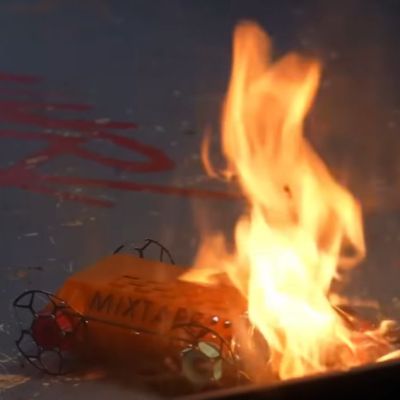
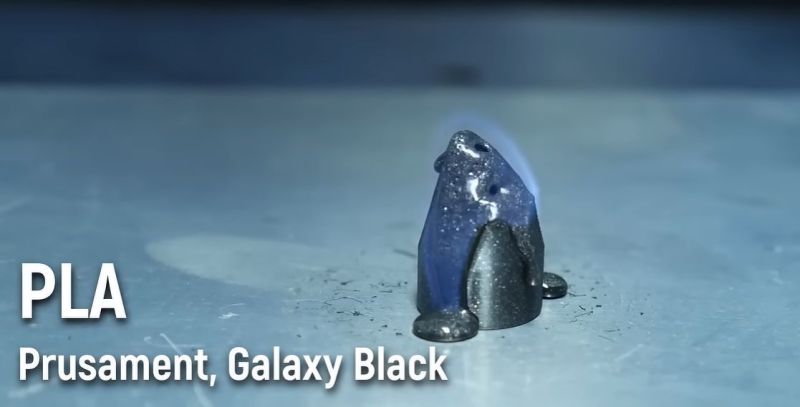
Materials exposed to an open flame in this experiment included various types of PLA, PETG, ABS, ASA, TPU and PEBA. Since PLA filaments have a significant amount of carbon in them it’s little wonder that these burned quite readily, though an interesting difference was immediately visible between an Elegoo PLA+ test cone and a Prusa Galaxy Black PLA cone. The latter required a blow torch to properly ignite, after which it burned rather hot whilst melting, unlike the dirty yellow flame of the PLA+.
So-called ‘high temperature’ PLA (HTPLA) seems to actively resist burning, self-extinguishing after a blowtorch treatment. Just these few samples of PLA already gave very different results, with very likely the additives being the defining factor since pure PLA is easy to burn as a way to dispose of it somewhat cleanly.
Moving on, black PETG didn’t really want to ignite, while ABS and ASA absolutely love to burn with a sooty yellow flame. HIPS was also tested, burning in a similar sooty manner as well.
Of all the materials tested, TPU was the least flammable with even the blowtorch not able to start ignition and only melting the sample. Foam TPU did however burn the most aggressive, followed by ABS, ASA and HIPS. Overall PETG and regular TPU seem to be your best bet if you do not want your 3D print to turn into a happily burning candle and potentially a general fire hazard.












I didn’t know 3D printing candles was a thing now? However, I do not see myself printing Xmas ornaments that could also be set alight. I think I just wait for the cinnamon or vanilla smelling filaments.
There’s a reason for the booming sales of chrismass lights which also might be cheaper than the filament smelling like burnt house.
Since PLA is not as biodegradable as the marketing materials would have you believe, I started researching what was the best way to dispose of failed prints and scraps, other than the landfill. Several research papers, including a couple of gov’t ones, claimed since it was made from corn, that incinerating it was the least environmentally unfriendly way to dispose of it and they would mostly burn away with little residue. Other research papers were inconclusive but mentioned and discouraged burning. Having set many plastic models on fire as a kid, I decided to experiment with some silk ‘copper’ and ‘bronze’ statues of a very unpopular politician. To my disappointment, they were hard to keep lit and I was left with a puddle of plastic not much smaller than the original. I’ve been meaning to try it again with plain PLA.
PLA is compostable by just about any commercial high-temperature composting operation, and they happily accept 3D prints. Just because you mistook “biodegradable” as meaning it can compost in your garden doesn’t mean you should spread FUD or promote burning plastic.
That’s why ABS are mostly black, with fire retardant
Come on people. Quit doing pseudo-engineering and passing off results that cannot be consistently re-produced. There have been published test methods per ANSI and IEC standards for this stuff for a hundred freaking years.
en.wikipedia.org/wiki/UL_94
https://xkcd.com/397/
Non sequitur. Has nothing to do with the principles of the scientific process. I’m talking about test standards that were written with a century of blood-letting experiences.
When I become emperor, proud displays of ignorance, such as this, will be punishable by exile to Tristan island, where they will stay until they pass physics and calculus, or until death.
Given that a copy of the standard costs $500, I’m quite sympathetic to people that haven’t read it.
https://www.shopulstandards.com/ProductDetail.aspx?productId=UL94_7_S_20230228
Dissolve ABS scraps in acetone, then mix in very finely powdered borax, use as a dip for parts that need to be fire resistant.
Do you realy have to 3D print it to burn it? Come on. 3D print term is evrywhere now like ai.