
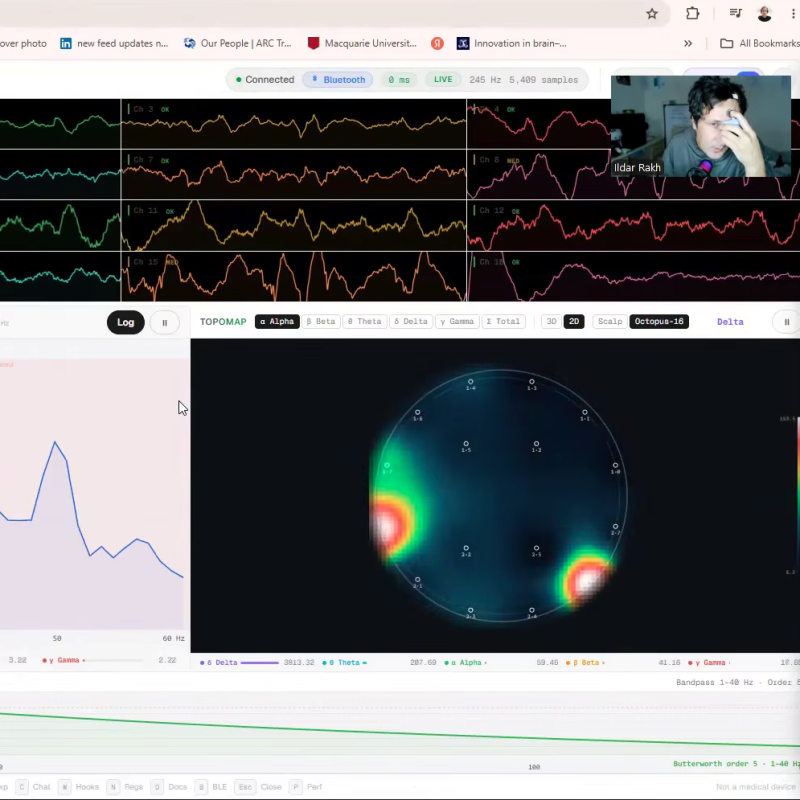
These days, most of us interface with our computing devices in the same old-fashioned ways—via keyboards, mice, and touchscreens. The idea of a more direct brain-to-machine interface remains appealing to many. [Ildar Rakhmatulin] and [Youssef El Abbass] have been working on just such a device, with an eye to using it for gaming.
The device is referred to as Octopus 16, so named because it combines sixteen EEG electrodes into a single compact package, along with the required common reference and ground. The contacts themselves are pogo pins, assembled into a coin-sized cluster. The device is strapped to the head, pushing the contacts against the scalp, and data from the electrodes is then siphoned off to a host machine via Bluetooth Low Energy. The EEG signals are picked up with a pair of Texas Instruments ADS131M08 ADCs, each with 8 channels, with a resolution of 24-bits to capture fine detail in whatever the brain is doing. An ESP32 microcontroller is responsible for grabbing the ADC output and trucking it out over Bluetooth.
The rig is designed for use with the PiEEG software platform. The team have experimented with the device, showing it off by using the EEG signals to detect an individual’s focus state and using that to feed into simple game environments.
Ultimately, what has been shown so far is not so different from the old Force Trainer toy, but the design might prove useful if you’re looking into doing EEG experiments on a budget. Just do your due diligence to make sure you’re getting more signal than noise out of those lovely 24-bit ADCs. Video after the break.












EEG is so cool, yet so out of reach for the average hobbyist. Well the chips are really expensive, but if one was dedicated enough i guess they could.
Ive noticed that a lot of cheap EEG amplifiers and kits (mostly for “educational” uses) are not EEG at all, but EMG. The noise specs simply couldn’t capture EEG. That’s why they tell you to move your jaw or think of doing it. The kits are anything but “educational” imo
I even came across a TL074 based “EEG” amp. Iirc it was on hackaday of all places! What’s next, using a 358?
I think olimex sells one at an affordable price.
E-sports follow the same financial structure as traditional sports. How long does it take for people to consent to having an intrusive EEG device implanted to have a chance to break the world record? Despite the potentially horrible side effects.
I guess Star Trek’s Pike was playing Pong the whole time.
He! I first read it as ‘EGG interface’ but then again ..it IS an egg interface..
“old-fashioned ways—via keyboards, mice, and touchscreens.”
Awww come on now. I know I am middle-aged now but touchscreens? old-fashioned?
I mean sure, according to Google the first one was made in 1965, which I am very happy to say is before I was born. But… and I guess opinions on this will vary but I think for the most part they haven’t been inexpensive and practical long enough to call them old-fashioned yet. I think it was what… the late 20-teens that we finally got cheap touchscreen displays at all the usual online shops where they are inexpensive enough that most of us would want to put them on our minor projects. And I can’t speak for anyone else but I STILL don’t have touch screen monitors on my desktop although my Lapdock certainly does.
Cool project though.