
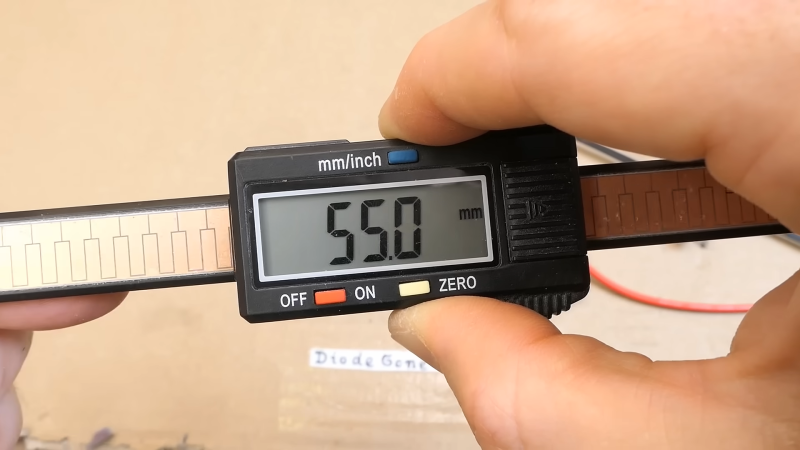
Most hackers and makers end up with a cheap pair of calipers in the toolbox at some point or another. [DiodeGoneWild] decided to take a particularly cheap plastic pair and tear them down to see what makes them tick measure.
The electronics is, unsurprisingly, all contained inside the carriage which slides along the ruler. The ruler itself has an etched copper strip inside, underneath the scale sticker, with repetitive T-shaped sections. Meanwhile, the PCB in the carriage has a series of plates for capactive sensing. As the carriage slides along the copper strip inside the ruler, the capacitive sensing plates pick up varying capacitances which are directly proportional to how far the carriage has moved, allowing for precise measurement of relative position. Zeroing is a job for the user, via the ZERO button. We get to see how this works on the bare hardware level, and [DiodeGoneWild] even breaks out the oscilloscope to help show us what’s going on.
[DiodeGoneWild] also notes that these calipers are particularly frustrating for how quickly they discharge batteries while in storage. This may be down to the convenience feature, wherein moving the caliper switches the display on. There’s no hard off switch here—so the caliper is always drawing some juice even when it’s just in the cupboard. This is why these things are forever turning up dead when you need them.
If you’ve never pulled apart one of these cheap tools, this is a great way to see what’s actually going on under the hood. We’ve seen some other great teardowns lately, like this deep dive into a cheap pair of smartglasses. Video after the break.












Ah yes, I know that frustration of my digital calipers always being dead just when I need them. So at Open Sauce last month I was thrilled to see that DigiKey was giving away SOLAR POWERED calipers at their booth! Never again with that particular dead battery in my measuring moment of need!
Solar, that’s genius! I’ve been taking the batteries out when not using mine.
Wait, solar as in life the cheap calculators kind of solar? Because if so, I need two!!!
Ya i had a pair of mitutoyo’s that were solar powered at my last job and I was like why are the all not like this!
Could they not be powered through the movement itself?
Do the techie shuffle.
The dynamo is less rugged and probably more expensive (BOM + assembly steps) than the amorphous silicon solar cell and capacitor.
You think this might work?
https://pt.aliexpress.com/item/1005005825496564.html 1V 85mA 25x30mm
I think you’d need more than 1v
I mostly use calipers indoors, and keep them indoors.
Another more effective way to make sure your calipers never needs its battery replaced: Dial Calipers. :)
These exact calipers are a legend on the 3dprinting subreddit, and the story is that the battery NEVER dies. I’ve had one for years and only replaced the battery once, despite my kid using it as a sword regularly.
I’m guessing it’s more a problem with batteries that have been sitting in closets or on shelves for years before you pop them in the device.
I doubt it. i had the same callipers and it would kill a battery in a month. then it bricked itself, so i bought a vernier callipers and learned how to read it.
My experience as well. They drain the battery just sitting in the drawer. Fortunately I have a vernier caliper and an old-style dial caliper as well. They get used, the digital caliper just sits.
Try turning them off when not using them. They’ll last for years then.
I’ve got one from Lidl that looks suprisingly identical to this one and yes the batteries die within days if left in despite the display being off. Case in point being I put a new battery in mine a couple of weeks back, using it for a few minutes each day, some days I remove the battery some I leave it in. Tonight the readings were going crazy indicating dead battery already.
When I first got it I used it for a short while then put it away with battery in. Came back a few months later and it was dead as a dodo so my first assumption was the caliper had died as surely a battery wouldn’t die after a few months of doing nothing. Now I’ve learned to take the battery out as soon as I’m finished but still forgot sometimes.
Same here, mine worked always for less than a week, that’s till I glued a AAA battery holder on the rear (where the sticker Is placed) then welded the two wires where the little tiny battery was placed, clip some gap on the lid to pass the cables, and then place a rechargeable AA battery…. A now this cheap calipers has been working for more than 3 months without the need to recharge the battery…. Hopes it helps you too.
A buddy of mine strapped an alkaline D-cell to the back of his; this was like 20 years ago and I’m sure it’s still running!
It used to be quite common to wire battery powered tools up to an external ‘wall wart’ style psu before lithium batteries made ‘cordless’ tools viable.
I actually think people would buy a gadget like what you are describing. There are people out there who want a caliper without the hassle of a battery. Plus, so many people are tired. Just word measure –that’s fine with me?
I think there must be multiple variants that look the same on the outside, because I’ve had maybe fifteen of these over the years (a few for me, the rest for other people to use during classes & workshops), and there’s exactly one of them that seems to last forever; the rest of them absolutely murder batteries. Doesn’t matter if you use the LR44 alkalines or the fancier SR44 silver oxide batteries, they go from brand new to dead within a month or two.
It doesn’t seem to matter whether you’re using them heavily or just leaving them in a drawer, so I’ve always assumed they just had atrocious standby current draw for some (undoubtedly unnecessary) reason.
I think I lucked out then, because the one I have is several years old now and I’ve not had issues with the battery lasting. It looks exactly the same as the one in the video… at least from the outside.
Exactly. I have found that there are two variants commonly sold in Denmark: In one of them, the on/off switch only turns on the display, and it remembers the zero point. The other one actually switches off when you press the power switch, with the small drawback that you need to zero it after turning it on.
Mmmm, no. These are cheap shit that kill batteries. It’s so irritating that I’m willing to spend 10x the price to get one that actually works when I need it, and I don’t have to pry the battery out after every use.
Talk about pathetic.
Almost all of the cheap calipers eat batteries.
It’s not that they turn on when the calipers turn on when the measurement changes.
The problem is that the power button turns off the screen, and not the whole device.
They are LITERALLY always on.
They could have simply been designed with a physical battery disconnect switch as the on/off, but alas, they are not.
They all need the batteries removed between uses, or a hardware battery disconnect switch modded in.
Mine kept killing the coin cell batteries, I glued a salvaged single AAA cell holder to the top of the carriage and soldered 26ga scrap wires to the terminals. Been several years without a change now, not bad for a 10min time investment
Surely there’s space enough inside the caliper to wire in a small on/off switch that cuts the battery connection, right?
This is what I was thinking while scrolling as I don’t want to kill a perfectly good solar calculator!
I was frustrated with the battery change like everyone else too. But I did exactly this to all digital calipers I own years ago. Since I do not use the output port to connect it to the computer and there was also no connector there, I used that space to put in a tiny sliding switch in series with the battery – scratch cut one of the traces and a short piece of wire to connect the switch, plus a small hole in the plastics to let the slider lean out and no battery change needed since then, 10+ years.
I have printed this aaa adaptor, no wires or soldering necessary:
https://www.printables.com/model/566515-simplest-aaa-battery-holder-for-your-caliper
Ha smart design!
I have a digital caliper from Pittsburg via Harbor Freight that is about 10 years old. The electronics package looks nearly identical but it requires a button push to turn on and the caliper is steel not carbon fiber. My battery life is about 2 years and I do a lot of measuring.
I also have a gorgeous Helios vernier caliper from the 1960s that is a joy to use. Sadly age and nearsightedness is making it harder to read the vernier accurately.
I have two of the Harbor Freight electronic calipers bought many years ago and several years apart, and they differ slightly (probably different suppliers as Harbor Freight likes to do.) Like yours, both of mine are steel. Unfortunately, both drains batteries in a matter of weeks if I leave them in so I always pull the battery when I’m done and now the batteries last years.
On the battery issue, wrap the button-battery in a small piece of paper then put it back in the caliper while it’s in storage. Very helpful habit to develop on digital tooling that’s only used once in a blue-moon.
Oh oh.. this nice article is a good reminder. Now I need to check my calipers (not used in ages) when I am home.
I am not worried about the calipers not working, but since a while cheap LR44 have the tendency to literally bulge, pop and spill their corrosive guts around when empty. I had some kid’s toys making a pop-hiss noise because of that.
Battery drain is in these is annoying because it seems easily fixable in hardware: a 1mm spring pin that gets pushed when as a physical power switch. Or a small physical power switch. Instead people have had to resort to removing the battery for decades.
It looks like I’m in good company having to take the battery out of mine every time I use it. And every time I think “I should get round to adding a switch” as I pop the battery out.
Battery companies must love these.
A lot of these also appear to have a data port of some kind. I’m sure someone has looked into those.
Several times, in fact!
Enjoy these ‘starter’ links and find more with ‘caliper data’ in the search box:
https://hackaday.com/2025/03/06/hacking-digital-calipers-for-automated-measurements-and-sorta-micron-accuracy/
https://hackaday.com/2022/10/17/custom-interface-adds-usb-and-wi-fi-to-digital-calipers/
https://hackaday.com/2019/07/04/hacked-calipers-make-automated-measurements-a-breeze/
https://hackaday.com/2016/05/17/improved-digital-caliper-interfacing-including-3d-printed-connector/
Used, decommissioned Mitutoyos off ebay for $20 > new battery-nomming Harbor Freight/Aliexpress garbage.
My used $20 Mitutoyos even came with a cool ‘CURTISS-WRIGHT Avionics’ sticker on the storage case. And they do not auto-on (or auto-off)… you have to turn them on with a button, and that means you also have to remember to turn them off.
However… I have once or twice (okay FINE, several times) forgotten the turn-off step and left them fully powered on in the case for days at a stretch, and they are still on the first cheap LR44 battery I put in them two years ago.
It’s a coin-toss for me whether Mitutoyos bought new for $150 or whatever are a better value than $10 random Chinese crap made by nobody-knows-who to nobody-knows-what-specs. But used Mitutoyos for $20 is not even something anyone should have to think about for longer than it takes you to type in the search query.
iGaging has some nice ones, they do auto on/off, but also do not eat batteries (they have a dual-stage sleep mode – leave them in standby for several days and you have to wake them with the pwrbtn); it’s a nicely thought-out and implemented balance between convenience and battery saving. But they are around $50, and you probably aren’t likely to find them on the used market for close-to-free.
Ugh, just checked and new Mitutoyos are up to $170 now.
And Hackaday found a new way to break comments. Y’all never cease to impress.
Then at that price point, I’d do new iGaging ones. McMaster #4996A72. I have that exact model and they are worth the $55. Along with those I also have experience with bought-new Mitutoyo, used Mitutoyo, and a shoebox full of half-functional Harbor Freights.
Most Mits on eBay are fake clones. Even the certs are faked now. And their dedicated fakes too, very very close to the original. The major tell is the sheer volume of them like-new for such similar prices all shockingly good deals. Be very careful. I’m sure deals exist and maybe some people don’t care, but it should be noted.
I got a pair of these when my eyes aged enough that vernier calipers were inconvenient. There seems to be a hidden way to change modes on the electronics as after fiddling around with the battery it switched into some weird mode related to measurements over 100mm. I suspect the same electronics are used in a number of measuring systems.
i have one of the ones that eats batteries. my hack: i took the electronic part off and replaced it with a bit of sheet plastic (cut from a yogurt lid) with a window cut into it and a notch to indicate where the measuring point is. i’m pretty reliably within +/-0.1mm just eyeballing against the tape ruler. precision comparable to my printer’s. take that, verniers!
but reading the comments here, it sounds like about 5-10% of them don’t eat batteries?? since this is a perennial hackaday article, it would be nice if the next edition of it added new information! i wish someone would figure out the secret to that fraction. what’s the underlying difference? is there a way to hack the crappy ones by replacing a low-quality passive component? is there a brand name or something to look for? are these lucky guys just actually using expensive ones and not realizing it? could someone make like a hackaday marketplace project of aftermarket logic boards for the cheapo calipers?
i don’t have the time (or really, the skills) for that but if it was my project i’d start by badgering one of the guys here who says they have a good pair into sending it to me, maybe in exchange for a mitutoyo set or something :)
The problem with building any kind of good/bad list is that these things are basically commodities, and the low end ‘brand names’ source from whatever white-label factory is offering the best deal at whatever point in time. Buying the same box off the shelf twice six months apart could give you two completely different electronics inside, built by completely unrelated factories, to completely different specs & standards..
yeah so it’d be a real hack to determine the parameters that determine success :)
I flip the LR44 after use. I don’t measure often but it’s a doddle to invert the cell when a measurement is required.
I 3D printed a AAA battery holder on my old one and that ran for a year or so, and just I got one from Amazon that is USBC rechargeable. The measuring block is a little chunky but it’s a nice solution I think
Moderately heavy solid wire, solder two pieces to battery terms and directly to a AA cell with a gun. No AA holder, discard button cell door. Ugly but holds up well fits in case and years out it’s ready to go every time.
Learn to read a vernier caliper and free yourself from battery dependence.
How do you do things like relative measurements, or addition/subtraction, with verniers that doesn’t involve a pencil, paper, and calculator? How do you do a direct conversion from metric to Imperial fractions with verniers?
learn to use a calculator and free yourself from crappy digital calipers :)
(25.4, learn it love it. i remember walking into the bike shop and saying “the handlebar diameter is 1 inch and three 128ths???” and the guy said “oh, you mean 26mm”)
I second that, it is as accurate as a digital one without the burden of batteries.
But, decent $50 digitals don’t kill batteries.
Do posts about calculators get a bunch of comments about ‘learn to use pencil and paper instead’?
Just “learn to use a slide rule.”
no, because every time i grab my calculator, its batteries are not dead. it helps that my calculator is on a multi-purpose device that i already accept the upkeep of, but even my AAA-powered calculator never had dead batteries. but the cheap digital caliper is always dead. my point is just, practical concerns are practical concerns (duh). don’t mistake practical for philosophical.
Agreed! I generally grab my verniers vs digital. Also helps to have a visual scale the measurement. I’m usually measuring something pretty basic where precision is not necessary or even helpful.
From what I can remember the cheaper callipers tend to use capacitive sensing
While the more expensive ones (such as Mitutoyo) can use inductive sensing instead.
Inductive being more resistant to contaminates such as oil on the slide.
I think the two things to make the battery last as long as possible are
1. if you use the more expensive ones (Mitutoyo) which use less power when not active
2. Use of silver oxide batteries, these tend to keep the voltage constant for longer, but then have a short drop off at the end of they’re life
Mine last for at least a year if not longer before I need to change anything
All the complex hacks on HaD and yet nobody can figure to add an on/off switch to those calipers.
It’s quite odd that, and it’s been like that for many years.
Seems most of the battery’s power is used to transmit mind-numbing rays then?
And yes I know there is not much room, but they very sell tiny on/off switches.
AvE (Uncle Bumblefork) already covered this one years ago.
https://www.youtube.com/watch?v=KnDype-j3hk&t
https://www.youtube.com/watch?v=WvszAb0Y0Ec
The real hack is learning how to read normal non-digital calipers and never having to worry about a flat battery ever again.
i have a real mitutoyo, and the battery lasts forever, but for rough uses, or to measure magnets, i have a chinese caliper with a AAA battery hotglued to it
Tighten the slider knob (thumb screw) during storage. That keeps ambient vibrations from waking-up the LCD and draining the batteries needlessly. Before I discovered this, the batteries would drain just from walking near the cabinet.
÷25.4, round to 1/64, check residual error. 5 mm → 0.1969″ → nearest 13/64″ is ~0.16 mm fat. Table: mm to inches.