
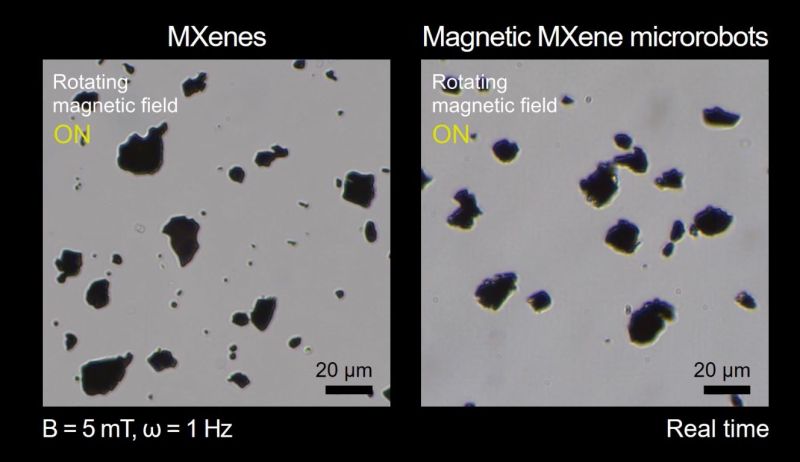
While in aquatic environments microplastics can be filtered out relatively easily, in soil it’s much harder to get to these microscopic particles. While you can certainly strip mine an entire area to process its soil, a less invasive method would involve something like the magnetic flakes proposed and demonstrated by [Jeonghyo Kim] et al. in a recent article in npg asia materials.
The Ti3C2Tx flakes, referred to as MXene microparticles, were designed to attract target microplastics. These were then combined with ferromagnetic nickel nanoparticles to make structures that can be propelled through soil using an external magnetic field.
During tests under laboratory conditions the researchers managed to remove about 81% of polystyrene and 72% of PET particles this way from soil, with a correspondingly higher percentage in water. After having the flakes rummage about for a while through the target material, they are removed with a strong magnetic field, which should recover most of them.
Naturally, the question with any such system is how it’ll perform once exposed to real world conditions and its myriad of soil types and conditions.












The amount of microplastics involved in the infrastructure required to manufacture these magnetic flakes far exceeds the amount of microplastics said flakes will ever remove from the soil. Just like keeping carbon out of the atmosphere, the best way to keep plastic out of the soil is to never put it there in the first place.
A reasonable solution to microprastics would be to zap the soil with some powerful laser plotter. They would decompose to simple CO²
Destroy other things too.
When you are done with that you don’t have soil anymore, only regolith.
“The Ti3C2Tx flakes, referred to as MXene microparticles, were designed to attract target microplastics”
Any product with an X should raise suspicion or XX , XXX
I’m unaware of a simple magnet that only attracts plastics, but it behaves like an excavator or a net.
Thank you for that info, if you dont mind can you elaborate more on the X XX thing please? Im in USA last time I drinked water was years cuz it made me sick or tasted weird. even bottled ones
How can I get a magnetic anything on the pipes on my water for sink bath etc…? Does that even exist?
Maybe like a descaler?
https://www.amazon.com/iSpring-ED2000-Electronic-Descaler-Conditioner/dp/B0744TC3PW/ref=sr_1_2_sspa?crid=23U5M0XK1HTSI&dib=eyJ2IjoiMSJ9.smWd1-bbJ7Opz5VAM3QmFfKLKfSJdD4P_8gpb75qdfBzVIxXLrTuaJzx-Qc9X0pMRWS_F4OS4tFsXcZaT_KMfhbxjnbuQaNHv9dHSdCYKG-4UPvM5wQfe0I8jx5jPSWDq3XmXVyqo4FWN7cNAQcVsOFaNsa9rv_YkCUqTT9bgOQ_hbwG9iKJ3Kp1T4k2ZRZxiNoki1DeiBkPGDg7Xl8lnhhAJbc4CnHeUSjNeJuZsHELdOMZKAv99pj-sJ0TWS5ppbMQ7zG0Fd-RweUL1N9obDy4w1FoEOQC5iIk23cHYWA.N_laO_2y5-VLHkLTyCXUr66m-sG1wxHM0Ky5eCNA16k&dib_tag=se&keywords=electronic%2Bdescaler&qid=1786715696&sprefix=electronic%2Bdescaler%2Caps%2C209&sr=8-2-spons&sp_csd=d2lkZ2V0TmFtZT1zcF9hdGY&th=1
I know that’s just for hard water, but maybe the same principal could apply for micro plastics? (IANA chemical engineer).
Those are intriguing devices, but they don’t actually remove anything from the water, so they’re unlikely to help the original poster.
They use an electromagnetic field to change how calcium carbonate crystals form in water, encouraging them to form tiny crystals that remain suspended in the water rather than bigger ones that become scale on the inside of your pipes.
… at least, allegedly. The principle does work to some extent in controlled testing, but the actual physics behind it isn’t straightforward, and results depend strongly on what else is in the water.
I think one of the factors is the amount of calcium carbonate in the water as these things don’t seem to work very well, if at all, in areas such as the south-east coast of England where there is a lot of chalk in the soil.
There are better ways to get things out of water – a good particulate and carbon filter will take out microplastics and a lot of other unwanted things, and if that’s not enough, reverse osmosis can remove pretty much all of the rest.
The solution in the article uses magnetism to move the plastic-collecting nanoparticles through the soil or water. It’s the nanoparticles doing the work, not the magnets. Sticking magnets on your pipes won’t do anything useful.
Cool lab result, but the numbers still mean roughly 19% of PS and 28% of PET remained in the soil after treatment. I’d be most concerned about scaling this to real fields and recovering 100% of the MXene/nickel flakes afterward—otherwise we may trade microplastic pollution for nickel or nanomaterial contamination. Does it work across different soil types, moisture levels, and common plastics like PP and PE? What is the energy/cost per acre, and how is the contaminated material disposed of? Promising, but it raises as many environmental questions as it answers.