
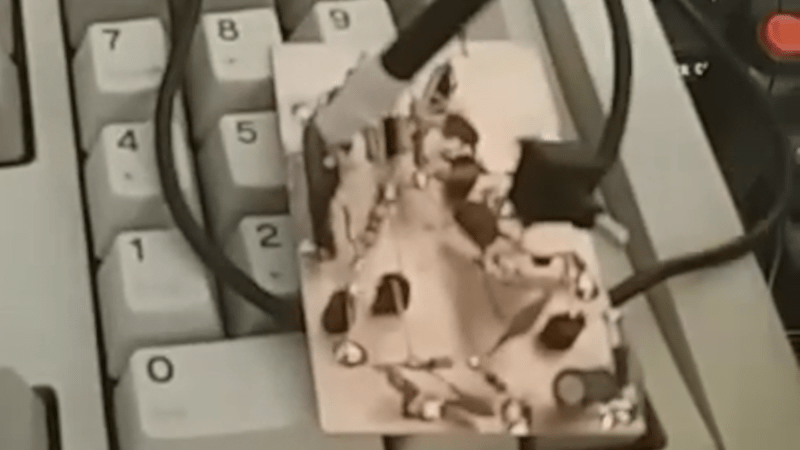
These days, modems are pretty fancy bits of kit, what with to keep up with the speeds of cable, VDSL, and fiber connections. At lower speeds, though, it’s entirely possible to build a modem out of simple discrete components. [sv3ora] did just that, building a simple modem for the CB2 Micro.
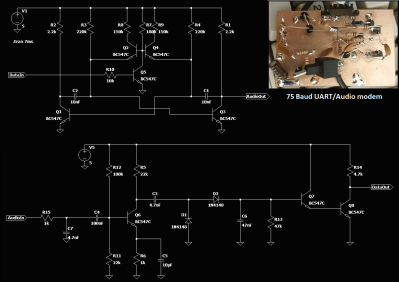
The project takes advantage of the fact that the V1.54 firmware for the CB2 Micro enabled 75 baud serial communication. Thus, it made sense for [sv3ora] to build a 75 baud modem to suit. As was the way in the days of dial-up internet, the modem modulates data into audio, demodulates audio back into data, allowing the CB2 Micro to send and receive data over telephone lines, ham radio links, or to store and retrieve data via mediums like cassette tape.
The device is built out of good old BC547 transistors. along with a smattering of diodes, resistors, and capacitors as supporting hardware. That’s all you need to turn slow serial into audio and back again. [sv3ora] does a great job of demoing the hardware, using it to store a program on tape and retrieve it again later.
We love old school modems around these parts. We’ve even explored ways to build your own dial-up ISP in the past!












Without any chips, this forces me to reconsider what exactly a modem is. In this case, just a circuit that converts serial bus signals to audible sound. Reminds me of an acoustic coupler without any acoustics.
A modem is a MODulator-DEModulator in the simplest sense. It intents to convert digital signals into analogue signals suitable for POTS (plain old telephone system), following the signal levels and frequencies that can be expected to work on that system, or any other system that has more bandwidth with vastly more complex modulation techniques like coax but must adhere to specific bandwidths as to not interfere with other transmissions.
Digital signals usually rely on square waves, which needs lots of harmonics (ie higher frequencies) to propagate properly, a POTS modem usually uses sine waves to limit the bandwidth or make optimum use of the available bandwidth like 56k modems do.
I’m no expert though, so others correct me if I’m wrong :)
Well, sure. That’s a telephone modem, meant for use over a telephone line. It’s really converting that digital signal into any sort of signal that can be sent through some medium where the digital signal alone might not fare so well and to also convert the received signal back to digital.
Instead of a phone line it could be radio waves, light via a fiber optic cable or even light via free space. You could build a modem that actually does use sound, perhaps audible or perhaps ultrasonic. Or maybe you can come up with something weirder than all that.
Yes, but there’s a catch: These audio signals aren’t necessarily “analog”.
I mean, they may if they have a pure sine waveform.
But on other hand, they are pre-defined audio pairs. That makes the, digital (pre-defined; digitus, fingered like a comb).
If they are two absolute digital signals (say, Bell norm or A/FSK in general), they are also binary.
The fax machine has same problem with definition.
It’s often mislabled as analog, but it uses absolute values.
A b/w fax machine is both digital and binary. It uses a black/white bitmap (bright, dark or 0 and 1).
The audio signals used by 2400 or 4800 Baud fax transmissions are simple A/FSK, too, if memory serves.
Well.. you are half right. You just described the “mod” in “modem”. It “mod”ulates the data into sound (or at least some sort of signal that is compatible with the medium you wish to transmit it across). It also has to “dem”oldulate the sound back to digital signal. That’s the “dem”. And yes, that’s all there is to it. Everything else your modern “modem” might do is just some other function crammed into the same box. For example, (a very unfortunate example in my opionion) many “modem”s today also have a router crammed into the box along with them. But that aspect of that box has nothing to do with the concept of a “modem”.
You’re right, I think.
But people have different ideas about this, I’m afraid.
By “a modem”, many modern people think of an Hayes compatible smartmodem with an AT command set.
And an acoustic coupler is a tone decoder/encoder with a micrphone and a speaker.
It’s main purpose was a legal one, a legal “hack”.
Because it wasn’t wired to the telephone line directly, it was no intrusion to the state-owned telcos of the time.
After all, the official telephone was used to dial and everything.
Then there’s amateur radio. There’s the distiction between a simple tone filter (RTTY), a dumb Packet Radio modem (PC-Com/BayCom, Hamcomm; for serial port) and a TNC.
But strictly speaking, a TNC also includes a form of modem (1k2 AFSK, 9k6 FSK).
Many classics such as PK-232 could also use an external modem circuit.
In the USA, acoustic couplers didn’t exist because of state owned system. They existed because AT&T claimed that they owned the wires and phones inside of any house they serviced; the people there just rented them.
It was 1968 that the Carterphone forced Ma Bell to allow third party devices, but they imposed strict limits on those devices until 1976. Which HaD covered 19 years ago https://hackaday.com/2016/08/16/retrotechtacular-tom-carter-revolutionized-your-phone/
The slow 75 baud speed is definitely a key factor in what makes this design so simple, as it avoids having to use any kind of clock synchronization or complex filtering within the modem itself.
But there’s no doubt it’s a proper modem; it audio frequency shift keying (FSK) to modulate and demodulate serial data, exactly what most “real” modems also did up to the beginning of the 1980s.
As the creator points out, it uses the same fundamental protocol as the Bell 202 modem from 1976; only the 202’s higher baud rate makes it incompatible.
It reminds ME of a cassette interface that stores and retrieves data on a cassette tape. Instead of connecting it to the phone line, you could connect it to the cassette player (with a different interface).
I wonder if anyone ever did the opposite, in the far past when computers all had cassette interfaces: instead of connecting to the cassette player, connect a microphone and a speaker, tape those to a phone, and exchange data with your friend who had a similar setup. It should have worked fine.
What would be some real world use scenarios for this application -outside of just for retrocomp kicks?
Besides retro computing, HAM radio, long distance telemetry, failsafe low size data transfer, just to name a few. This stuff can be done in software, but it was fun to make a modem out of a few discrete components. It does not have to be useful, or meaningful to be fun. :)
Hi folks,
Cool to see my JHOC (Just A Handful Of Components) modem appear on Hackaday, plus your nice comments!
To make a simple modem out of discrete components, I had to reduce the UART speed of the CB2 micro firmware to 75 bauds. 75 bauds was a nice division from the previous 2400 bauds used, which I sacrificed to achieve the lower speed with simple dividers (1200 bauds still available).
Note that the modem could cope with a bit of higher speeds, but I have just not tested this yet, I have only tested it at 75 bauds.
The modem had to be discrete and as simple as possible, to match the philosophy of the CB2 micro: “a single chip 8-bit through hole components computer, with as simple hardware as possible, easy to program and use, with as many features as possible”.
2 more stages (a mosfet for low loading, driving a small speaker, and a microphone preamplifier) would make this modem to have an embedded “acoustic coupler” with lots of volume to communicate “wirelessly” (audio) on a silent room with a computer.
I plan to do those changes (I have actually tested the mosfet), cause they do not cost much on components and add those nice features.
This modem does not include any mark/space filtering, so it expects a clean line (like a telco or an FM transceiver). For noisy HF HAM radio, any filtering is performed in the transceiver anyway (those have already RTTY mark/space filters).
BUT, because the actual modem does not depend on filtering, it is very tolerant on frequency variations (with temperature changes).
Note that this is just the modem with the set of frequencies. Any data protocol can go through. The CB2 micro uses ASCII but HAM radio uses BAUDOT.
The intention was to use this modem as a way to store programs on a tape, acoustic coupling programs exchange and through HAM radio too. I have only tested the tape part on a BAD recorder, yet it works fine. I have also tested the whole thing on the oscilloscope to verify the operation.
I would love to see your comments on this, as I have never found a simpler low speed modem, no matter of how hard I searched on the net. This might be the simplest modem one could build. JHOC modem!
73
Kostas sv3ora
Hi, this is generally true, but..
There was a time in which 7-Bit ASCII had been recommended as a successor to 5-Bit Baudot code.
In the 1970s, many RTTY decoders/encoders could do Morsetelegraphy, Baudot and ASCII.
They also sometimes had Kansas City Standard,
but maybe that was mainly for the datasette (they could use them for text storage).
But anyways, ASCII didn’t superseed Baudot for some reasons.
The traditional 45,45 Baud transmission remained the most well known.
It’s still used in RTTY contests.
That being said, there’s still AMTOR (a variant of SITOR) that uses 100 Baud or something. It uses 7-Bit Baudot, basically.
ASCII was found to be less robust in a noisy HF, non-error-correcting environment than Baudot. Baudot is still out there, and is supported as a sound card mode, which is nice, but being an old Army radio & landline teletype operator, I kinda miss the adjustments, clatter, smell of sewing machine oil, fooling with paper tapes, and cleaning up of chad.
Hi.
I announce the Version 2 of the 75 bauds JHOC modem!
http://qrp.gr/cb2/extensions/index.html#14.3_Circuit_diagram_v2
Version 2 reduces the number of transistors from 8 to just 5.
It works equally well, if not better, than version 1. It is very reliable on my tests on cassette.
It really can’t be made simpler than this. :)
https://en.wikipedia.org/wiki/Pennywhistle_modem
I have that modem! See how much more complex is inside :)
It’s 300 bodies and got PLL, that’s why
Yes indeed!
This makes me think, the classical 14.4K and higher modems used the rather narrow audio spectrum of phone lines, so that means you can probably now modulate a cheap laser module and have similar bandwidth with ease, so if you have two old modems could you just make a ‘plug-and-play’ optical long(-ish) range private directional communication system with some lasers and optical pickups?
Because we got plenty of communication, but to have it be private is another kettle of fish.
Problem is probably that those old modems don’t like any slightest interruption, AFAIK, and I’m not sure if you can make them relax a bit on small perturbations.
Oh well, it’s just an idle thought.
Well, slower speed and wider pulses was why 5-bit Baudot eas found to be mire robust than 7- or 8- bit ASCII on noisy HF channels. The timing errors that showed up due to multipath distortion, Doppler shift, etc were swallowed up by the wider pulses of Baudot.
Hi, Here is the third and final version of this modem, which includes an acoustic coupler http://qrp.gr/cb2/extensions/index.html#14.4_Modem_Circuit_diagram_v3
It it quite insensitive, so as to not induce errors from the room noise. The sensitivity can be adjusted by varying the 180R.