
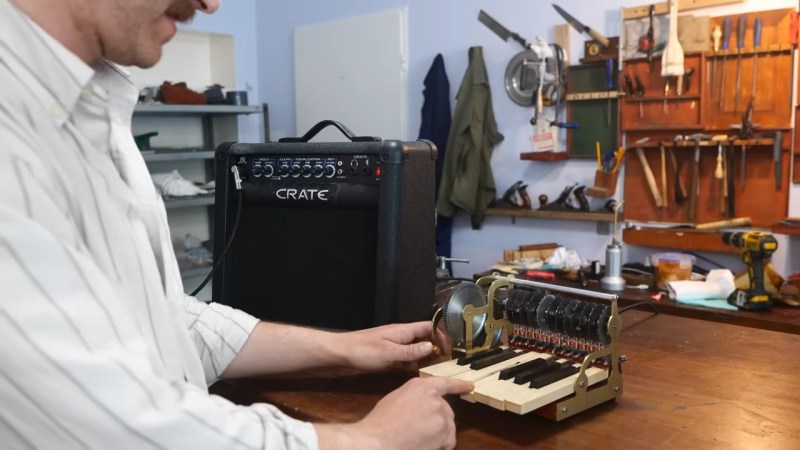
The Hammond organ is an early form of electronic– or perhaps electromechanical– musical instrument. It solved the very real problem of organs normally being the sort of thing you built into a cathedral, allowing a similar sound to fit into a piano-like form factor. Their workings are a so simple that it’s hard to wrap your head around it actually working– which is why [Uri Tuchman] built one on YouTube. Also for a gift exchange, but we’re not Santa, here– we’re here to learn, and [Uri] does not disappoint.
[Uri]’s organ is a bit smaller than what the Hammond corporation was putting out back in the day, just one hand-cranked octave– and it lacks the distinct spinning speaker in favour of plugging into any old guitar amp. It’s enough to get the idea across. Each of the twelve keys acts as a simple switch, wired to a pickup made from a coil of wire around a steel rod– much like a magnetic pickup on an electric guitar. The pickup faces the tone wheel, which is the part that feels like magic: the tonewheel spinning past the pickup acts exactly like the steel string vibrating in an electric guitar, its ferroelectric motions inducing a tiny current. The tonewheels smooth teeth are spaced to create sine waves at the frequencies corresponding to each key, so it has to be exact. That’s why while the rest of the brass-and-wood build is [Uri]’s beautiful craftsmanship, the iron tonewheels are CNC’d.
Aside from the amp it is plugged into, there are no electronics here. There’s nothing to double or otherwise alter the frequencies: one key means one tonewheel– twelve for this build– and if the RPMs are off everything is out of tune. Good thing [Uri] made it hand-cranked! Well, it is for a gift exchange. Maybe it’s a white elephant sort of thing, because we can only imagine that making it much harder to play. On the other hand, [Uri] demonstrates some neat effects by varying the RPM at the end of the video, so perhaps that’s a feature.
As nice as [Uri]’s work is, Hammond Organ Company filmed the construction themselves, back in the day if you want to see the true quill. Alternatively, you can get more of [Uri]’s craftsmanship with this square guitar.











No safety glasses. We need an ominous organ chord progressions to signal impending disaster.
Nahhhh blud not the PPE narc
its a outrage! burn the internet!
its not called verysavehackaday.com for a reason.
That sounds like a temu version of HaD. (Yes, I know it was a typo. A fun one though)
12 equal tempered notes on one shaft can’t be done, unless it has hundreds of teeth on each wheel. It’s good we never actually hear him try to play a scale or tune. The teeth are more half wave sine than whole. Trying to replicate 12-th root of 2 spacing in gears is near impossible, Hammond could only get close and thus their distinctive tuning not quite ET but close enough for ear as ET is out of tune anyway. Meantone is possible.
I’ve junked out many spinet Hammond generators but no full console ones. They are quite a mechanical wonder. They made clocks before organs.
You could achieve fine tuting by piping audio through a DSP chip. A TMS320 could easily do it.
Yeah, but then you’d just be playing an over-complicated digital synth.
tl;dw
1. It’s just an advert for some chinese PCB manufacturer
2. It’s just a bunch of narcissistic content creators being narcissistic.
JohnU: someone not familiar with Uri’s work.
Maybe because of the vibe he gives off (and the singing). Though more of a full of himself (justified or not), not a narcisstic type.
The “advert” was one sponsor section of a minute in a 20 minute video.
What’s worse is that JohnU is not me – I really enjoy Toolroom Takeover and even if the outputs are not 100% practical it’s always an occasion to see talented people doing interesting things.
Anyone who replies with tl;dw or tl;dr is not entitled to an opinion. And YES entitled. If your not capable of absorbing the content then just stay quiet, nobody needs to hear your hubris.
Well, they are entitled since the ad money that funds these videos comes out of their pocket.
And yours as well.
Youtube ads take about $45 billion per year from all the companies that advertise, which you end up paying through all the stuff you buy, and divided by the roughly 1 billion people in the North America and EU which is the major revenue source, it’s about $45 per person per year and increasing.
In your opinion, at what point is the public paying enough that individuals get a permission to complain about pointless filler getting shoveled onto the tubes on their dollar? Remember that you don’t get a choice: you pay, watch it or not.
There’s also a catch-22: if you think “oh, then I’m gonna watch all the good stuff for my money’s worth”, and everybody does that, then it’s going to increase the view counts, add to the number of ads shown, and encourage even more filler slop to be produced – all to the profit of Google.
It’s leveraging the tragedy of the commons to goad the consumers into wasting money.
Dude can you pick any other username when making shitty comments please?
@dude
I skip the crappy ads and yes I understand the economics of it. I use an ad blocker that prevents the beginning of video ads from being shown and yes Gargle knows if you use an adblock. The video site slows down significantly if you use an adblocker. I also refuse to watch anything on the Bumble site because my adblocker doesn’t work on that site.
At a high level, Google auctions ad placements based on the demographic group the browser user was in. I always wonder what would happen if advertisers demanded demographic groups included “the group of people that use ad blockers” or “the group of people that haven’t clicked on an ad since before the tag was invented”.
They already keep general metric of dollars per click, and that’s showing the overall effectiveness of the advertising including people who block ads. The value of online advertising according to these metrics is basically non-existent since it takes anywhere up to $5 per click, and rising, and that doesn’t even guarantee a sale.
That’s gonna eat up your profit margins really quickly, so the point isn’t to get people to buy any particular stuff based on the ads. The point of advertising for the big companies is twofold: buy up the advertising slots so the consumers can see your brand instead of the competing brand, and drive up the cost of advertising for your smaller competitors because it hurts them more in proportion than it hurts you.
Advertising was supposed to be about informing consumers about the available options, but it has become a self-serving business that operates on a lose-lose principle: you lose less if you play the game, so everyone must play it.
I like to imagine what would happen if the demographic group info Google provides in the ad placement auctions included groups such as “people that use ad blockers” or “people that haven’t clicked on a link since before the tag was invented”.
If Google runs an ad auction when they know you are using an ad blocker, wouldn’t that be fraud on the advertisers?
Yes, but how would they know if Google isn’t telling them? Or if they’re simply reporting the number of views and saying they got to pay according to the views whether they like it or not. After all, Google controls the platform and the metrics, and if you don’t like it then you can go pound sand.
Btw. they recently changed the count of video views to how many times it was started, not how many people genuinely watch any significant portion of the video. That’s probably because many people start watching a clip, realize it’s AI slop, and quickly shut it down – but since they have to watch the ads first to get there, that counts as a view for the business side of it.
Then there’s also the statistic that around 90% of youtube views come from mobile devices, smart tvs, and tablets. Desktop/laptop users count for about 7-8% of the total.
It’s not impossible to use ad blockers on mobile, but it’s much more difficult and can’t be done with Google’s own browser or youtube apps, which tells us that the vast majority of users do not in fact use ad-blocking. That’s the main reason why Google isn’t going all guns out on the blockers – it doesn’t pay to put too much effort into it.
Smarttube works great on Android – unavailable for Ios and I’m not aware of an equivalent for Ios so that’s 50(?)% of mobile devices ‘exposed’ to YT ads.
The question is, how many mobile user are smart enough to download it, or just use the default apps they’re given?
The ad-blocker doesn’t matter for the point. Google still gets your data to sell to the advertisers, who use the information to chart their demographics and whatever. Even if they can’t show you ads, they can know everything about you by the data they collect and that’s money in their pocket anyway.
The crux of the matter is this:
The central injustice of modern advertising is not merely that consumers pay indirectly, but that they cannot see, control, or refuse the cumulative cost. Advertising therefore rewards firms for competing to occupy public attention even when little information or social value is produced.
Advertising lowers the threshold for cultural experimentation, but it also creates an unlimited subsidy for attention capture. Unlimited attention subsidies do not merely reward volume alongside innovation; they systematically favor actors willing to produce the greatest volume, exploit the weakest safeguards, and manipulate engagement. Such actors are far more numerous and scalable than creators capable of producing genuinely valuable ideas.