
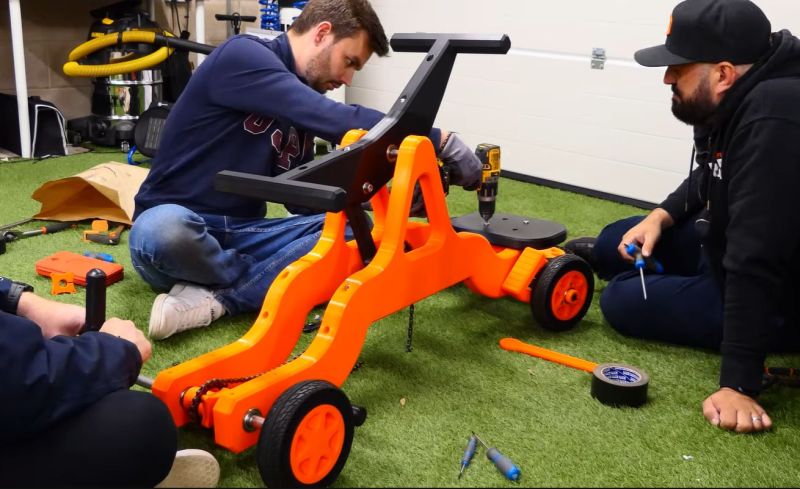
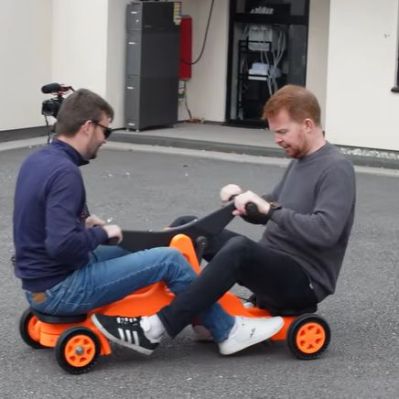
A staple of old movies featuring railways, many handcars – also called pump trolleys or pump cars – feature the characteristic seesawing beam. Requiring at least two people, the motion of this beam is subsequently converted into the rotating motion of the wheels, propelling it at a leisurely pace across the tracks. As a fun and yet functional mechanical contraption it also makes for an entertaining 3D printable project, which is what [Sam Barker] and [Tom] did.
You can find the entire project over at Printables if you are feeling the itch as well, though as of writing details on the required bolts and shafts are still pending.
Since the entire assembly had to be lugged over to the Open Sauce event in the US, they had to design it to be small enough to fit into check-in luggage and easy enough to reassemble in a hotel room. Naturally this put some constraints on the full size of the contraption, with it omitting compatibility with standard gauge railways and also being decidedly fun-sized.
That said, it seems to have left an impression on the folk over at Open Sauce, and it’s hard to argue with the sheer fun factor of such a co-op mode of transportation. Even if bicycle-style handcars are more popular these days, especially for tourist purposes, the old seesaw-style has that certain charm to it.












Just because you have a 3D printer doesn’t mean you have to print the whole thing. It would have been a lot faster and cheaper to make most of it out of wood or metal.
It seems like a lot of youtubers are wasting massive amounts of plastic for something that will probably never be used again once the video is done.
Always amusing seeing men’s attempts at scissoring
It’s a “Not that there’s anything wrong with that”-mobile.
“Requiring at least two people” is not accurate.
Technically, only one person is required for propulsion.
True, you can substitute the second person with a counterweight or just more elbow grease, but it’d be a lot more exhausting on longer stretches.
the only real problem is getting the thing up to speed (or uphill), once it rolls, the handles go up and down “quite easily”. A counter weight should not be required and would actually make things worse. Because when moving the handle up it means also moving the counterweight up, making it even harder. I do no know how this all related to the plastic piece of … but that’s not the point.
Watch out for quicksand
Yeah, don’t want to lose a $500 handcar
Dammit, you guys beat me to the Camptown Races reference…
It begs the question, having a separate crank for left and right wheels, two independent handles per person, how tricky would it be to make a steerable version. Maybe a spring to return each handle the a midway position and some sort of bicycle break lever actuated locking clutch to keep the handles aligned when you want to go in a straight line.
Although making all four wheels independent and install omniwheels.might be a step too far.
The proper American name for these is a gandy dancer. I checked on the interwebs and it shows a gandy dancer as a railroad worker, but add HO or N gauge gandy dancer and the hand powered cart comes up. I had an N gauge railroad kit as a teenager and the hand cart I bought came in a box that said “gandy dancer” on the side. Now I’m confused as to what the right term is. (As a teen I was told it was called a gandy dancer because of the up and down movement of the user.)
Beg to differ…
https://encyclopediaofalabama.org/article/gandy-dancer-work-song-tradition/
In the US in the mid 1970’s, my dad worked for a railroad. The only term I can recall hearing was “hand car”.
Maybe your model handcar was named “Gandy Dancer” to make it more eye-catching on the shelf at the hobby store.
if it’s not on rails then it’s just a pump car, not a railway pump car. words. meanings. yada yada
I never understood handles instead of pedals on these, lots of hard work for sure. Oh but shoulders and backs strained with shovels and hammers then, so par for the course.
The guys doing it were swinging hammers the rest of the day. This would barely be an after thought of work for them.
Certain technologies and materials are predestined for certain uses. This vehicle just begs to be made of wood, I think.