
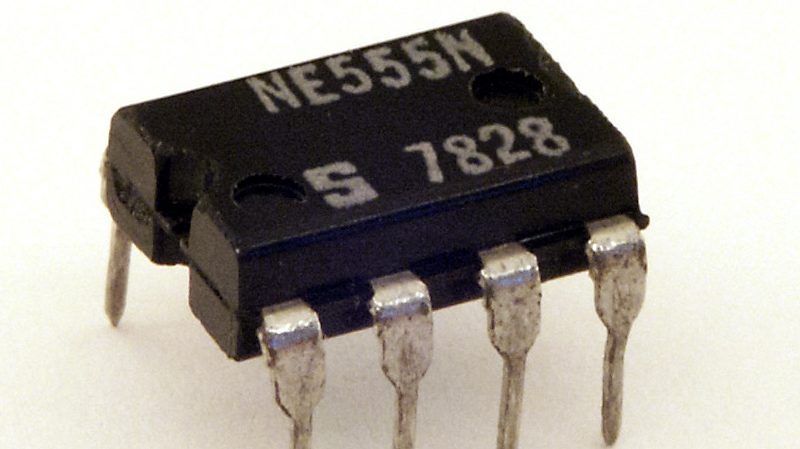
If you’ve got a cheap ham rig, it might not be very practical for you to receive certain transmissions out of the box. However, if you were to hack in a convenient little beat frequency oscillator (BFO) to your rig, then you’d be up and running. Here’s a simple way to do just that with a venerable old part everybody knows and loves.
The build in question concerns the use of a 555 timer IC. It’s seasoned with the right smattering of resistors and capacitors to taste, producing a 455 kHz beat frequency oscillator. This can be injected into the intermediate frequency chain of a receiver, making up for the lack of a steady carrier wave when receiving continuous-wave and single side-band suppressed carrier transmissions. Thanks to a potentiometer in the circuit, it’s tunable, too, from 455 kHz, plus or minus twenty percent or so. Thanks to the versatility of the 555, it’s possible to run the chip on a wide voltage range, anywhere from 4.5 volts to 16 volts, which makes it easy to install in just about any old radio set without requiring adding a specialized power supply. There’s also an alternative design that EDN covered in greater detail some time ago.
If you’re eager to dive into a wider range of transmissions than your radio can currently receive, this old-school ham hack could be just what the shack ordered. We feature plenty of good ham hacks around these parts, and don’t forget—we always want to hear about the freshest ones on the tipsline.












……Did I just read an article saying the 555 is a timer? Just making sure.
According to the AI hallucinations, “… it is widely (???) known as an angel number signaling major life change and personal growth, a classic electronic component called the 555 timer IC, and a fake prefix used in phone numbers in movies…” : ]
As a side note, the best/most-fun experiments I’ve done way back when (last century to be exact) involved dual-timer ICs (556, if I remember right), since I could easily chain two independent 555s. Electronica muzak, to be exact, bleeps and beeps.
Which 555? The normal one or a TI one, a TI one might be anything, you never know.
A “cheap ham rig” (a transceiver) will already have a BFO and product detector, otherwise it couldn’t work CW or SSB at all. The intended target here is a cheap general-coverage AM or shortwave receiver. Also a BFO doesn’t extend frequency coverage, it lets you demodulate additional modes on frequencies you already receive. 2% of 455 kHz works out to roughly ±90 kHz. A BFO needs a few kHz of swing with fine resolution; a single pot spanning 90 kHz would be unusable for tuning SSB.
Potentiometers and other electronic elements can be implemented in software with
ode23orode45functions. During the era of ATmega324 it was hard to code becauseavr-gccwas not really cut out for the job but with STM32F407 chip you can easily do it.A 555 as a BFO? So.. a square wave then? I guess the harmonics will get filtered out in the radio. I’d be concerned it might desensitize it a bit though.
Back in the day this was done with an IF can. Every cheap little (or not so cheap) AM receiver had a little can with an adjustable inductor and a capacitor inside already tuned to 455khz. It was pretty easy to build a BFO with that, one transistor and a few other components.
I found that having the ability to tune it from the front panel was nice though. This could be achieved by putting a variable capacitor across the coil. But… every time you moved your hand toward or away from the knob the tuning would change! One way was to couple the knob to the capacitor by a long non-conductive shaft. I preferred replacing the capacitor with a diode and replacing the knob with a potentiometer. I used the pot as a voltage divider to reverse bias the diode with a voltage I could vary using the pot. So the diode would act as a varicap. And the pot only carries DC so.. no hand effects.
P. 41 https://www.worldradiohistory.com/Archive-Poptronics/90s/90/PE-1990-05.pdf