
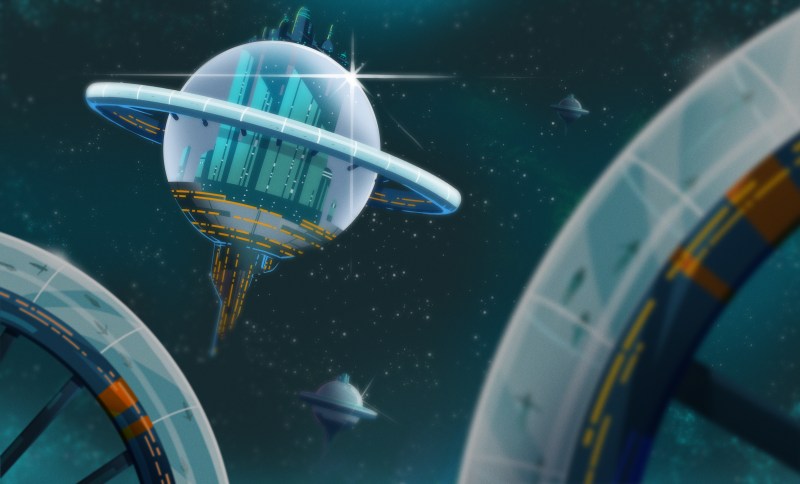
Last time we found out the idea of space stations is surprisingly old. By the 1950s, everyone knew we’d be working in beautiful space stations that rotated like a wheel to give us the illusion of gravity. Of course, that didn’t happen. But we did get some practical space stations, even before the current crop. The road to get there, though, was predictably bumpy.
Convair: From TASSEL to MARS
Convair had been studying multi-person orbital stations under Krafft Ehricke since the late 1950s. One result was TASSEL, an acronym for the Three Astronaut Space System Experimental Laboratory. Proposed in 1960, TASSEL was a three-man laboratory intended for an Atlas-Centaur launch into a roughly 200-nautical-mile orbit and missions lasting two or three weeks.
Around the same time, the Air Force asked contractors for proposals for a Military Test Space Station, or MTSS. Convair was one of five companies selected for the study in 1960. The surviving record suggests that Convair’s TASSEL work fed directly into its MTSS proposal.
Then Convair did something unusual for an era overflowing with beautiful paintings of spacecraft that never existed: they built theirs. Well, sort of.
During late 1960 and early 1961, the company constructed a full-scale ground mockup called the Manned Astronomical Research Station, or MARS. The station itself was about ten feet in diameter and fourteen feet high, with two floors for working, cooking, housekeeping, and sanitary facilities. A Mercury-like reentry capsule beneath it brought the whole assembly to about 28 feet tall. You can see a contemporary video about the program below. There’s also a cache of photos and a post by [The Space Review] explaining it all.
MARS obviously wasn’t going to orbit, but that wasn’t the point. Engineers could use it to work on the less photogenic parts of putting people in orbit: life support, oxygen consumption, water regeneration, contaminant monitoring, controls, displays, and simply discovering whether people and equipment actually fit where the drawings said they would. Crews later spent as long as 30 hours inside the mockup.
Exactly where MARS fits among Convair’s various proposals is still being pieced together. Archival evidence indicates that it grew out of TASSEL and closely overlapped Convair’s submission for the Air Force MTSS program. Photographs in the San Diego Air and Space Museum archive are even identified as “MTSS/MARS.” Whatever name was on the proposal of the week, by 1961 Convair had progressed from drawing space stations to building a high-fidelity example on the ground.
Olympus and MOL
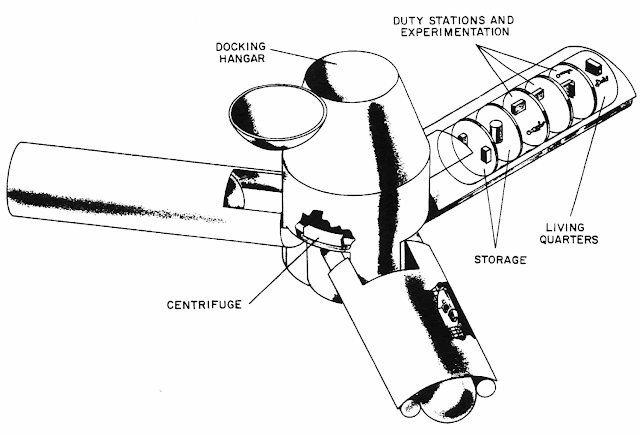
NASA wasn’t far behind. In 1962, Edward Olling at the Manned Spacecraft Center proposed Project Olympus. It would have been an 18-person station intended for launch around 1966 or 1967. It wasn’t the classic doughnut. Instead, three long arms extended from a large central hub, and rotation would provide different artificial-gravity levels at different distances from the center. The station would orbit about 300 nautical miles above Earth.
This is especially interesting because Olympus wasn’t a far-future colony study. It was being considered while Mercury was still flying. Then President Kennedy gave NASA a somewhat more pressing assignment involving the Moon.
Olympus joined the large pile of spacecraft that looked great in presentations.
The U.S. Air Force had another station that got considerably closer to hardware: the Manned Orbiting Laboratory, or MOL. Approved in 1965, MOL would have put two military astronauts into a polar-orbiting station attached to a modified Gemini spacecraft (Gemini B). Its actual classified purpose was high-resolution reconnaissance. You can see some silent footage of some of the hardware in the video below.
They selected astronauts. They built hardware. They modified a Gemini capsule with the unnerving idea of putting a hatch through its heat shield so the crew could crawl into the laboratory behind it. MOL was canceled in 1969 without a crewed station ever flying.
Meanwhile, docking — one of the basic tricks required to make stations useful — was becoming real.
Dock of the Bay
On January 16, 1969, Soyuz 4 and Soyuz 5 docked in orbit. There was no pressurized tunnel connecting them. So Yevgeny Khrunov and Aleksei Yeliseyev put on spacesuits, climbed outside Soyuz 5, traveled across the docked spacecraft, and climbed into Soyuz 4. Two spacecraft had effectively become a tiny space station, but changing rooms required going outside.
Apollo 9 flew less than two months later and provides an interesting parallel. The command module and lunar module could dock, and crews could normally transfer internally. But what if the tunnel couldn’t be used? NASA planned to demonstrate a contingency EVA transfer from the lunar module to the command module.
Rusty Schweickart was supposed to perform the exercise, but space sickness caused NASA to shorten his EVA. He tested the lunar EVA suit and portable life-support backpack from the LM porch while Dave Scott partially exited the command module, but the complete external transfer was never performed.
Salyut and Almaz
On April 19, 1971, the Soviet Union launched Salyut 1, the first actual space station. The first crew failed to dock successfully. The second crew, Soyuz 11, spent more than three weeks aboard, but all three cosmonauts died during reentry when their Soyuz depressurized. There is some video from Salyut 1, but no audio.
The Salyut name also concealed a second program. Some of the stations were civilian Salyuts, while others were military Almaz reconnaissance stations similar in purpose to MOL. Salyut 2, 3, and 5 belonged to the Almaz line, although Salyut 2 failed before a crew could arrive.
Later Salyut stations gained a second docking port. That was a huge improvement because Progress cargo ships could bring supplies and fuel while a Soyuz remained attached as the crew’s ride home. Long-duration spaceflight was becoming practical rather than heroic improvisation. Of course, none of them rotated.
Skylab
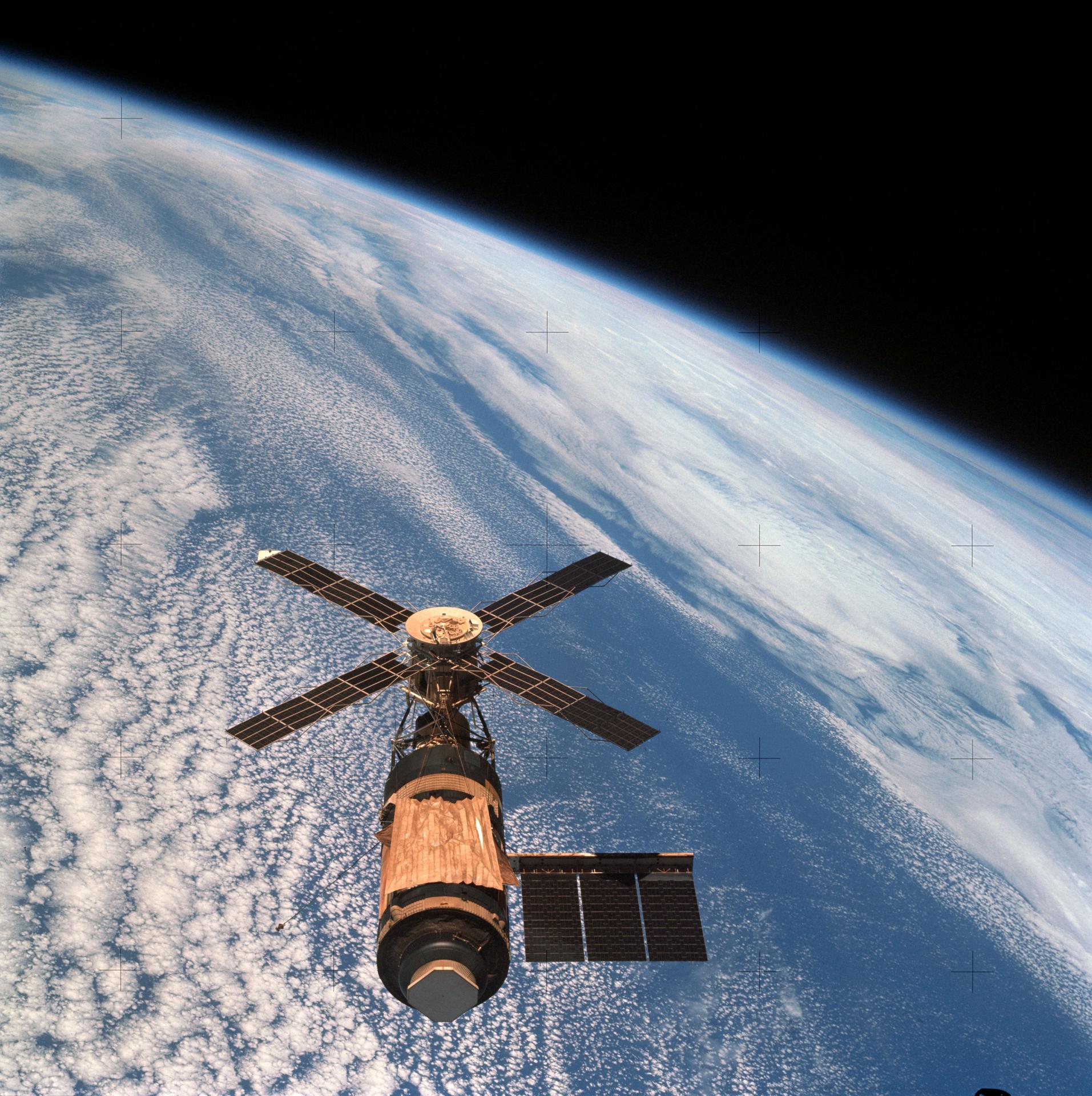
The United States took a different route. Skylab was essentially an enormous converted Saturn V upper stage. Launched in 1973, it gave its crews something previous spacecraft had lacked: room.
Three crews occupied Skylab, staying as long as 84 days. They conducted solar astronomy, Earth observations, medical studies, and experiments designed to determine what happens when human beings spend months rather than days in weightlessness. After all, why build a giant rotating station if people could simply learn to live without gravity?
Then again, we learned that long-term microgravity isn’t free. Bones, muscles, cardiovascular systems, eyes, and assorted other bits of the human body complain when they don’t have proper gravity. Still, a nonrotating station was far easier to build, so rotating wheels stayed on the drawing board.
Freedom Isn’t Free
By the 1980s, NASA was ready to try again. In his 1984 State of the Union address, President Ronald Reagan directed NASA to build a permanently occupied space station within a decade. What eventually became known as Space Station Freedom was supposed to be a large modular facility assembled by the Space Shuttle.
It would support research, Earth observation, satellite servicing, and eventually serve as a staging point for missions beyond Earth orbit.
Freedom went through redesign after redesign as costs and requirements fought each other. It did not rotate. While NASA redesigned Freedom, the Soviets quietly launched something considerably more important.
Peace In Orbit
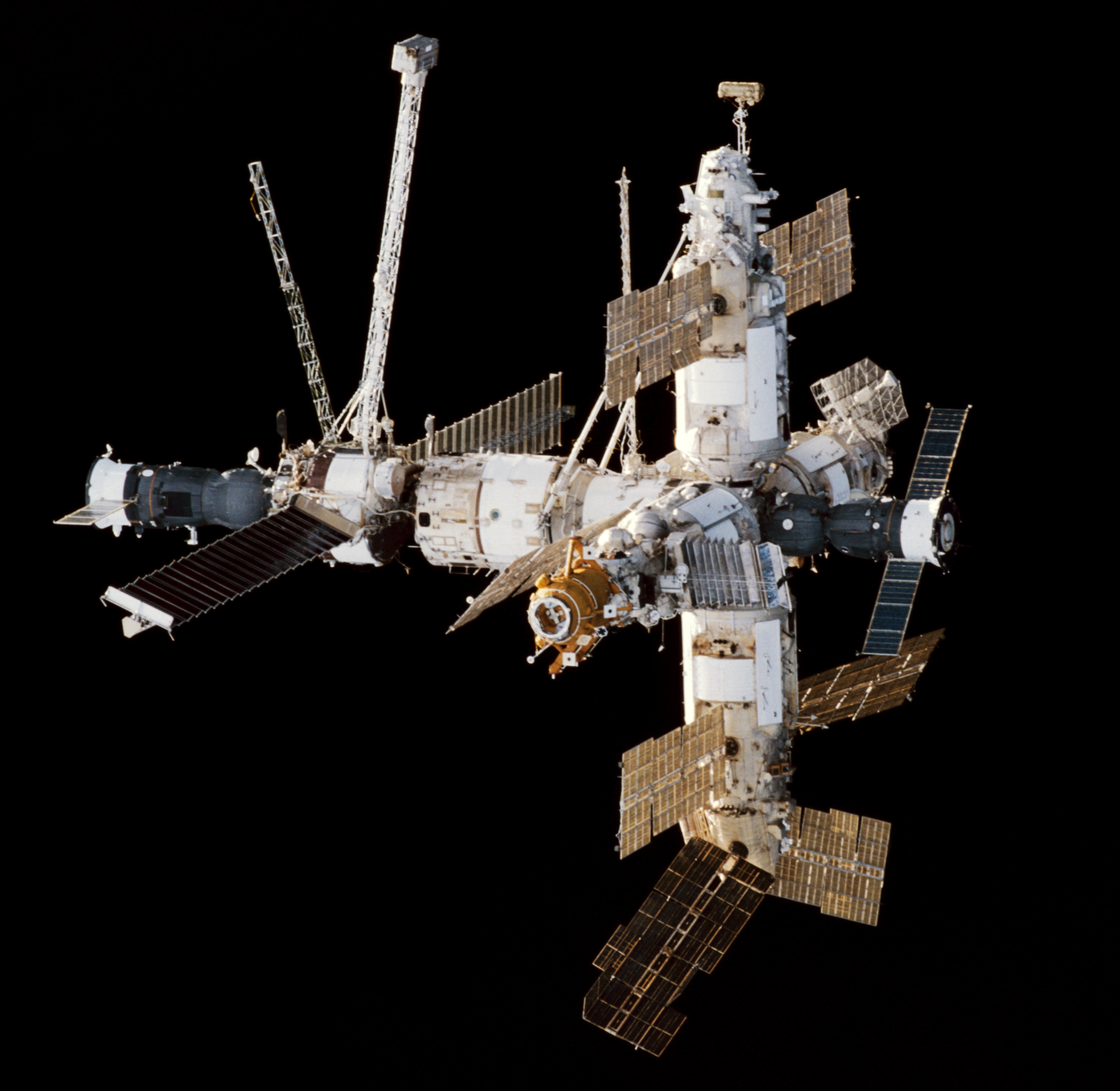
On February 20, 1986, the Soviet Union launched the core module of Mir.
The name means “peace,” although the Russian word can also mean “world.” Unlike the earlier Salyuts, Mir was designed from the beginning as a modular station. Additional laboratory and equipment modules arrived over the years and docked around its core.
It looked nothing like Noordung’s wheel. It looked more like somebody had been assembling an enormous machine in a garage and kept finding useful places to bolt things on.
Mir represented decades of incremental Soviet experience: Soyuz, docking, Salyut, Progress, long-duration crews, orbital repairs, and modular construction. It demonstrated that a space station could become not merely a spacecraft but a place — one that crews could maintain, modify, repair, and inhabit for months at a time.
Where’s My Wheel?
That may be the most surprising thing about the history of space stations. The rotating station wasn’t some goofy 1950s science-fiction invention. Serious engineers were proposing artificial gravity before anyone had launched anything into orbit. Oberth discussed rotating stations in 1923. Noordung drew a remarkably complete wheel station in 1929. Von Braun made the concept famous in the 1950s. NASA seriously studied rotating stations in the 1960s. The physics works.
We’ve simply never needed artificial gravity badly enough to pay the cost.
If you can tolerate microgravity, a station can be a collection of pressure vessels, trusses, solar arrays, and docking ports. If you insist on one g at a comfortable rotation rate, suddenly you are contemplating a structure hundreds or perhaps thousands of meters across.
Still, Edward Everett Hale put people aboard an artificial moon in 1869. Noordung put them aboard a rotating wheel in 1929. Kubrick had airline passengers walking around one in 1968. So after more than a century and a half of talking about space stations, I have only one question: When do I finally get my rotating space station?











Reading the end of the title I suspected HaD went into hamster business.
In a way, the first spacecrafts were the first space stations, albeit with a very short lifespans. I would add here the vomit comet and the space simulator pool(s).
All these tests were (and again today are) like the helping wheels for space (including rocket) science. All that was learned in the 1970’s was forgotten and only the recent private and chinese advancements made money approuvers to let NASA go to the Moon again.
Is it now the time for next big leap for the human kind? What comes after Mars?
Europa. We must attempt landing there.
The Firstborn may have something to say about that. Best not to rile them, given what they can do to planets.
I think the article failed to mention an important point: the absence of gravitational forces is a crucial factor for work on the ISS, for example. Nowhere else can research be conducted under microgravity conditions. This is a key purpose of real world orbital station(s). No one needs gravity there; it would only get in the way. After all, a space station isn’t meant as a wellness retreat for human beings – at least not outside of science fiction ;-)
Well, keep in mind though, that an orbiting station can actually have multiple levels of gravity including “near zero”. Or you can have a little companion for your low grav stuff, but having gravity in your living quarters makes logistics and other things way better. Olympus had that, if I recall, where they had 3 levels of gravity spin quarters.
Unless there is a major medical breakthrough, gravity is essential for long term human health.
“Nowhere else can research be conducted under microgravity conditions.”
Vomit comets and sounding rockets are habitually used for microgravity experiments, though obviously of limited duration.
Was always wondering about the coriolis force as well, because eventual precession would gradually set in and things like docking would become darn complicated. Not only one has to match the angle of rotation, but chase around after the docking port that will be wobbling around.
Babylon 5.
Wobbling docking port is a bug, there’s a fix for it.
“If you insist on one g at a comfortable rotation rate” This strikes me as simply wrong. Because acceleration is indistinguishable from gravity for reasons, “comfortable” is not an issue. The actual issues are achievability, engineerability, and sustainability. And those are just the ones I can think of, it’s by no means a complete list.
No, it isn’t gravity so you get Coriolis effect rearing up. Also, the smaller the ring the bigger gradient of gravity you have between your head and your toes.
Did I say it is gravity? No I did not so no. That said, correction accepted. Someone else had already covered the two things you mentioned. I’m not the Beatles don’t wanna hold your hand but I was arguing against the one word “comfortable” having been in a centrifuge and experienced “artificial gravity”.
Wow you wrote all that and didnt even touch on the Stanford torus, a proposed 1975 design for a donut-shaped space station that spins to create artificial gravity relying entirely on lunar materials and space manufacturing to avoid the prohibitive costs of launching heavy materials from Earth.. Conceived by a NASA and Stanford University study, it would measure 1.8 kilometers wide, house 10,000 people, and use massive mirrors to beam sunlight inside.
Size: 1.8 km (1.1 miles) wide total diameter with a 130-meter wide interior habitat tube.
Gravity: Rotates once every minute to mimic Earth-normal gravity on the outer ring.
Lighting: Uses a large non-rotating mirror angled at 45 degrees to reflect sunlight into the living areas.
Shielding: Covered with thick layers of lunar soil to block cosmic radiation
The original 1975 NASA Ames/Stanford study estimated the total cost to build the Stanford Torus at $190.8 billion. Adjusted for modern inflation, that equates to roughly $1.1 trillion. But with reusable spaceships like starship that could be trimmed down making the realistic price tag closer to $220 billion only about 1.5 times the historical cost of the International Space Station ($150 billion)
This kind of thing is so laughable, just saying “lunar materials” as if it’s magic is cute for 70’s magazines but in reality the issues to overcome to actually manage to use ‘lunar materials’ are insane, and for a big part unknown, and even now impossible to calculate.
Impossible to calculate to the uninformed and uninspired perhaps.
They had it quite well thought out.
The original study allocated the budget across four distinct categories:
Research & Development: $30.1 billion
Production Operations: $14.6 billion
Transportation & Launch: $114.3 billion
Lunar Base Setup: $31.8 billion
. Lunar Mining and Gathering
Location:
A permanent mining base is established on the Moon.
Materials:
Robots harvest lunar soil (regolith), which is rich in aluminum, titanium, iron, and oxygen.
Packaging:
Mined materials are packed into standard bags or blocks for transport.
Space Transport via Mass DriverMechanism:
An electromagnetic railgun (mass driver) on the Moon launches material cargo.Destination: The payloads are shot into space toward the Earth-Moon L2 Lagrange point.Catching: A giant “mass catcher” at L2 collects the incoming bags of lunar soil.
Processing and Refining at L2Power Source:
Giant solar furnaces use concentrated sunlight to melt the lunar ore.Separation: Industrial plants separate raw materials into pure aluminum, iron, and glass.Byproduct: Chemical processing extracts oxygen, which is saved to create the station’s future atmosphere.
Fabricating the HullShaping:
Automated space factories cast the refined aluminum into structural beams and heavy plates.Assembly: Construction robots weld the segments together to form the main 1.8-kilometer-wide donut tube.Expansion: Workers build the central hub, access spokes, and the primary chevron-shaped mirror systems.
Radiation Shielding and Outfitting Protection:
Robots wrap the exterior hull in a 1.7-meter-thick layer of raw, unrefined lunar slag.Atmosphere: The interior is pressurized with imported Earth nitrogen and locally mined lunar oxygen.Interior: Construction crews build internal soil beds, farms, homes, and public parks to complete the habitat.
Following the successful 1969 Moon landing, public interest and political willpower for massive space expenditures rapidly evaporated. NASA’s budget was severely cut in the mid-1970s. The agency had to pivot from “visionary sci-fi ideas” like space colonization to utilitarian projects. NASA focused all its remaining resources on building a reusable transport system: the Space Shuttle program
That whole thing is a non-starter. Predicting costs is a mug’s game. How do they get the manufacturing equipment to the moon? If you say they manufacture it there it’s “To the moon Alice!” for you. An itemized list of the stupidity is beyond the scope of this comment but “Giant solar furnaces”? Moon-mining robots? Pull the other one.
just bury your head in the sand and wait for the world to end
“They had it quite well thought out.”
No, they’re just scale estimates. There’s no way for them to be able to have solid numbers, because stuff like in-situ lunar manufacturing hadn’t even been studied yet.
The number that’s got the biggest uncertainty (and is always wrong) is the R&D number. You can’t project that well because, well, it’s research, and because all the materials costs follow R&D, estimating R&D wrong scales up the materials/launch costs by inflation. This is literally why most major research projects end up over budget.
One of my prize possessions as a kid was the report from Stanford on that. The idea was to build solar power satellites and sell power back to earth via microwaves. You can read it online now: https://web.archive.org/web/20091214010802/http://settlement.arc.nasa.gov/75SummerStudy/Table_of_Contents1.html
I thought about mentioning it, but it was really a far future design. I wanted to focus on things a little closer to the 1950-1960 horizon.
“Where’s my wheel?” Probably the same place as my Jetpack and Flying Car…
Jetpacks and flying cars are available, but something you absolutely do NOT want any member of the general public to acquire/use.
It would be like giving people VX gas for ‘personal protection’.
Flying Taxis perhaps? ;-)
Flying cars do exist since the 1970s or so. Basically cars with wings that could be folded down.
What we don’t have are classy floating cars like in the Jetsons cartoon.
I guess that’s what everyone wanted to see in year 2000,
rather than some big quad-copter with seats that looks like a flying spider.
Drones kind of made both semi-irrelevant.
So why was my comment removed? I just mentioned, that you could rotate two tethered compartments around a core or around each other for microgravity, needs no torus. It’s also probably the most realistic version, since working with 1 km cables with a few tons load, is nothing new in engineering.
Hm. But that wouldn’t be as much as elegant, maybe.
It’s like trading the USS Enterprise (ST:TMP) for the Prometheus (SG1). ;)
Another solution would be to use lightweight, enflamable material that can be filled with air to keep the torus shape.
That way, sensors or other things such as antennas or gyroscope wheels could be installed.
And if it aims to follow the structure of a bicycle wheel, cat’s eyes could be installed on the spokes, too. For..science.
But on a second thought, they could also be installed to two tethered compartments.