
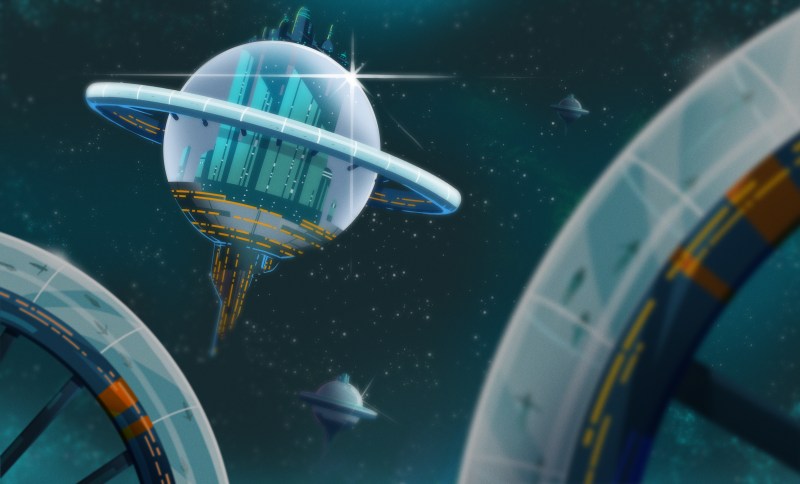
People have lived in space stations for decades now, but something is wrong with them. Where are the big rotating wheels? You know the ones. They show up in old paintings of the future and, perhaps most memorably, in 2001: A Space Odyssey. Spin a great wheel in space, and people can stroll around inside with something that feels suspiciously like gravity. It seems like an obvious idea.
It is also an old idea. Much older than actual spaceflight, in fact. But to find the beginning of the space station, we have to go back to a time when powered aircraft were still several decades in the future.
A Moon Made of Bricks
In 1869, Edward Everett Hale published The Brick Moon in The Atlantic Monthly. The moon in question wasn’t natural. Hale imagined building a 200-foot-diameter sphere made from bricks and putting it into orbit as a navigation aid. Sailors could sight it and use its known orbit to determine their longitude. There was only one small problem: the thing was accidentally launched with people aboard.
That makes The Brick Moon generally regarded as not only the first fictional artificial satellite, but also the first fictional space station. Hale followed it in 1870 with Life on the Brick Moon, describing how the accidental colonists got along up there.
Hale didn’t have rockets. He proposed flinging the thing into the sky with giant flywheels, but, then again, it was 1869, so we’re inclined to cut him some slack. As the 19th century turned into the 20th, however, people started doing the math.
Konstantin Tsiolkovsky is best remembered for putting rocket flight on a sound theoretical footing. The Russian schoolteacher wrote extensively about orbital flight and space habitation, envisioning people living in orbit long before anyone had demonstrated that a liquid-fueled rocket actually worked. His ideas included rotating habitats to provide artificial gravity.
Hermann Oberth’s 1923 book Die Rakete zu den Planetenräumen — The Rocket into Planetary Space — Oberth went beyond fiction and seriously considered a permanently inhabited station. He envisioned it being periodically supplied by smaller rockets, serving as an observation and communications platform, and even acting as a jumping-off point for trips farther into space. He also suggested spinning the station to give the crew artificial gravity.
Enter The Wheel
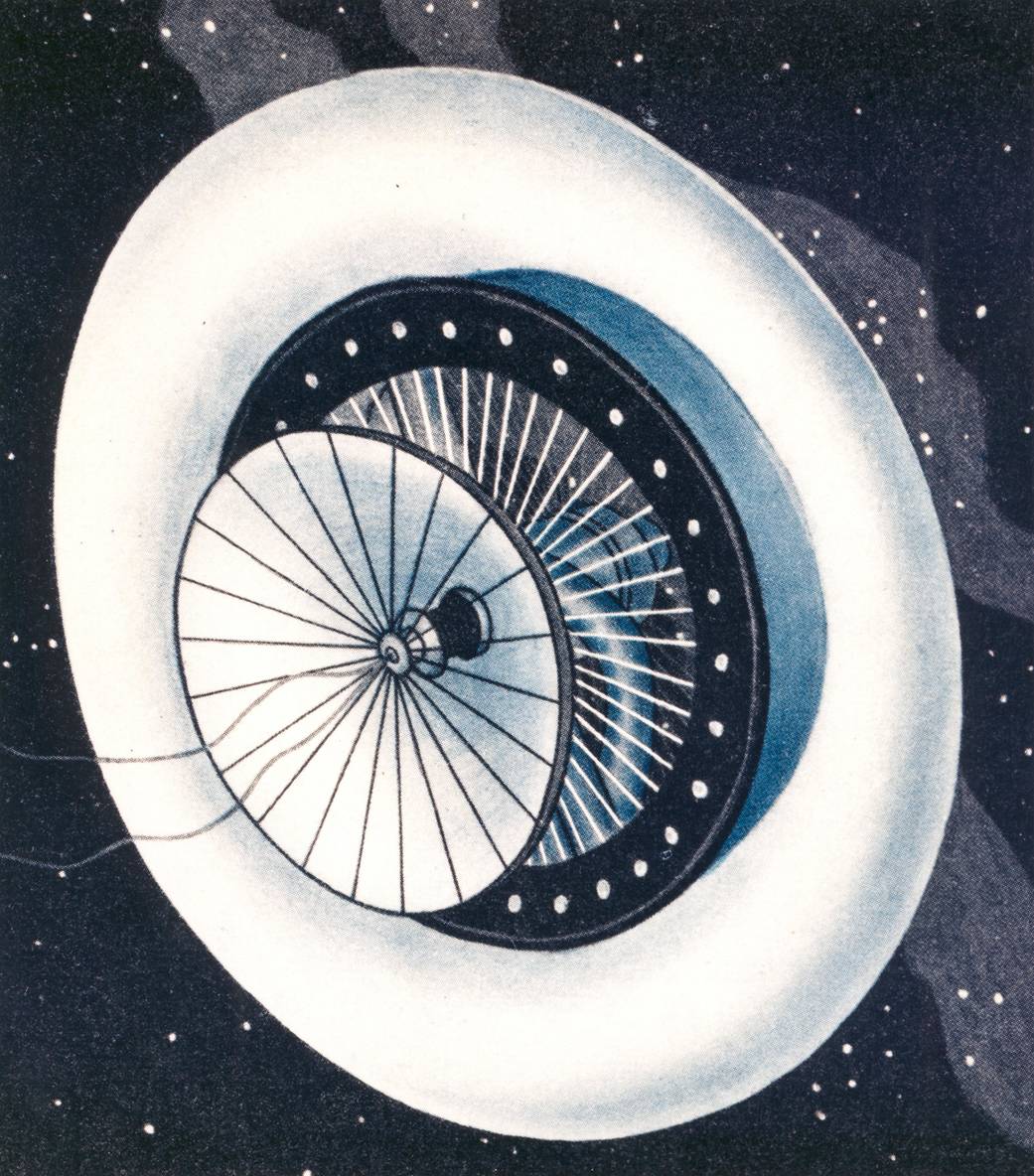
But the space station that looks like the space station in your head probably comes from a different Hermann. Herman Potočnik was an Austro-Hungarian army officer and engineer who wrote under the name Hermann Noordung. In 1929, he published Das Problem der Befahrung des Weltraums, translated by NASA many years later as The Problem of Space Travel: The Rocket Motor.
Noordung didn’t merely say, “We should have a space station.” He drew one. His station consisted of several components, but the memorable one was the Wohnrad — literally the habitation wheel. Living quarters occupied a rotating ring connected to a central hub. Rotation provided artificial gravity, while other portions of the complex could remain weightless. He considered power, communications, observing Earth, astronomy, docking, and the practical business of living in orbit. NASA calls his work one of the first detailed technical designs for a space station.
If you have seen Wernher von Braun’s famous wheel station from the 1950s, you may notice something. Von Braun certainly knew Noordung’s work — he had cited it years earlier — and the family resemblance between Noordung’s 1929 Wohnrad and the wheel station that von Braun and Willy Ley presented to American readers in Collier’s in 1952 is hard to miss. The only place we have found the articles is the reprints in Horizons, by the AIAA (start with page 46).
Whatever the exact family tree, von Braun was the man who put the wheel-shaped station into American popular culture. In 1952 he described a 250-foot-class rotating station in Collier’s, accompanied by some gorgeous Chesley Bonestell artwork. A few years later he took the idea to television with Walt Disney.
If you’ve never seen these, they are worth your time. Disney’s 1955 Man in Space and Man and the Moon let von Braun explain a remarkably detailed vision of rockets, orbital stations, and trips to the Moon to a mass television audience. A generation of kids grew up expecting this stuff. What happened?
Gravity, More Or Less
The attraction of the wheel is simple. You can’t really make gravity, at least not without bringing along a planet-sized lump of mass, but acceleration will do nicely. Stand on the inside of a rotating ring, and the floor keeps accelerating you toward the axis. In your rotating frame, it feels as though something is pushing you outward against the floor.
The acceleration is a=ω2r where (r) is the radius and (ω) is the angular velocity. Sadly, the numbers explain part of the problem.
If you want one Earth gravity at the floor, you need to either spin fast or have a large ring. For example, at 1 RPM the ring has to be 1.79 km in diameter. Speed up to 2 RPM, and you can get away with 447 meters. At 4 RPM, you are down to 112 meters.
Seems like you could just keep going faster, but there’s a problem. Four RPM doesn’t sound very fast until you are inside the thing moving your head around.
Humans can adapt to rotation, but increasing the speed makes Coriolis effects increasingly noticeable. Move your head, climb a ladder toward the hub, throw something, or even walk spinward instead of anti-spinward, and the results aren’t quite what your inner ear expects. NASA artificial-gravity studies have often used approximately four RPM as an important practical region for human tolerance, although this isn’t a hard physical limit and training matters.
There’s also a gravity gradient. Your feet are farther from the axis than your head, so they weigh slightly more. Make the radius large enough, and you won’t notice. Make the station small enough, and things get strange quickly. So bigger is better except when it comes to cost, of course.
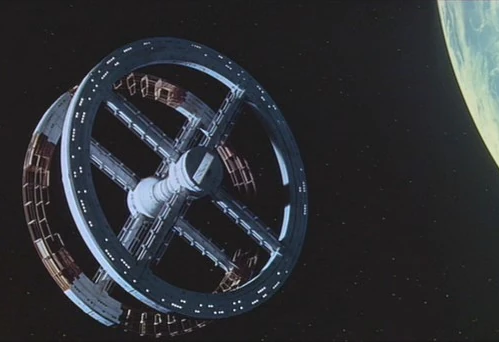
There is another oddity that movies sometimes get wrong. The outside circumference of the wheel is the floor. “Down” is away from the hub. Imagine a tire in space. You aren’t walking around on one of the flat sidewalls with the axle beside you. You are walking around the inside of the tread. So when a movie gives you a nice conventional room with a picture window on what looks like the outer wall, stop and think about where gravity ought to be pointing. Depending on the geometry, that window would probably be underfoot.
Stanley Kubrick got this wonderfully right in 2001: A Space Odyssey. Both Space Station V and the rotating centrifuge aboard Discovery make “down” follow the rotation. The famous jogging sequence works precisely because the circular wall of the set becomes the floor as the camera watches.
Next Time
Next time, I’ll look at early attempts to make a space station ranging from TASSEL, MTSS, and MARS to real Soviet and U.S. stations that had varying degrees of success. Spoiler alert: none of them are going to rotate for gravity.
Of course, people didn’t just imagine space stations. They also imagined moon bases, both fictional and actual.












Made me go look up what SpinLaunch is up to: apparently they’re talking “orbital data centers” now.
Unrealistic plans are great for separating investors from their money. The more complicated the better; then you can say “we tried and failed” instead of admitting there was no intent to succeed. Space exploration is gonna be plagued with this until it becomes as boring as railroad travel.
Sometimes the function of the market is to remove the Accursed Share from people who should not be holding it at that moment. If you can make some money doing rocket things that way, more power to you.
Made me struggle to remember the name of SpinLaunch. Bit gutted to find out that’s their new direction of travel, but can’t blame them in this redic climate either.
Yeah, “orbital data centers” is a funny joke. It seems that there are actually stupid enough people to believe that because space is cold, it’s a great place to put servers there, because, you know, they need to cool down. Unless you realize how hard is to remove heat in open space…
What makes no sense about the orbital datacenter argument is that the technology development you do to deal with heat is exactly the same technology that would make it so that you don’t need to cool it on Earth, except it’d be way easier.
The issue with cooling in space isn’t really removing the heat, it’s transporting it. Well, I mean, okay, it’s both, but there’s literally only one option for ultimately removing heat in space, and that’s radiation, meaning a giant radiator plate. And we already can make radiator plates that are close enough to 100% efficient that there’s no real improvement possible (it’s just the emissivity of the material), so figuring out how big it needs to be is just an undergraduate physics problem. Maybe even high school. Do the math, figure out how much area you need, and the radiator plate’s done.
So really the challenging engineering part is moving the heat around. And if you develop an efficient way to transport heat to keep electronics cool (and there are ways, obviously) good enough for space… why in the hell wouldn’t you just use closed-cycle ground-source heat pumps on Earth?
Whenever my kids ask “why do datacenters use so much water” my response is always “because the companies are too cheap to do the engineering.” It’s crazy.
Exactly. In this case space doesn’t help at all, but actively prevents you from cooling the electronics, making things more expensive. Unless this is the primary point, as h2odragon suggested.
I mean, like I said, the actual difficult part of the engineering is getting the heat away from the actually processors/GPU. The actual radiating into space is functionally a solved problem. So if you’re one of these companies and that’s what you’re actually working on, if you can get it working, you could just… license the solution to ground-based stuff anyway. The fact that it doesn’t become an actual orbital thing doesn’t necessarily mean the research isn’t profitable.
Actually, why those types really want to put data centers in space, is regulation.
Can’t be hold responsible in a lawless space.
Doesn’t work that way. The Outer Space Treaty dictates that a country that launches something into orbit retains jurisdiction, basically the same as maritime law. So if they wanted that, offshore datacenters do the same thing.
There’s this long-standing science fiction visual of an astronaut being exposed to space and flash-freezing like he’s been dipped in liquid nitrogen. Nope, heat build-up is the problem, even though it’s very cold outside… You’re inside the universe’s biggest thermos, with the biggest chicken lamp burning right in your face, and heat always overstays its welcome.
South of Mars orbit is where it gets cold. Around earth orbit, if you’re not in a planetary body’s shadow, it’s rather toasty.
At Earth orbit, the blackbody equilibrium temperature is 278 K times (1-albedo)^(0.25). This means for an object with the absolute lowest albedo possible, you’re only going to get to 278 K (about 5 C) unless you do clever engineering so the albedo depends on wavelength (absorb the Sun efficiently, radiate infrared poorly).
The reverse is much more common (high albedo in the visible, low albedo in the infrared) – plenty of white paint is designed this way – and actually an object like that would be warmer in a planet’s shadow than floating free in space at the same orbital distance.
For most typical objects it’s going to be a bit below freezing. So not really ‘toasty.’ The reason spacecraft have thermal engineering issues is because they generate a lot of heat themselves – generally very significant compared to the heat from the Sun.
What’s funny to me is I learned more about heatsink inefficiency in the relative vacuum of space from the BattleTech table top game than I did from any formal education.
Heat management has always been a factor in the games and the in universe heat sinks operate at something like 1/6 efficiency in space compared to ground. Being a pedantic nerd I had to look up how NASA handles things and fell down a rabbit hole of thermodynamics that left me digging through theories on room temp super conductors.
Cyrano de Bergerac, the guy that Rostrand wrote the play about, wrote about rocket powered space flight to the moon in 1657, between swordfights and having affairs with everyone he met. Current evidence is that he came up with the idea of rocket based space exploration, probably based on his experiences with early explosives in siege warfare.
Baroque starships would have been sick as hell though, nobody can deny it
space suited people rigging trebuchets on the surface of steel-and-wood spacecraft, landing parties using rapiers to puncture each others’ suits…
Chronicles of Riddick.
Instead of lots of bricks—maybe one big block…shades of JASON OF STAR COMMAND:
https://en.wikipedia.org/wiki/469219_Kamo%CA%BBoalewa
https://spaceflighthistory.blogspot.com/2016/12/a-vision-of-future-military-uses-of.html?m=1
https://nss.org/islands-in-space-the-challenge-of-the-planetoids-the-pioneering-work-of-dandridge-m-cole/
Single launch torus
https://up-ship.com/blog/?p=40017
Other concepts
https://up-ship.com/blog/?p=9436
The SLS version of this is what I want to see:
https://up-ship.com/blog/?p=45219
https://www.slideshare.net/slideshow/the-space-island-project-copyright-2003-the-space-island/3672536
Doesn’t have to be a ring. Just tether two compartments, doesn’t even need a “core” in the center.
Does anyone else have that dream where your taking a dump and you suddenly loose gravity. Turd chasing you, you flap your arms in panic getting nowhere fast and when you try to wave some air at the menacing log it just puts it into a rapid flipping motion accelerating it towards you! Would flapping your arms achieve any sort of propulsion in microgravity?
Mystery station
https://projectswordtoys.blogspot.com/2026/09/station-to-station.html?m=1