
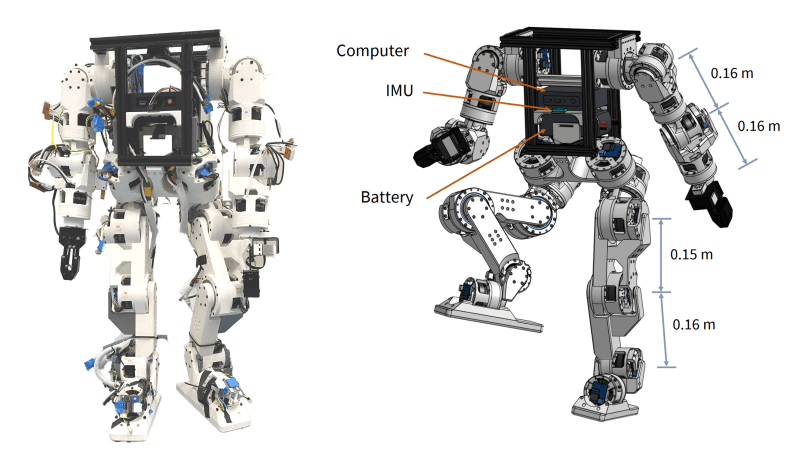
Humanoid robots, even scaled-down ones, tend to be expensive. The Berkeley Humanoid Lite offers a more accessible and economical option by centering the design around 3D printed actuators that make up the bulk of the robot’s frame.
 The actuators are made by combining motors with printed cycloidal gearboxes and an embedded magnetic encoder. They’re modular, so even if one has no desire to recreate the whole robot it might be worth checking out the actuator design details to see if they might be useful in some other way.
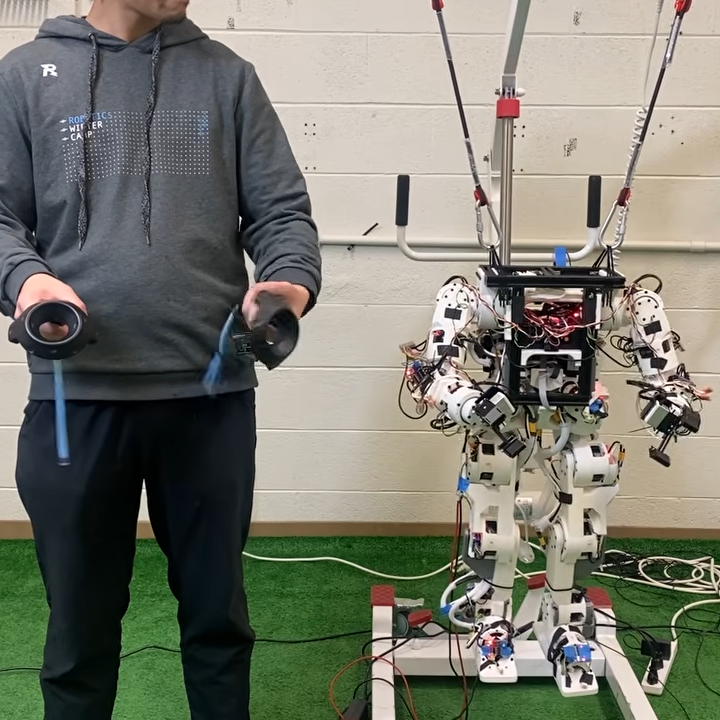
The Berkeley Humanoid Lite isn’t a finished product so much as an open-source, easily customized reference design. The GitHub repository contains everything one might need, and you can watch some basic demonstrations, including VR-driven teleoperation, in the video embedded below.
At a total hardware cost of under $5,000 USD it’s still expensive, but much more economical than other humanoid robots, open-source or not. As mentioned, even if one doesn’t plan to build one, the modular actuator design is worth keeping in mind for other purposes.












188$ per actuator according to their bom. No torque / lifecycle ratings.
I’m absolutely all for DIY actuators, but premade ones like robstride have got cheap past few years
Worth noting those are planetary reduction boxes though, while the ones featured here are cycloids. Kinda comparing apples to oranges.
Well advances in the academy lead to cheaper products after economy of scale is applied, so it still might be a step in that direction down the line.
$188 per actuator is expensive for a diy project. this one costs $40 by motor,esc and around 50g ABS filament: https://makerworld.com/en/models/1279205-5010-cycloidal-gear-actuator?from=search#profileId-1364911
Bookmarked
I’ve seen this done even more cheaper—
https://m.youtube.com/watch?v=2l0lrT3JWlw&pp=ygUdTXVwcGV0IHNpeCAgZG9sbGFyIG1hbiBwYXJvZHk%3D&ra=m
Thanks for posting that. Great.
oh it may be more cheaper but does it be more better too?
Okay, those are some excellent tips from an unexpected source.
Thanks for posting, it really made my day.
“Mo better blues” doesn’t lend itself to correction, Mr. Micro-aggression ;)
I was going to post “even more cheaply” but it got away from me.
-Beaker (who loves the SNW Puppet episode)
P.S. You should hear my impression of digital fragmentation:
“…ip…op…-ut….mx..NO SIGNAL”
In place of snow, I just put jigsaw pieces on an overhead projector, so I can even do pixelated fragments in an analog way too…
“Mo better blues” doesn’t lend itself to correction, Mr. Micro-aggression ;)
I was going to post “even more cheaply” but it got away from me.
-Beaker (who loves the SNW Puppet episode)
P.S. You should hear my impression of digital fragmentation:
“…ip…op…-ut….mx..NO SIGNAL”
In place of snow, I just put jigsaw pieces on an overhead projector, so I can even do pixelated fragments in an analog way too…
Assembly time belongs beside the parts bill here. For a teaching robot, building and repairing the actuator can be part of the value. For a lab trying to run the same experiment on several robots, calibration time and replacement frequency could change the cost comparison quite a bit.