
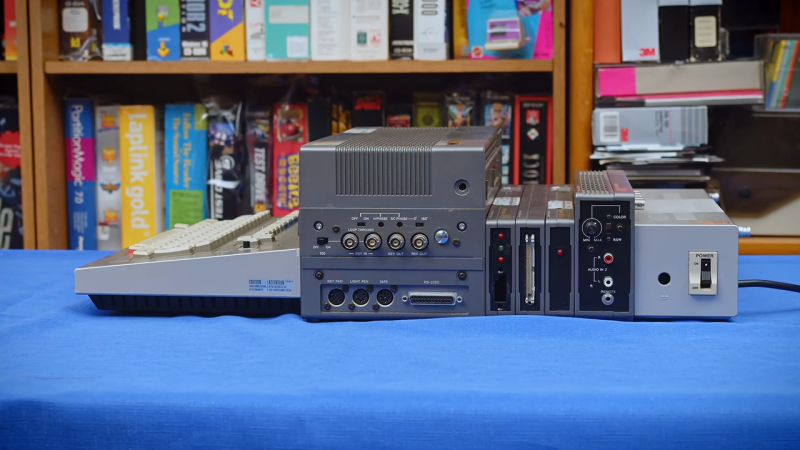
In 1982, desktop computers were coming into their own, and no clear leaders had emerged. But everyone knew they wanted a piece of the action. This led to, among other things, Sony’s SMC-70, which, frankly, for 1982, was a good-looking, if not oddball, machine. [Tech Tangents] shows the machine off in a recent video.
From the front, the computer looks more-or-less like everything else. But as you move backward, you can see this computer wasn’t another typical entry into the market. One of the things that was the hallmark of successful business computers of the day was expandability. The earlier Altair had the later-titled S100 bus. The IBM PC had the ISA bus. But in both cases, you had to open the box to plug and unplug cards.
The SMC-70, though, had a very unique system. Instead of boards, users would line up modules and stab them with what amounted to skewers to mechanically secure the stack of modules. You could stack some modules vertically or horizontally using ribbon cables or external cables. This particular box needed some power supply work, and a 3D printer lets it look essentially stock.
Computing-wise, the SMC-70 was pretty typical. A CP/M machine with a 4 MHz Z-80 wasn’t novel then, although few CP/M systems had 3.5-inch floppies. What set the Sony apart was its 16-color graphics system, which was well ahead of its time. It even had some sound capability.
It also had a module that offered quite a bit of video output capability, which shouldn’t be surprising given Sony’s other product lines. There was, apparently, an 8086 module that eventually became available, but it was late and didn’t run MS-DOS (but could run CP/M-86).
A few nice features didn’t catch on. A dedicated red help button on the keyboard was a nice idea, for example. There was even a RAM disk mode, which was great if you didn’t suffer power outages.
Of course, Sony made many more computers. If you want to play with a CP/M machine, you probably could get a virtual one up in a few minutes.












That’s a beast, look at all those BNC jacks… I can hear synthwave music just looking at it
Well, they had the right idea in some sense. One thing that keeps the home desktop / laptops alive as a segment in the age of cellphones is that the industry eventually settled on a peripheral standard that allows you to attach external modules without opening the case (USB). Printers, hard disks, tv tuners, keyboards, mice, and monitors all connected to the same external port.
Has to be an industry standard though. I’m not going to buy all those devices from the same company.
1978 Atari SIO – child of Joe Decuir(USB co-author) ;)
1986 ADB (Apple IIGS) – was reused on Macintosh II, SE and NeXT Unix workstations.
SCSI
HPIB/GPIB
1990 PCMCIA card
1995 IEEE 1394 (aka FireWire aka i.LINK) – the better alternative to USB in its day.
That computer looks absolutely insane with all of the modules attached!
It probably weighs a ton tho, I would hate to lug that thing around with a CRT monitor…
Makes the lunchbox computers that came along several years later look easy to travel with, lol.
Hi! Sony was very active in the later MSX/MSX2 era, too!
This device looks like a hybrid between a home computer and a video titler (title generator).
The VideoTech VTG228 is such a video titler, for example.
What I think is remarkable is the early use of 3,5″ micro floppies in 1982.
I mean, sure, Sony made those diskettes.
But still interesting to see it being used in an era of computing that still used 8″ floppies (older CP/M machines, 8″ was original standard format).
I mean, where I live, the “old”” 5,25″ HD mini floppy (1,2 MB) was still occassionally used by 1995.
Computer stores and stationary shops still sold them at the time.
So it’s a strange thought that the “young” micro floppies were in use for so very long already.
Someone should have thought that they’re more recent.
One underappreciated thing about the lunchbox and luggable PCs, is that they had only a single electrical cord to plug in. That made beasts like the Compaq Portables more easily “portable” from one desk or room to another within an office or school building. Also for the original Mac, Apple might have marketed it’s “portability” more subtly than Compaq, but the utility of the design was immediately apparent. If one looks at the specs, it’s inferior to the Apple IIGS in almost every way, and sure, the Mac GUI was revolutionary, but the iconic aio box design also sold it to the professionals and business-people that Apple needed, for big profit margins. Also got it a recurring spot in Bloom County alongside Bill the Cat.
I can’t find the slot for the betamax tape cassette.
Actually, one or two U-matic decks seem to be missing. Because it has the superimposer option, I guess that this box was used for professional video editing and (sub)titling. In the 1980s, many Sony-equipped TV studios used them.
Correct. The video post-production (i.e.editing) house, Video Tape Associates in both Hollywood Florida and Atlanta Georgia used Sony SMC-70s as edit controllers for high-end (st the time) magnetic videotape recorder such as 1″ Type C and 2″ helical Quadraplex IVC-9000s as well as others.
The reason being, the SMC-70 had an add-on module which accepted NTSC video synchronizing pulses. Those were the timing signals which drove cameras, tape machines, video switchers and video effects devices so that television shows could be edited to broadcast quality. I worked at the Atlanta studio for twenty five years and was offered one of the SMC70 edit room computers when they were decommissioned in 1990. Foolishly, I turned down the opportunity to have one of these perfectly serviceable retro edit computers to keep in captivity for the hobbyist market today.