
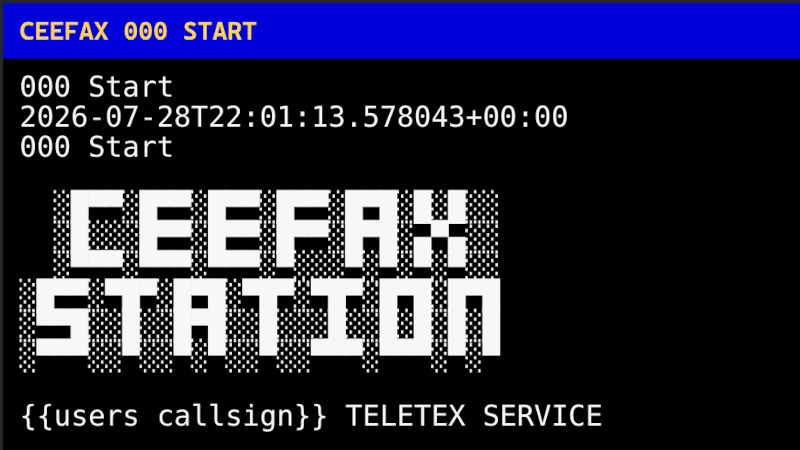
Old-school teletext with its pixelated text and block graphics may now be largely a thing of the past, but that doesn’t mean it’s without enthusiasts or there’s no more life in the idea. [M7TJF] has a project which takes teletext and puts it on amateur radio through the magic of AX.25. It’s called CEEFAX Station, in honor of the BBC’s teletext offering from back in the day.
What you get is a Linux package or a Windows executable, which you run and presumably hook the computer up to a radio. It can either be a transmitting node or a receiving one for browsing pages, and there’s an online map to track who’s doing either and on what frequencies. This is all brand new so there’s not much on there at the moment, but we expect that as people try this mode, this will change.
Sadly it’s a little unclear on how the protocol works and how the pages are encoded, but it’s early days. Meanwhile if you hanker for the real thing, it’s still about in some places.












Wireless Internet 2.0: let freedom ring. Could use this since it’s not demanding.
Shoved the git repository into chatGPT and got a nice breakdown of what’s actually going on. Short answer is, they’re just shoving the raw data through an AX.25 AFSK channel and calling it a day. Still interesting.
Be aware, broadcasting is strictly forbidden in Ham radio. This is valid for experimentation purposes, but running it continuously would potentially run afoul of the law.
Amusing, since the whole thing was authored by cursor. Cutting humans out entirely (except for the liability of running it)
“You’re absolutely right!”
Wow. Calling for the assassination of the President of the United States… Just how did that slip past the HaD moderators?
I would imagine this could run over local municipalities’ frequencies SSB, and not nationwide.
next sterp , bbs over satelite
Turn a Starlink terminal into a BBS.
why not. starlink can send free signals for emergency data ane weather.
That already was a reality with Packet Radio in the 1980s.
Back then, you had a radio/antenna, a TNC and a terminal and each TNC used to offer a private mailbox.
The TNC was like a home computer built for communications.
There also was “store and forward”, so that e-mails could be sent throughout the amateur radio network.
https://en.wikipedia.org/wiki/Amateur_radio_satellite
https://en.wikipedia.org/wiki/Terminal_node_controller
What’s sadly not has become a thing was ANSI art (using escape sequences).
The BBS/mailbox experience on Packet Radio remained stuck in the 1970s..
That being said, there were exceptions.
Packet Radio programs such as Graphic Packet made Packet Radio much more colorful.:
You could play online games, pictures could be sent/received and be displayed “live” and so on.
Compressed/encoded file transfer via 7plus also was a thing, I remember.
The Baycom software also had a graphical chess program, I remember.
So it wasn’t just a pure text mode experience.
Today reticulum use similar system. have ‘web page’ without html (similar trof or markdown)
but still this is not good for emergency situation. Satelite is better options.
P.S. Reticulum can send message trought paper or usb flash drive too
Will forever think of Andy Jenkinson.
Legal if it were running on a mesh system ?
AX.25 is not “brand new”. There were packet BBS’s all the way back in the 80’s.
Speaking of AX.25, there’s an extension called FX.25 that provides FEC.
Unlike the other alternatives, it is an extension and it keeps backwards compatibility.
It works entirely on the TNC side, Packet Radio applications such as UI-View or FBB don’t need any modification.
It’s ideal to bring aging AX.25 infrastucture (digipeaters) into 21st century.
It would also massively improve APRS reception, for example, because the UI frames are working unconnected.
https://en.wikipedia.org/wiki/FX.25_Forward_Error_Correction
I knew some old-timers who would check the results of the horse races or football games or whatever it is they had bet on through a website that showed screengrabs of the local teletext channels because the workplace didn’t have televisions but did have computers. I always thought it was a very curious way to adapt.
That’s cool (and a bit weird)! 😃
Personally, I used to use my PC to read Videotext/Teletext pages about two decades ago!
Back then I had an Hauppauge “WinTV” TV tuner board.
It was a full-size ISA board with Windows 3.1 software.
I was able to attach the house antenna on the roof via an Belling-Lee connector.
The Windows 3.1x software had a dedicated Teletext software decoder.
It was almost like browsing old school BTX pages from the 1980s (BTX and German Teletext did relate visually like Prestel/Ceefax did).