

A typical response to the previous article on why PLA filament is so darn brittle. This has led some people to not use PLA filament at all, while others promote using PLA only for prototyping and throw-away parts, especially in light of PLA being compostable under the right conditions. For many mechanical parts, people turn to PETG.
Much like the PET polymer used for everything from food containers to drink bottles, PETG is durable, more resistant to degradation through mechanisms like hydrolysis and its filament form doesn’t need to be coddled like PLA does. PETG, on the other hand, tends to come from crude oil and shrugs at industrial composting conditions.
In terms of durability, degradation mechanisms and recyclability, is PETG the basic FDM filament which we should all just be using?
Polyethylene Terephthalate
PET (backbone: C10H8O4) is a polyester, just like PLA (backbone: C3H4O2). Due to how common PET is in both packaging and textile applications it’s usually just called “polyester” when used for textiles, where it is often blended with cotton and other fibers. When used in packaging PET has the sometimes rather unfortunate property of being permeable to oxygen and carbon dioxide, so that it may have to be combined with an additional oxygen-blocking layer.
This aspect of using PET for packaging is detailed for example in a 2017 review paper by Youri Michiels et al. in Applied Sciences. The main drive for using polymers like PET in packaging is due to these being more economical than traditional materials like glass and aluminium, both of which are highly impermeable to oxygen and carbon dioxide.
Consequently, a number of active and passive barriers were developed, something that is also essential in organic electronics like OLED displays when the traditional glass layers are replaced with polymers for making something like flexible displays. Active barriers can be oxygen scavengers, while passive barriers would be the application of additional materials to the basic PET film or bottle, usually in the form of a coating. This also helps to prevent the infusion of PET with colorants and aromas from food or drink, which is a common issue with recycling PET bottles.
Naturally, this can pose issues when trying to use PET materials for 3D printing, as you cannot be certain what percentage of PET waste is actually PET and what other polymers make up the remainder. This was studied by Mikołaj Garwacki et al. in a 2024 paper in Materials, with a PET-PETG blend containing PET film waste. They found it necessary to add an elastomer additive (IM) to prevent brittleness.
Triple Copolymer
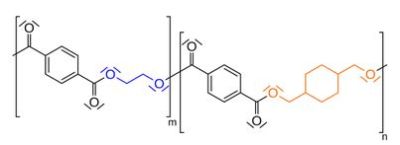
The name polyethylene terephthalate (PET) already suggests that it’s more than just a polymer of purified terephthalic acid (PTA) monomers. Thus, in addition to said PTA we also see ethylene glycol (EG) monomers. This creates the basic PET copolymer as we know and love it. When we talk about PETG (polyethylene terephthalate glycol-modified), we thus do not mean the addition of glycol, but rather the replacement of said EG monomers with another monomer.
Thus PETG has a third monomer added, usually in the form of cyclohexanedimethanol (CHDM), which replaces some of the EG monomers in the resulting copolymer. In addition to PETG the ratio of CHDM monomers can create additional copolymer types:
- PET -> PTA + EG.
- PETG -> PTA + EG + <50% CHDM.
- PCT -> PTA + CHDM.
- PCTG -> PTA + EG + >50% CHDM.
Typically PETG is chosen for its high transparency and toughness properties, which is a property that’s rather useful in packaging like bottles. Although PETG FDM filament is basically PETG, something like a plastic ‘PET’ bottle can thus be PETG as well, and likely is due to the aforementioned properties.
Stability
One of the complaints with PLA filament is generally that it’ll become brittle no matter what, owing to the combination of increasing crystallization reducing movement within the polymer matrix, and hydrolysis shortening the polymer backbones. PETG filament has a much better reputation here, with it usually considered to be basically immune to brittleness.
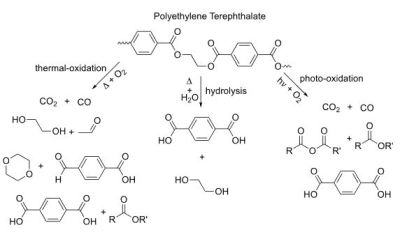
The bad news here is that PETG still attracts moisture from the environment and – it being a polyester – still has a backbone that is susceptible to hydrolysis. Another common degradation mechanism is that of photo-oxidation, along with thermal degradation.
This is detailed in this 2020 review paper by Ali Chamas et al. in ACS Sustainable Chemistry & Engineering on the degradation mechanisms of various plastics within a range of environments.
As noted in the paper, hydrolytic cleavage of PET chains is very slow under neutral pH, but strongly enhanced in acidic environments. Fortunately carbonated drinks stored inside PET(G) bottles aren’t at too much of risk here, as the carbonic acid from dissolving CO2 in water is only a mild acid and thus shouldn’t hasten degradation too much.
In order for thermal degradation to occur, fairly high temperatures are required, above that for PLA, while exposure to UV light can cause photodegradation as is typically observed with many plastics. Overall long-term stability of PET polymers is not a commonly cited concern, with the cynical take of discarded PET single-use bottles potentially outliving human society being not too far from the truth.
Barring PET polymers ending up in a particularly acidic, UV-irradiated and high-temperature environment, it’s remarkably stable, even if not as much as polypropylene or polyethylene. While there are now enzymes that can dispose of PET polymers, such as PETase and MHETase, these probably are no real risk factors to your spools of PETG filament and rather just convenient ways to dispose of misprints and waste in the future.
Sample Size Of One
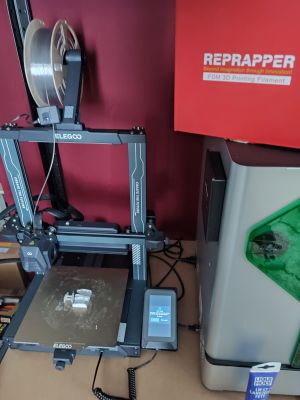
In addition to the above theory and the perusal of the scientific literature on the topic, I figured that I would also try printing with a rather old spool of PETG filament. It dates back to the time when I was still printing on the Creality Ender 3 v2, with receipts showing a purchase date of March 2023. This spool has spent considerable time just lounging about on the FDM printer’s spool holder before being stuffed back into a sealed plastic bag and forgotten about until recently.
Digging this Reprapper-branded spool of clear PETG filament out of storage, I was momentarily dismayed at it having been stored by past me in just a resealable bag with no attempt at a vacuum, just with a probably expired baggy of forbidden silica candy tossed inside the bag. Let’s consider this a worst-case scenario.
Feeling particularly adventurous, I decided to not even dry this much-abused spool of PETG filament and just see what happens when printing on my Neptune 4 bed slinger. After some initial fiddling with loading issues I fixed this by snipping off of the dodgy tip of the filament, presumably due to its mangling by the Ender 3 v2’s extruder gear and hotend.
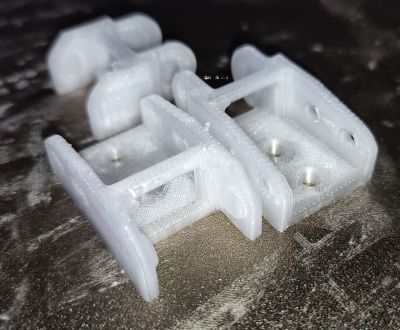 I still had my worries about the extruder teeth marks from the previous printer and the presence of a few bends in the filament that made me suffer PLA-related flashbacks, but after slicing up a cable chain model that I had printed many times in PLA before, the printing was very much uneventful.
As can be seen in the photo, I was greeted by a happy print result. While keeping an eye on it for the first layers I did notice a bit of oozing, but after a few minutes it normalized and the cable chain elements were printed cleanly, including the big overhangs. I was able to clip the elements together as well without any brittleness or other issues.
I probably should have turned on the auxiliary cooling fan on the Neptune 4 as PETG prefers things cool unlike PLA, but even with this YOLO printing attempt with a neglected spool of PETG I was left impressed. After my recent experiences with PLA I was bracing for at least a few hours of troubleshooting, but this was almost boring.
Vibe Check
With this printing experience and the scientific literature put side by side, I think that they concur. Despite me taking no precautions at all, even a more than three-year old neglected spool of PETG filament printed just fine. There were no signs of stringing or other issues that would prevent me from just queueing up another print. Although I’d still advocate at least for keeping PETG spools in at least a sealed bag or container, it’s not nearly as fragile as PLA.
Since my previous article on PLA’s brittleness, I have opened its still factory-sealed twin in the form of black PLA and found that although it’s not nearly as brittle as its white sibling, it too began to snap off if left at anything beyond a gentle curve. Clearly this puts a pretty big expiration data on PLA filament, but it’s still an open question whether it was just this particular batch of Sunlu PLA filament.
In light of all this, I think it is fair to say that PETG is by far the most ‘no fuss’ filament for general use, with PLA only having its theoretical composting advantage. Yet when taking into account that this is only guaranteed for pure PLA without additives, and PET-degrading enzymes exist, that theoretical advantage doesn’t seem so convincing anymore.












Great explainer! I wasn’t so lucky with neglecting my PETG a year or so ago, but I just left the roll on the machine in a basement for 6 months and then was confused and frustrated when my print head got globbed up and had to be replaced twice before I finally did my research about PETG being hygroscopic.
I generally agree that it is a superior filament, and easy to work with, but I would just caution people to take care to keep these dry and buy a dryer if you plan on keeping rolls around for months to years. I’ve put my printers into a more controlled space, but if I don’t use the PETG for a month or two, I always take it off and dry it before use again.
I’m glad you had such a good experience with your PETg — even with PETg that I try my best to keep healthy (not hard because I live in a semi-desert, but I still bag it with silica and evacuate the air), I have to print it super slow (like, Monoprice Select Mini speeds), bed adhesion is terrible, and it snaps quite easily. For me, PETg is not a filament that ‘just works’. Time to find a different supplier maybe? I’m buying Matter3d, a local manufacturer.
I’ve been using Overture PETg for a few years and have had good results. My 2 cents.
Thanks for the tip. What’s your max speed?
300mm/sec with 3,000mm/sec acceleration. Running Klipper on an Ender 3 Pro. Because of the small part sizes I print, I don’t typically see speeds over about 150mm/sec. It’s definitely faster than stock, though.
Overature makes good petg. It’s my goto; on well tuned printers (current gen prusas at work and a voron zero at home) it does indeed just work.
Heated bed is more important than for pla, most profiles recomend at least 80c on the bed. At those temps it sticks great to a modern pei bed.
Also, avoid the matte finish and metallic finish stuff. Much worse print results and mechanical properties. Go with the generic black, grey, or white glossy petg, I’ve had great results with all of them. It’s also the cheapest.
The voron crowd does say white is weaker since it’s loaded with more pigment, but for overtures petg I’ve found it to not be a big deal.
For general purpose mechanical parts, petg is my goto. If I have more stringent requirements, I switch over to fiber filled abs or asa. Tpu is also remarkably useful, the stuff is basically indestructible with full layer strength.
I live in a desert. I haven’t had any moisture issues with PETG left out in the open for months. Except for during this time of year, “it’s a dry heat” applies where I live and work.
I have access to 3 different printers and don’t need to print slower than the default “Generic PETG” profiles. That’s the low end of speed, though I rarely tune a filament to achieve more speed, I can get more speed when I feel like I need it. PETG for me is slower than PLA, but not glacial.
As for bed adhesion, I have two “modern” printers (AD5M, K1C) with textured PEI beds and generally have no issues with adhesion. Two things that may help if you haven’t already addressed them: 1) clean the print bed well with warm, soapy water. 2) Make sure that your z-offset is correct. If your printer supports it, you might try closing up that z gap a tiny bit at a time to see what happens.
Oh, and make sure you’re slicing with PETG profiles, not PLA…ask me how I know. Temperatures matter.
I have far more problems with PETG bed adhesion on my Ender 3 Max Neo with a glass bed. But, in this case there can be waaay too much adhesion. Sometimes the parts can’t even be pried off of the bed after it cools. (Warming the bed, and/or applying some isopropyl alcohol at the base where the part touches the bed generally releases –eventually– with a small amount of prying).
My favorite PETG brand is WhateverIsOnSale and I haven’t had any horrible experiences yet. Running a job with DEEPLEE PRO right behind me (has a bit more smell than some others). Creality regularl ol’ PETG has worked well for me. Pinball brand (because I liked the idea of printing my pinball machine parts from it) is perfectly functional. Sunlu works well. I suspect that your filament brand is not your biggest issue to solve.
What nozzle and bed temperatures do you use?
Nature-inspired prints
https://techxplore.com/news/2026-09-nature-3d-large-scale-renewable.html
On lasers and plastic surfaces
https://phys.org/news/2026-08-power-lasers-durable-nano-patterns.html
For metals
https://techxplore.com/news/2026-08-beneath-surface-metal-additive.html
Lastly, Blocc chemistry for the masses
https://phys.org/news/2026-08-blocc-chemistry-automate-molecular-discovery.html
You forgot to mention that PETG is thought to have a similar if not lower UFP and VOC emissions than PLA even though it prints at a higher temp. Certainly it’s much lower in both than ABS or ASA, yet has many of the same benefits for higher temp and outdoor uses. Also you missed a chance to link one of the many HaD articles on printing transparent objects with PETG.
So did you. Seach is your friend, as is Joe – complaining in the comments that it has been covered before (with a collection of more links, you’re welcome):
https://hackaday.com/2025/11/29/how-to-print-petg-as-transparently-as-possible/#comment-8219295
“PETG, on the other hand, tends to come from crude oil”. Like nearly all plastics, PETG comes from ethane/ethelene (like poly-ethelene), a byproduct of purifying natural gas. The USA is the World’s largest exporter of ethane. No oil involved.
I have been printing with mostly PETG since 2019 and I can say it is a mostly great material to work with.
I store partially used rolls in a Billy Bookcase that maintaines about 30-32% relative humidity at 75-80F. Most colors have no issues even if left for a few years.
From my experience, it’s the additives that cause the most hydrolysis. Anything with a glitter look or silk look do not fair well without drying. For example: Hatchbox Copper or Bronze, Overture Starry Blue or Army Green can’t be left out for more than a week without having to run it through a dehydrator.
I had printed a small item from a Hatchbox Bronze that had been left out for a couple months and it was so bad it looked like the slicer had applied fuzzy skin settings and stringing galore. 8 hours in the dehydrator, reprinted the same gcode and it was smooth, stringless beauty!
Never had those issues with basic colors like black, white, blue or red.
The additives will definitely change how the material behaves, yeah.
I prefer to stick to neutral, clear PETG exactly because of that, but it could be a fun topic to research which color additives are the most hygroscopic and such :)
Everytime I try petg it fails miserably. Prusa mk4s.
I had an entire spool of Inland PETG fail miserably on my MK4 with a textured plate (even with a bed adhesive and cutting print speed by 90%).
The same filament prints just fine on a smooth plate (which Prusa warns not use with PETG) with a default profile.
(Caveat: I have to drop my extrusion multiplier if I’m not using gyroid infill, because otherwise the nozzle drags after enough layers.)
Prusament PETG works fine for me on the Prusa textured plate.
My guess is that there are some filament manufacturers tuning their blend to reduce adhesion so they don’t get complaints about wrecked bed surfaces, but those filaments cause the warp -> spaghetti problem on textured plates.
I’m really glad I got that figured out (eventually) because PETG handles stress forces much better in my functional parts.
On my MK4S, I use the textured plate for PETG, PLA, PLA+, and TPU. PETG on the smooth plate slowly pitted the coating. PETG & PLA brands include Creality, Polymaker, Elegoo, and Computer Microcenter’s house brand (I needed it that day). TPU from Overture.
That’s unfortunate. I’m doing fine on a MK3S (with a Revo hotend, but it worked fine with the original as well). I did need to tune the height of the first layer, it was a bit more sensitive to that than PLA. Also, I found that it works best (on the smooth sheets) to have it fully clean, no glue stick or anything. After that, it printed fine. It’s more prone to stringing than PLA though.
My MK4S prints PETG and PLA/PLA+ just fine; also TPU. I use PETG for outdoor and heat-sensitive uses, otherwise I’ll use PLA.
I have several friends that also 3D print. Each has had issues trying to print PETG so I was apprehensive when trying it for the first time. The PETG (eSun black) prints from my old school E3 came out quite nice with only slight modifications required to the basic Orca PETG filament profile. I’ll be using this stuff more often.
I’ve just recently started printing PETG and the only real problem I had until last night was brim bed adhesion, as in it just did NOT want to come off. If I happen not to be home when a job finishes, then heating the bed back up to 80-85C seems to help a lot.
I did have a learning experience last night: printed a fairly large, flat part that did not want to release (right after the job finished, so the bed was still hot). I wound up flexing the PEI plate a bunch and actually tore about a 1/4″ roughly square section of the bottom of the print off by accident.
I’ve had awful experiences with PETG because it sticks far too well to my PEI print bed. It’s taken a craft knife to get it unstuck before. I think I need a sacrificial layer of pritt stick or a different bed.
I use PET tape over glass on my machine. PETG was taking chunks from my glass.
Another thing is that I typically need to print much slower than PLA to get extrusion quality I am happy with (65mm/s print speed vs 100mm/s with PLA).
I only use Atomic filament so results may vary.
I use hairspray over textured PEI for PETG at 70°C. An application will last for several prints, and can be refreshed with Isopropyl alcohol in a spray bottle. It helps both with adhesiion during the print and with self-release when the print surface cools down.
Over on a FB group I have seen people recommend that if you get scraps of PETG stuck (typically in my case it’s brim) to the bed, printing something like a small rectangle over it (I knocked up something 20x20x3mm in OnShape pretty quick) tends to get the leftovers to pull free with the new part. A little wasteful, admittedly, but it works.
I agree, once I discovered petg i pretty much stopped using pla for anything.
I’ve been printing since 2015 and have not found a use case for PETG that ABS isn’t a better fit for. I would only use PETG if I didn’t have a print enclosure.
PETG vs ABS
– PETG is 20% denser, meaning you get 20% more print volume per roll of ABS vs PETG
– ABS is way cheaper
– ABS can be printed very fast without stringing seen in PETG
– ABS is much easier to postprocess, e.g. easier to sand, you can join prints with no adhesive using solvents, vapour smoothing, etc.
– ABS is stronger in the important metrics (impact) while still being lighter and more temperature resistant
– ABS prints well while holding moisture, PETG won’t print at all.
– PETG 1st layer adhesion is temperamental. However ABS likes to warp…
i don’t understand ABS love. between the bad smell and the warping, i consider it completely unusable. i would rather use even PLA. shrug different strokes i guess
According to a chemist at Ultimaker I worked with PET-G is superior over ABS in every single way.
Except for that pesky heat resistance thing. Also post-processing. Oh and it’s hard to glue together with traditional glues.
Solvent weld with ethyl acetate… you can get it at Home Depot. Look for “MEK Substitute”.
Warping is primarily a problem if your printer doesn’t have a heated enclosure. I have found that 50C chamber temperature is the minimum to avoid warping, but higher is better.
The real problem is that you can’t run a print cooling fan on ABS prints because they will delaminate, even with a heated chamber. So you have to print multiple copies or sacrificial parts to slow the thing enough that the print layers can cool sufficiently during the print, otherwise you get mushrooming and other quality problems.
Even with 60C enclosure, I always get warps.
But 10 year old prints still work great, just yellowed a bit.
Where are you buying your filament? ABS, PLA, PETG all cost about $15-20 per 1 kg spool depending on where you buy. That’s for one at a time orders. There’s no significant difference in price between any of them. If you’re running a printer farm you probably buy in bulk at lower prices. If you get stuff with CF or glass particles you’ll pay a little more.
If your PETG is very stringy, try drying it.
You can solvent weld PETG prints with ethyl acetate, sold at Home Depot as “MEK substitute”. It’s thinner than water and will find its way into the tiniest spaces.
I like ABS as much as you do, but for most applications, PETG works as well without the smell and without requiring a printer that has a heated enclosure.
I print PETG and ABS on smooth and textured PEI bed surfaces, with no problem with the prints letting go, ever. Maybe your temperature is off, or the bed surface isn’t clean. I have found that if I print TPU then try to print ABS next the adhesion isn’t great, so I always clean the bed before printing with a different material than the previous print.
ABS left outside is dead after a year (at my place). UV just kill it, it becomes dusty and doesn’t have its mechanical properties intact. I have PETG part that are 10 years old on my car and they are like new (but dirty). ABS is just not worth it. At least use ASA but then, there’s no advantage whatsoever to PETG anyway.
I used PLA and ABS for my first several years of printing.
PLA was easy but turns to mush at too low a temperature. PLA prints don’t survive hot cars and I have even had them go soft outdoors in the hot sun! Also I have had several PLA spools go brittle on me long before they were used up.
I have ABS prints that have survived outside through several hot summers now. But it can be tough to get a print that doesn’t warp it’s way right off the bed!
As soon as I finally obtained a hotend that didn’t contain a nylon sleeve inside so I could crank up the temperature I tried PETG.
Soooo much better! PETG is almost as easy to print as PLA. Yet I have had prints survive multiple summers in my car.
The only downside… it doesn’t hold paint very well, isn’t solvent-weldable like ABS and isn’t very easy to sand. But if you can print the surface and color you want without paint and sanding then it’s great!
Oh.. and about PLA being “compostable”. While technically true that is practically false. PLA is only compostable at high temperatures that do not exist in a home composting pile nor in the bottom of a modern landfill. While technically one could compost it in some sort of industrial high temperature composter I have never heard of such a thing actually being done on any scale. Your PLA poop, failed prints and broken stuff are just as permanent as someone else’s PETG or ABS.
PLA would break down in a few months if hot enough (but that’s over 140F / 60C, so not practical in general terms). It should still start to crumble in years not decades from hydrolysis at lower temps (even decades would be a lot faster than a chunk of ABS…)
You can solvent weld using ethyl acetate for high surface area joins.
Dichloromethane will solvent weld PLA or PETG but is more difficult to buy. Just a single drop will turn contacted plastic to goop, allowing an unbelievably strong bond with very little preparation. There is a commercial product available for 3D prints which contains dichloramethane but I forgot the name. I think Emily the engineer on YouTube used it to make a life-size floating benchy
tbh petg has definitely been my fave to print. pla is fine. I guess. but petg generally has that shiny factor that wins me over every time😂
One element the article missed is flow rate. PLA can operate at a significantly higher volumetric flow rate, probably because it melts much faster. Modern printers move so rapidly that PETG melt speed can easily become the limiting factor, slowing down your prints. Prusa Slicer limits PETG to roughly half the maximum speed as PLA by default.
This isn’t as disastrous as it sounds, since your printer only occasionally hits this max rate. But it can add ~25% to print time for large objects.
That being said, I have been using PETG almost exclusively for many years. I resort to PLA only if I want a funny color and don’t care about part strength. (PLA has some interesting color options like metallic, silk, or multi-color filaments.)
TPU filament also forces you to slow down a lot, so PLA is more of an exception there it seems. It does indeed lend credence to the concept of using PLA for rough prototyping before you commit to that ‘final’ print.
So rough draft print a version in PLA to check for sizing and fit and details that you didn’t catch in CAD, before doing that ‘fine quality’ print in PETG, etc. When I see how many iterations of a design some people go through, that could add up to a few hours of printing time saved.
been using PETG for 18 months now. i’m happy with it. when i googled it before switching, i found most people who have troubles with it are using older printers…something about the hot end design advanced around 2024 and now i think no one has any problems with PETG except sticking to the build plate? i can report that increasing bed temp to 75C and washing it with soap got reasonable bed adhesion for me on a textured PEI plate.
I have had no issues printing PETG on this 2023-era Neptune 4 at least, even with the textured PEI plate still covered in glue stick goop and such from earlier printing attempts. Printer presets and probably environmental factors are likely to contribute here.
I use Elegoo Rapid PETG for almost everything I print. It prints nearly as fast as PLA. I use a textured PEI build plate heated to 60°C and don’t have any adhesion issues. It does produce more stringing than PLA, but that can be cleaned up quickly with a heat gun.
Everyone I know who 3D prints a lot (myself included) uses PETG as the default, except for art prints. PLA makes it extremely easy to get strong, great looking prints… But a few months later they always crack to pieces, or warp due to “heat” (more like warmth). A lot of youtubers have run toughness and tensile strength tests that show PETG is not that great, but that doesn’t at all match my personal experience with it. I have designed hundreds of mechanical parts with PETG and they NEVER randomly fail. I guess it might be more accurate to say not that PETG is strong, but that it’s predictable. You can feel how strong a part is after printing, and when you come back to it after months of use it’s basically the same. Side notes, I almost exclusively print in black, for the inherrent UV resistance. I also just use cheap overture PETG from amazon. I was using the expensive Prusa stuff, but I found that overture has exactly the same performance.
Question is how you define strong.
PETG tends to bend a bit under load, avoiding stress concentrations that start a failure. Good for most real life usage. But that doesn’t show up on most lab tests.
At the same time it’s a matter of your frame of reference – proper engineering materials are in another league. If you can process them the way they need.
I use PETG for almost everything now, unless I want a test print and use PLA. I find I don’t get the resolution with PLA that I get with PETG. I can get much finer detail without the blobs or zits that I get with PLA. That was partly due to my printer setup, but I was just never able to dial it in.
And it took forever for me to learn this, but use a textured plate when printing with PETG. It will save your sanity, and a lot of money replacing smooth build plates.
I print with both in about even quantities, on a (heavily modified) MK3S+ using Prusament branded filament exclusively (except for some TPU, LW-PLA. and PA6-CF). I just really like the way they spool them. I’ve had some issues with tangling of other brands I’d rather not have repeated. (Plus they’re nice colors, print well, and you get well tuned profiles included with their slicer.)
I find PLA to print nicer (better print quality) and easier (less failures). PETg is always a bit stringy (angel hair) for me.
Some of my filament is as old as my current printer (my previous two printers, DIY ones, used 3mm filament). I do store it vacuum sealed with dessicant. But after a year or so the dessicant gets saturated anyway. I only replace it when I take a roll out to print with.
When my PETg gets really stringy (actual stringy as opposed to the regular angel hair), or the PLA gets brittle, I just put it in the food dehydrator for a few hours, and it’ll be good as new again.
I live in a dry, hot climate and PETG is my go to. In this area, it is great. Let’s me down far less than PLA