
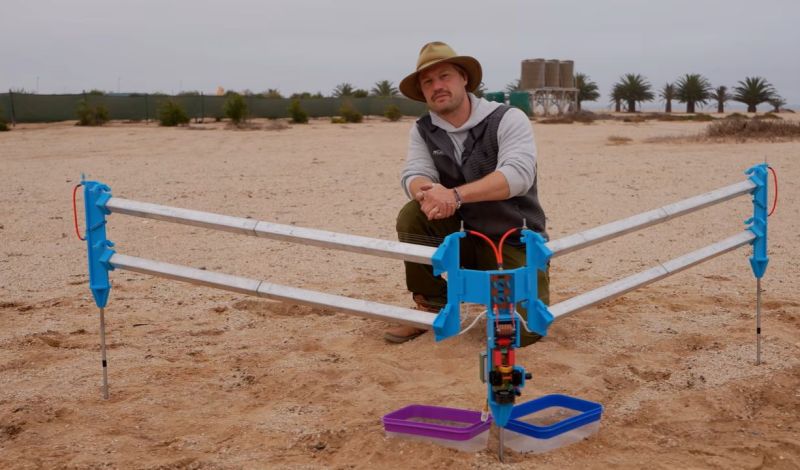
As fun as mucking about with simulated environments in a laboratory is, at some point you have to do those field tests to demonstrate that your prototype actually works in the real world, under real conditions. This is what the [Plasma Channel] recently did for their fog harvesting system by setting it up in the Namib desert.
We previously covered the atmospheric water harvesting attempts, using electrostatic precipitation to draw the moisture in the air onto the collectors where it can then be harvested. This is rather different from existing approaches with e.g. fine meshes and hoping that enough water molecules bump into your mesh, so theoretically it should be much more efficient. In the lab it worked well, but reality always has the last word.
The Namib desert is at the top of the world’s most arid regions, competing with the Atacama desert. What it does have going for it is regular fog rolling in that lasts until sunrise, providing a good target for water harvesting. Interestingly, this field test was performed together with the University of Namibia.
Of course, moving the prototype in check-in luggage for the flight to Namibia took some redesigning and testing. Fortunately everything, including the solar panel, arrived intact, allowing trials to commence. This initially took place at the campus of the University of Namibia, joining a number of other atmospheric water harvesting projects that had been previously installed there.
Unfortunately the fog proved to be rather elusive, leading to a few fruitless attempts. It also proved that the salt in the air from the ocean spray, even a few kilometers inland, was highly corrosive, especially to high-voltage electronics. Although the system basically worked, happily harvesting water under the right conditions, it does need some redesign before it’ll be tested next in the Atacama desert.












How does it measure up to the baseline (plastic garbage back wrapped around a tree or bush)?
Not many trees in the desert to wrap the plastic, so even if inefficient, this would work better.
But I´m curious is there is some study about where the fog goes after it passes over the desert, and what ecosystems depend on it. Drying it up may not be an improvement.
That’s why they don’t use trees, they put long sticks in the ground instead.
The main issue is that even if you did get “free” electricity out of solar panels, this system is so inefficient in converting it to water that the investment costs are prohibitive to the people who need the water. When the capital costs are divided by the small amount of water it can produce, it would be cheaper to import bottled water than use this.
A plastic bag strung up between two sticks in the sand is far superior on every count. It also actually works in field conditions instead of breaking down due to the very moisture it was supposed to collect.
In a sense, this whole project is one of those “Let’s build a big 3D printer to make houses for poor people in Africa” type of deals, where some western tech startup milks money out of stupid people, or in this case harvests clicks on Youtube and begs for donations, with a project that seems well intentioned but has no hope of succeeding because of known technical and economical limitations.
It’s only the polite assumption that the person might not fully understand what they’re dealing with, that keeps me from calling it a scam.
noname I think is talking about capturing the plants transpiration – a vastly more efficient way to gather water, assuming you actually have the plants to do it on. The sheet strung between sticks to catch some fog is passive, but really really low yield, even when done on a boat actively moving through the fog…
This is forcing so much more fog over a condensing surface just from the ionic winds that it should be able to actually capture a significantly higher proportion of the water in the fog. So as making outdoor salt spray durable electronics isn’t an impossible problem to solve once you know you need to, and then you have a device with a very very long lifespan taking vastly more water out of the fog every time it is there. More sails doesn’t do you any good when you run out of land area in the fog and have nowhere to put them, or are now putting them so far from the desired consumer you must put in lots of pipes and pumps to move the water before it is lost again.
But then it doesn’t measure or compare at all, because that’s an entirely different thing. Apples to oranges.
Fog collecting nets are not condensing surfaces either, they are mechanically capturing the droplets from the wind that blows against or through the net. Again, apples to oranges.
Fog collecting nets typically capture 2-10% of the moisture present in the air, while electrostatic systems can capture around 50%, but the cost of building and operating them is so much greater than simply stringing up more netting. The general consensus of the field is that they work, but the energy efficiency is so terrible that there’s no point.
that is great, when you have space for more netting that will actually be in the fog, or needs so small that vastly smaller fraction captured is sufficient – but when you really want to capture practical volumes to roll the desert back or supply the large number of humans (which tends to be the stated goal(s)) concentrating so many times more water matters. A system like this doesn’t have to be that bad really, as build it right it should last a very long time with simple maintenance, and while its going to have an impact on the ecology it isn’t likely to be nearly as hostile to natural world as the alternative means of getting fresh water.
Also energy efficiency wise what are you comparing it to? As active desalination via any method is bonkers energy consumption too, with scale and environmental problems of its own. The reality is that nature generating and largely distributing the freshwater with just a few pumps here and there to divert that rain/snow melt to where we want is always going to make any artificial systems seem awful efficiency wise. But nature doesn’t oblige everywhere, even this historically renowed for damp island of the UK has this year been basically liquid water free for an improbably long time!
We need the negetivity of doubting Dudes to consider pitfalls or possible issues down the track.
BUT too often such negetivoty without attempting to assist with possible solutions or suggestions can dampen a project that with further consideration can or might be solved with Brainstorming and or further input or assistance.
Brave are those who give it a go….. and they deserve every assistance.
You don’t need 10 reasons why something won’t work if you cannot get past the 1st reason your project fails BUT being fully aware of ALL possible pitfalls can and will be an advantage in the final outcome….. Don’t give up.. Success doesn’t always come easy but can be extremely rewarding AND sometimes leads to other directions and achievements.
Paul Georgeson
Info@savesupport.au
Badly. It uses enormous amounts of energy per gram of water.
This guy is the epitome of overstatement. “Wildly successful” and “promising” my ass – he even calculated the energy per gram and if I remember correctly it was kilowatt-hours per liter. Yet he thought it was promising for irrigation, which needs tons of water per day.
Previous video with artificial dense fog: 21 ml/Wh which translates to 48 Wh per liter. Of course in this video they managed to collect absolutely nothing under real world conditions. Just some condensation on the rods.
So, you might spend a laptop battery’s worth of electricity to get 1 liters of water, or about 21 liters per kWh.
Here’s the thing: for the cost of a laptop battery, you could buy a whole lot of plastic screen mesh and simply build a bigger fog collector with no running costs in electricity.
Solar energy is running at around 15-20c/kwh over lifespan, and reducing rapidly. 1c/litre for water makes sense in lots of applications. So let’s not right this off just yet!
What was result? We are working on system at IIT Chennai India. We want system giving about 2000 litres per day, solar based power.
Nothing. It broke down because moisture caused arcing in the transformer.
This system is nothing short of a terrible idea, if only for the fact that you would be using a lethal high voltage electric fence to collect water.
You’re seeing it wrong. It does bad for water collection, but it’s exceptional for wild animal capture. See, you use your $$$ solar panel to generate e- to high voltage fence and a very small amount of water. Use this water to attract animals (desert animal can smell water hundred of meters away) and when they are close to the collection pot, they’ll touch the electrical fence, electrocute themself. Come back, take the dead bodies, sell them to local population => profit.
It might also be useful for local justice departments – string them up anywhere with a problem of solar panel theft. Bait and trap.
I think with the right power converter, this moisture farm can get quite efficient.
That is, if you can speak Bocce.
Nothing like wasting time with your friends when your chores are done. Any body wanna go slaughter some whomp rats later?
Schrödinger’s fog
adding AI fog is how you know author is serious about science
Permaculture sounds like a much better idea than this. I will admit, I have no deep knowledge or experience on the subject besides some youtube videos but it kinda makes sense.
Its a technological solution, just without electricity or man-made infrastructure, just landscaping. There will be rain, why not capture it in a series of dug ponds and gutters and just altering the rain runaway path?
i agree about permaculture but in this instance, there will not be rain.
Write a holiday trip off as business expense, generate clickbait.
What more did you expect?
Get donations, travel around the world cosplaying science
Just as with the recent targeted cloud seeding by drone in Alaska, the concern and research should be on where does this moisture usually go. Does the fog normally keep an area of scant vegetation alive, the only food source for nomadic animals? Is it hard packed desert where the moisture running off to start a stream that keeps villages alive? Or soaking into the ground to add to the water table? The idea of slowing desertification is fantastic in theory but not at the expense of life further down the system. The fog nets that are saving women 6+ hours a day of labor are wonderful and if they capture 10% of the fog that should be the place to start a study to see if there’s impact past the immediate area. If the electrostatic harvester takes 50% that could be a huge impact. Luckily it doesn’t seem feasible yet!