
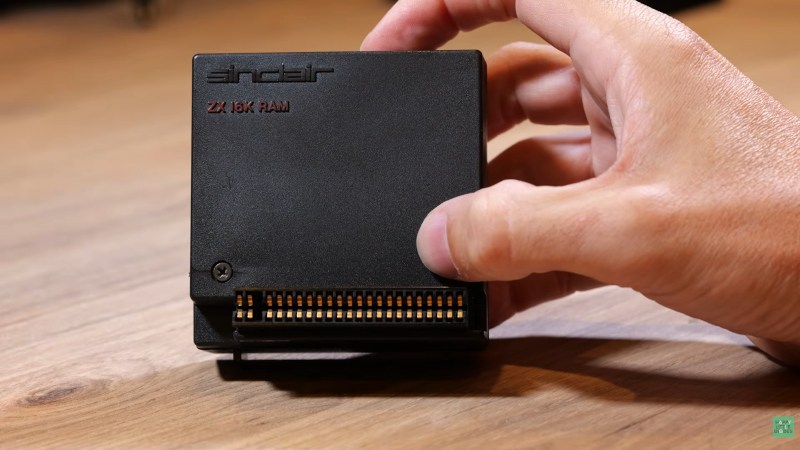
Sir Clive Sinclair and his company were notorious for pushing the limits of electronic parts in search of a low price, and his ZX series 8-bit computers were fine examples of this art. The ZX81 came with a meagre 1K of memory, and a popular upgrade was a 16K RAM pack. [Happy Little Diodes] has opened one up, and to his surprise, found many more parts than expected.
Inside the box is a pair of PCBs connected by ribbon cables, one of which has a selection of 74 chips and the other the 4116 RAM chips and a discrete component power circuit. This complexity comes from that cheapness, the 4116 is an inexpensive DRAM chip and requires an eclectic set of power supplies.
The functions of address selection are straightforward enough, as is the DRAM refresh circuitry. The power supply is clever in that it’s a self-oscillating switcher that provides +12 and -5 volts with a single transistor. We particularly like the quench diode in the 12 V Zener diode regulator circuit.
The ZX81 gave a huge number of British kids their first taste of computing, and learning to use a limited memory space is something that stays with you for life. The film doesn’t mention the most notorious feature of the 16K pack though, that it had been developed with a machine clamped to the desk. Using one in a real-life location was an exercise in not jogging your machine, because the slightest disturbance would trigger a reset.
The ’81 was also famous for its membrane keyboard. Another popular upgrade back then was a new one.












I had one of those! A ZX81 with the 16K RAM cartridge, that is. It only worked (sort of) when held in place with a some fat rubber bands.
Same here! I remember my mum buying one for me. A price of £80 sticks in my head for some reason, but after 45 years, that could very well be wrong – it was a lot of money back then & I don’t think we had that sort of disposable income.
Blu-tak was my preferred way to hold it in place.
Remember FAST and SLOW modes, the former interrupting the screen refresh for every keypress?
The original ZX80 was, if I remember correctly, about a hundred quid complete, but the ZX81 was about eighty or ninety. The kit, I believe, was £69,99 (nice!)
I had a 16k RAM pack, but it wasn’t Sinclair, can’t remember the make, but it was known for quite a few ZX add-ons. It was the same width as the ZX and slightly taller, but shaped to blend in with the overall shape of the computer.
MEMOTECH
Yep. Properly shaped and Velcro to attach…
Yes! any bump caused the cartridge to scuttle RAM contents.
Since the keyboard presses alone caused the main CPU to move around, it was going to happen.
The edge-card connector seemed OK but nothing to hold the expansion module up.
I made good money adding heatsinks and (input series) diodes for the 5V supply to stop overheating on ZX-81’s. The 16K RAM extra load was too much.
We used to build little wooden frames for our ZX81s, this helped keep it more steady when type and deduced the risk of RAM wobble taking all your code way!
I could never get my ZX81 to save reliably to tape, which meant I got very practiced at writing out longhand, and subsequently re-typing, my programs. The only reason I was ever grateful that the RAM was a mere 1KB!
We ended up getting a “data” tape recorder and “data grade” tapes for saving saving stuff. It generally worked most of the time. But consumer audio tape recorders weren’t so reliable.
I removed some windings from my transformers to solve my overheating and crashing. Then later I bought the memory pack and had to deal with crashes again when I didn’t handle it like nitroglycerin.
I also suffered the wiggle ram problem. However, in 1983(?) I was invited to lunch with Clive at his London mews flat for an interviewing for a senior management position in his Meta Lab. Testing his sense of humor, I made a comment during lunch that he had developed the first “flying” personal computer. Clive looked up from his lunch inquisitively. With a smile, I said that every time the RAM pack caused the ZX-81 to crash and erased my work I would fling the ZX-81 across the room! He didn’t smile and I never worked for old Clive.
If you watch “Micromen”, you will see why :-D
Hey, that documentary is really neat! Thanks for the tip! 😃
I was lucky as our zx80 arrived second-hand with a ribbon cable to attach the expansion ram to the port. No wobble-worries!
guh!! around 1992 i got ahold of a spectrum for $2 at a yard sale and i only used it a couple times before throwing it out because not only did you have to type in your program from scratch every time, but there was a situation just like that one…it had a flakey connector somewhere and if you looked at the machine wrong, it would reboot itself. don’t know if that was a unique fault of the spectrums but it sure was frustrating!
But the speccy could save to cassette tape?
I also had a ZX81 (it was a kit) and then purchased the 16K RAM pack (more memory than you’ll ever need🤣)
Lots of black insulation tape to prevent the wobble-to-reset “feature”!
It wasn’t just the British kids that got their first taste of personal computing with a ZX81. There were advertisements in Byte magazine by US vendors selling the ZX81 to the North American market. I bought a ZX81 in Canada by mail order, “back in the day”.
In later versions of the Sinclair ZX81 memory expansion there was only one pcb inside. They put all the 74ls logic in one custom chip.
Did they? I haven’t seen that version.
Yes they did. It is an issue 3 pcb with only 8 x 4116 ram, 1x 74ls157 and 1 Ferranti DIP20
ULA with datecode 1982 week 38.
I have a hugh collection of sinclair with more then 30 16K memory expansions so can compare them.
Here is a picture on a website (not mine) of that type of ram pack https://levosretrocomputerprojects.co.uk/zx81-ram-pack-issue-3-4164-update
Very good! And gosh, I might have one. I have a DK’tronics keyboard/case for a ZX81. It has a RAM Pack connected and screwed in. I only remember it having one PCB. I’ll check in a few days.
Without the word “series” after 74, I thought at first there were a LOT of chips packed in there ;)
VLSI’s antonym… Very Large Scale Disintegration 😂
Let’s be honest, if Sir Clive thought he could save a penny per unit by using discrete transistor logic with an auction job-lot of army surplus transistors, he’d have done it.
Same. First I was expecting to be impressed that so many components could even fit in such a small enclosure, and secondly wondered how a master of efficiency could stomach to produce such a complex piece of kit.
I still have and cherish my ZX81 and 16k RAM module. All in original packaging. For a kid from a 2 bed council house in the North East coal fields it, set me up for life. My entire career has involved designing electronics and software and now managing an electronics design and manufacturing company.
Similar story here. So expensive at the time, but paid off massively in the long run!
Hm? I thought the ZX81 was one of the cheapest home computers of its time..
Since it used a foil keyboard, the ULA circuit and defective RAM chips to reduce price.
Anyway, I agree the 16 KB expansion did cost a bit of money.
The third-party keyboards and chassis, too.
You are correct. But if you are a kid in a coal field in the North East of England, or (like me) in a tiny fishing village in the north west of Scotland (after foreign factory fishing kills all the stock – thanks Thatcher!), then money is tight, your family likely lives from paycheck to fish sale, with multiple jobs to try to ensure food security. For a family like that to forking out the ~50ukp (a month or 2 of food security?) for a 1kb ZX81 was not easy.
I got lucky, my dad was persuaded/tricked into buying a ZX81 by a salesman, while I was supposed to be returning a vacuum cleaner or buying a calculator or something. He was told it could do his (fisherman small business) taxes for him. Then when it didn’t do the taxes, they then convinced him to get the 16kb ram pack for it. Shortly after he give up on it I was allowed to touch it. *** Life changing! ***
” (after foreign factory fishing kills all the stock – thanks Thatcher!)”
I’m loath to bring politics into a completely unrelated thread, but I fear your ire here might be misplaced. Blame should attach instead to the europhiles who took Britain into the EC/EEC/EU and gaily handed over “our” fishing rights in return for… hmm.
Thatcher negotiated with EEC, using fishing rights as expendable bargaining chips in order to protect other economic interests, like the London financial sector. She also “privatized” fishing quotas, leading to consolidation (bad for self-employed fisherman – good for big business and foreign operators).
She did stick a band-aid on it in form of the Merchant Shipping Act – but this didn’t help small boats at all, and ultimately got struck down with 100million ukp being paid to foreign operators as compensation.
I am sure if Mark had of been a small boat fisherman, she would have done something other than bargain away fishing rights.
Now, ask David Thomson’s parents how Thatcher help them buy a ZX81.
Ah, I see. That makes sense to me, thanks for sharing your story!
I must confess that the ZX81 was a bit before my time.
My father had one in the 80s when it was current, but maybe a few years past its original release.
He used it for ham radio, electronics projects (relay cards, measuring things etc) and liked the BASIC interpreter.
As for myself, I got one myself years later at a flea market..
I recognized it because of video game history (-I played ports of 3D Monster Maze and was curious of the ZX81 original-) and because of then-young emulation scene.
There was an early ZX81 emulator for the Atari ST, for example.
But that’s another story, of course.
Personally, I can only imagine how it must have been in your time and place.
But I think as well you were lucky to being part of pioneering days of home computing.
There was something magical about it (-I was late to the party, but my first computer was a Z80 computer that still had a datasette drive, too-).
And you got the proper configuration for your micro, too, which was great.
Because too often, a lack of RAM expansion was a show stopper to any computer owner.
A computer without it is perhaps like having an AM shortwave radio without a BFO knob, something feels missing..
Ah, yeah! 3D Monster Maze! The mists of time will pass over you….
Just amazing from text games. and the odd 2D game, to a real 3D graphics game, even if the controls experience was a bit frustrating. I wouldn’t be that blown away again until years later when I played Elite on the BBC micro.
Yes, I was so lucky. In school I was terrible at everything, then computers came along. It was a privileged to get to be part of that – even if at the time just too into computers to notice.
It was the ZX Spectrum that used defective RAM chips. An actual ZX81 either used a full 1kB x 8-bit chip or 2x 1kB x 4-bit pair of chips (the same PCB could accommodate either).
Oh, my bad. Thanks for pointing that out! 🙂
I obviously must have been confusing ZX81/ZX Spectrum trivia here! 😅
That’s absolutely brilliant David. Also set me on the path of coding for the last 50 years!
I’ve just put one of those in the cupboard below my ZX81 and Next.
i had a timex sinclair with a similar expansion pack that i remember removing the connector from a physically soldering to the computer, thereby avoiding all the issues with bumping and such. but that was my beater computer i got for next to nothing. my true love at the time was a vic-20 that i had learned to write BASIC programs on without a monitor (since my household had no teevee) — to play various sounds of course
I had the Timex Sinclair, too. But I don’t remember having much trouble with the expansion pack. Mostly, I used the computer on the floor, lying in front of the TV, and I guess this didn’t shake much.
I had one, but from Memotech. Never had an issue with it losing its memory though.
Our Memotech was the width of the ZX81 and slightly higher. It came with velcro to hold it on so it didn’t wobble.
Spent a day and a half copying in a program from a magazine (Gone Fishing – if I remember the game) I think I managed 2 attempts at running the game but had syntax errors before my Mum came in with a cup of tea for me. As she put it down she knocked the RAM pack and it crashed and reset. She just said “Oops, sorry about that” and walked out… I think I was too stunned to even be mad at her.
I’m pretty sure that even today, you are pressing the “save” button on any computer a bit more often than any other person. At least I do for similar reasons.
My first was a ts1000 2k ram went 16k expansion then found one where you pulled the cpu plugged it in the the cpu into it 64k but every time you booted you had to reset system variables like ramtop to get the full 64k
I had a Timex watch back in the 1970s. I bought an Apple II+ in 1982. I bought a ZX80, but not the ZX81. I don’t remember why. Even though, both the Apple II+ and the ZX81 had low line and column counts with upper case only and everything was programmed in BASIC. Those were fun days. But the prices, whoa!
I saved up all summer to buy that 16k expansion ram for my Timex/Sinclair TS1000. People complain about memory prices have never paid $100 for 16 kilobytes of ram.
The 16k suppresses the original 1k. My dad rewired it to make 17k. Then programmed the game of GO on it, assembler routine in the 1k. Mainly cause a magazine said no one had programmed that game before.
The simple solution to ram pack wobble was a 2cm ribbon cable, the cable could flex sufficiently to absorb the motion decouple the two so as to keep the RAM contents safe.
It took a little bit of soldering, but since I was an 11-years-old kid who bought it as a kit (PCB + all the chips, resistors, capacitors etc) and soldered it together myself (hey, I think my pocket money was £1/week back then, this was already a serious savings effort), this wasn’t a big deal.
It looked a little bit messy because, being 11, I couldn’t just order components from RS/digikey, but there was a kindly old guy who ran an electronics surplus store who could get stuff and who didn’t care that his customers voice hadn’t broken yet :) And it worked a treat. These days I’d make a kickstarter :)
I recently spent £2 on a 62256 RAM chip and fitted it inside my original ZX81 (bought for me when I was 8 years old) to give 16K. Because my RAM Pack wasn’t reliable back then without a load of Blutak, and it certainly hasn’t got any better after 45 years. Very cheap, easy (and reversible) modification. The ZX81 is still going strong, although I load from SD card not tape these days.
My second computer was a ZX81 + Sinclair 16K RAM Pack (the first was a 1K ZX80). I had a lot of fun with it for the 5 or so months I had it, before I resold it so I could have a ZX Spectrum for Christmas.
I had a few RAM Pack wobble crashes, but I largely solved mine by mounting the ZX81 itself on a book, so the RAM Pack would hang off the end rather than touch the table ( I used it with the 14″ B&W TV I inherited from my Grandad).
The height of the RAM pack made it worse though, because it would act as a lever at the edge connector end.
I think with a bit more foresight, Sinclair could have vastly improved RAM Pack reliability. The RAM Pack appeared for the ZX80 a bit before the ZX81 appeared, so the ’81 could have been designed with it in mind (also, there were 4kB RAM Packs for the ZX80 too). By designing the plastic moulding for the pack to include two plastic tabs and screw holes, users would have been able to fit them just under the main body of the ZX81 and secure the pack with a couple of short screws. The cost, even by Sinclair standards would have been minimal, easily enough to cover the return rate.
But expansion for a ZX81 was precarious by design. The ZX Printer was a plug and edge connector that fitted between the main body and then the RAM pack hung off that. My solution above would have helped there though.
Hmm, pity Hackaday doesn’t support even simple bitmap images, nor the ability to insert ASCII art diagrams.
Yes, so looking at the video it’s actually worse than I thought. The RAM Pack does in fact have two small extensions that protrude down from the bottom, so the pack can rest on the table – which will make things worse!! You can see this at around 2:38.
I built my ZX81 kit one Christmas when I was about 13.
In transit the pins of one of the bigger IC’s had got pushed through the membrane keyboard rendering it useless. It took weeks to get a replacement, my mum was furious!
Eventually I transplanted the whole thing into a redundant Linotype-Paul case (with full-size keyboard) that my dad acquired from work. This meant I could lie the RAM pack on its back with a header extender inside the very robust chassis – no more wobble problems for me.
I did some other things too, like inverting the video signal so it was white on black.
Looong time ago now!
You will probably find replacing the electrolytic caps will improve things, the older they get, they loose capacitance and increase impedance due to drying out.
I used my ZX81 and RAM pack on the floor and don’t recall any wobble issues. I was a COBOL programmer at the time recovering from a back injury and face down on the bed using the ZX below on the floor was a much needed relief from boredom.
I had a Memotek 16k RamPak. It was the same width as the ZX81. I don’t remember having and issues with it though. I do remember putting blobs of blutak on the cursor keys covered over with sellotape, for gaming.
Aren’t you going to show us the insides of the module then?
I must have been the only ZX81 user to have very few problems! I got the ZX81 and then a ram pack some weeks later along with a book of games and programs, no disks or even cassette tapes, though I could sometimes save to a cassette after typing something in. My only complaint was the membrane keyboard sometimes would not accept an input then type the same letter half a dozen times just by looking at it! I never had the tiniest problem with the ram pack, it clicked on first time and worked perfectly that I remember 45 or so years later