
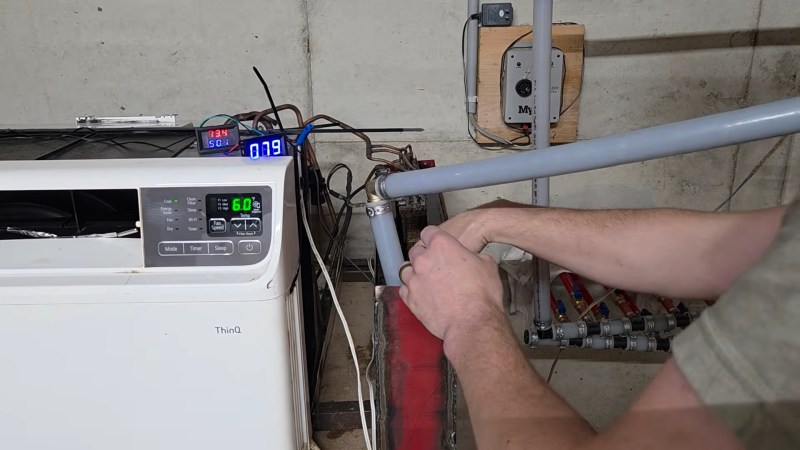
Heat pumps are great, because they pump heat around, and we often don’t want heat where it is. Need it somewhere else? Pump it! It’s great. It’s also a bit pricey if you’re buying new, but [Craftsman Chris] over on YouTube realized that the window air conditioning unit he found in a dumpster is, in fact, a heat pump. Normally it’s an air-source heat pump, but with a delightful series of hacks, he gets it automated and hooked into a ground loop in his latest YouTube video.
The heat sink is provided by a bunch of PEX tubing [Chris] buried in his back yard. After experimenting with using the water loop for cooling directly, he realized that pumping heat out of his house into the cold ground would go much better with a heat pump. That’s where the window A/C came in. After cleaning and servicing it, it was time to convert it to dump heat into water rather than outside air. To do that, [Chris] welded up a tank made of scrap metal around the existing heat exchanger. It’s designed for air, sure, but water takes its heat just fine. The nice thing about this is that by keeping the internals of the air conditioner mostly stock, he doesn’t let out any of the tasty, tasty CFCs that may be hiding inside.
Connecting this unit to his thermostat is equally hacky– he takes an old Programmable Logic Controller that looks fit to run a small factory, and hooks it to a single linear actuator to poke the A/C unit’s stock power button. Is it elegant? No. Does it work? Yes. Is it a hack? Indubitably!
We’ve seen window units pressed into whole-house A/C service before, but adding the water loop is a great hack. We saw a window A/C used as a ground-source pump before, too, but that was a Canadian project and so sensibly turned the machine around to provide heating for the maple mansion.












Tech Ingredients on YouTube did this a year or two ago, including some nice data collection and experimentation with varying implementations of the ground loops.
Yup. Original: https://redirect.invidious.io/watch?v=s-41UF02vrU
Thanks, the conclusion segment is great. Like a 3x bump in efficiency… Nothing to sneeze at. Surprising you don’t see this done more often commercially. I suppose it’s a pain if somebody drives over the lawn and cracks a pipe, or if the soil shifts.. Is there some other massive downside I’m missing?
It wasnt actually 3x, and i have done these kinds of experiments.
The most gain in efficiency you can get is about 2x depending on how hot the condenser was actually running at prior to the modification. You can simulate the system with the free nist-cycle-d hx refridgersnt simulator. -just plug 60% in for the efficiency of the motor and 90% for the efficiency of the compressor. And you will get your walmart 10 seer window ac.
The compressor in a daikin or mitsubishi minisplit is 90% efficient or more. So 30% less power just because of the motor upgrade.
Anyhow, there is a way to get a 3x improvement; if you have a very shitty compressor that has a lot of leakage at high head pressure, that miraculously fixes itself when the condenser cools off. -thats the only explanation a significant improvement in capacity from cooling the condenser.
I have a friend with a 4 ton geothermal system to heat his home. My 17 seer LG minisplit is more efficient than his system, 98% of the year. At a ground temp of 45F his evaporator is running at 33F pulling heat out of the ground.
But for some, a ground source is the only heatpump option available for 5F or colder climates.
I don’t know what is available in your part of the world, but the Canadian government considers cold climate air-source heat pumps are efficient down to -30C (-22F). They list thousands of cold climate models on their site.
https://natural-resources.canada.ca/energy-efficiency/home-energy-efficiency/canada-greener-homes-initiative/heat-pumps
Installation cost. I wanted to do it for the house I built 20 years ago and the payback period was 20+ years. The video shows a slinky coil version that ins placed in a shallow pit, which is less expensive than drilled wells but not as efficient. Shaking hands with someone who owns an excavator costs more than the air-to-air heat exchanger on a typical split system, and getting a drilling rig out to your property for boreholes costs more than an entire air-source HVAC unit. Plus, water-source heat pumps (in the US) are crazy expensive because the volume of sales is low, the expertise for installation is rare and the companies selling the systems feel entitled to a percentage of your savings for their marketing acumen. (Yes, I know a guy who sells and installs them; he’ll admit to every word of that)
I quite like it, but very overkill. Honestly i would have just put a car radiator in front of the condenser, and keep the AC as close as original as possible.
Or at least put some heat exchanger between the ground loop, and the water in which the condenser is submerged, and put some corrosion inhibitors
In some ways having your project featured on Hackaday is like making love to a wasp nest.
Or as I like to call it, a standard Tuesday evening
Congratulations!!! You have won “Today’s Funniest on the Internet”.
"... having your project featured on Hackaday is like making love to a wasp nest."
I think that using an intermediary working fluid with very low specific heat would ruin most of the efficiency gains. You want the water. Getting splashed with water at 200 degrees is a lot bigger of a problem than having 200 degree air blown at you. You are effectively thermally insulating your heat pump.
I seriously doubt that it had CFCs in it. If it’s a heat pump it’s more than likely HFCs.
As the article says, it’s a window AC unit. Not a heat pump when plucked out of the dumpster.
Whether it has CFCs or HFCs depends on the date of manufacture, and the country of sale. Both HFCs and CFCs have ozone-depleting ability, though HFCs are less depleting. And no matter the refrigerant, venting most/all common refrigerants (including Ammonia-Hydrogen, and Propane) are really not advised for a variety of reasons.
An alternative?
https://techxplore.com/news/2026-09-cooling-device-built-sustainable-refrigeration.html
That’s pretty cool, haven’t heard of that effect used for a serious heat pump before. 400 watts isn’t very much, but I’m sure they’re testing a scaled-down bench model… The cobalt is slightly concerning but it says it’s only about 2% of the alloy.
I tried to look up efficiency figures and they’re kind of cagey about it, with some similar methods matching the COP range of a regular old window box (3.0 ish). But hard to say what the actual results will be in a commercial device when you’re working in the lab.
The longevity thing seems like a solution looking for a problem, we have traditional ACs that last generations (they used to make them that way at least… maybe not anymore.)
New refrigerants slash greenhouse effects by more than 3/4 and they break down rather rapidly in the environment, so that problem is at least partially ameliorated. Still, this stuff is interesting and it’ll be a good one to watch in the future.
Why waste your time with a scrap AC unit? 12K BTU? Don’t think so.
20F difference doesn’t sound much.
I believe you are looking for drive-to-home-depot-a-day
mmm…service call many many moons ago ,old guy now re-very-tired , iffy recall but had an interesting discussion with the design engineer…the ground sourced units ( me tinks command-aire units…on a common hydro balanced ground sourced loop…he insisted under the parking lot was ok at 150 ft loop into the drilled dirt wells later backfilled, no bueno needless to say all the evap units tripped on head, obviously the engineering company was toast after eating the loop relocation bill…we had a test well next to the parking lot the numbers were crap then…go figure
mmm…back in the day playing with r502, r290 and 600 plus r11 for no compressor coil heat absorption coil above ground and a buried condenser ,same sized, with a small evap coil mmm bout half sized ,all by vapor volume thru a hand metering valve showed interesting results, btw old school heat wheels r swamp land in value
mmm turbocorp u say ‘the best’ commercial units by far…apologize for the rant ,old age
I kind of did the same thing; I bought a 12kw pool heating pump and converted it to heat my house. Working great for almost 4 years now!
I didn’t know you could get Tetanus from a video until I saw that air conditioner.
The PLC cobtrolled physical switch warms my frozen heart enough to make it sweat slightly.