
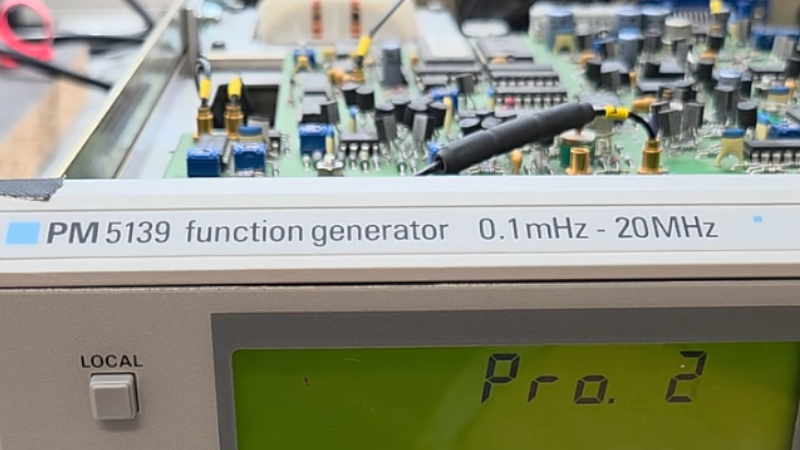
The Philips PM5139 is not famous. It won no great victories on the battlefield, nor was instrumental in changing the political landscape. It was just a useful function generator that you might find on a workbench somewhere, doing its job quietly and relatively accurately. [doctormord] has been doing the work to reverse engineer this humble piece of hardware.
The PM5139 is poorly documented; the only existing service manual out there is for the PM5138A, a less-capable sister model. Hence, there was some value in reverse engineering the device to understand it better. Work started with two EPROM dumps capturing what Philips put in the box all the way back in the early 1990s. From there, the code was examined and tinkered with until [doctormord] felt confident to modify it and improve upon what was already there. This was achieved with the aid of an 8051 emulator that could run the code to make it obvious what was going on. The result was a custom “V2.0” firmware that adds six arbitrary waveforms to the function generator and the ability to play simple music, amongst other tweaks.
We love to see old hardware given new functionality, even decades down the line, and we love some good reverse engineering, too. Video after the break.












One of the “fixes” is smoothing programmed waveforms. Wouldnt those samples be dithered on purpose?
Hey rasz, that’s something I couldn’t find out if it’s either on purpose or not. The service manual also doesn’t give any clue on this. I also can’t find any fully complete service manual, the one for the 5138A is missing important parts for the whole Controller/Digital setup.
Cheers
Christian
Speaking of LLMs in the last post, and the text in this project git apparently entirely authored by Claude:
The “accent” that Claude effects is different from (e.g.) ChatGTP and, IMHO, it’s offensive. Way too many superlatives and qualifiers, and a distinct ‘Captain Kirk’ punchy stilted clause construct style. It’s really off-putting. Often I’ll just give up and stop reading despite the interesting topic — it’s too tiring.
Dear Paul,
sorry to hear that. To me it’s quite difficult to write down all this comprehensive stuff and findings a pure assembler listing gives, in a way everyone understands, especially but not only english isn’t my native language.
Best regards
Christian
I totally understand and agree with your approach, and would not argue doing it differently. I use Claude myself for the same things: I’m looking for a way to tone down its style. I have not yet discovered how to modify its output style — it keeps reverting to its native “accent”.
Dear Paul,
thats what i usually also do, telling “her/him” to be human readable, on point, with no drama and and superlatives (if this is the right meaning). I’d think it is best to give it some “training data” of old posts or articles written by you/user. This usually works well with Gemini.
Best regards
Christian
You could try having it do a much heavier accent to compensate. I find that “pirate”, “australian”, “uwu”, and “noire detective” work well. Though, uh, if you pick “uwu” you may have to tell it to not replace every vowel with uwu.
Newest latest here:
https://youtube.com/shorts/RJKwy_QURL8
Next thing would be to implemented MIDI and or using the Modulation output on the backside as a second independent output for another instrument via PCM or SQ-wave noise forming.
Claude’s writing style aside, I really liked this generation of Philips devices. They were solid, competent instruments, with new digital functions, well thought-out controls and great functionality at a good price. And coming at a time when Tek was rudderless and waning trying to come up with decent new digital scopes, and HP was commanding much higher prices. They had a real shot at taking that market segment, then… crickets. What happened? Couldn’t find a sales channel or a competent marketer?
It came at a time where Philips was restructuring (no longer a do-all almost state-owned company) and sold the whole T&M department to Fluke. One example is: all the Philips counters were made in Sweden, that company lives on as “Pendulum Instruments” today.
Hi all,
It seems it was (is?) also known under the brand ‘FLUKE’ – Service manual here:
https://www.eserviceinfo.com/download_start.php?downloadurlid=172060
Hope that helps.
Best regards
Peter
Hey Peter,
thanks for this. Unfortunately it is the user manual, the real service manual is still not available anywhere. :( Best regards Christian
Hi,
Sorry for that, could you try this address please?
https://www.manualslib.com/manual/4173088/Philips-IAnde-Pm-5193.html
I think they have both manuals ;-)
Best regards
Peter
In the meanwhile “we” investigated further to use this device as something like a wavetable synth, and it does pretty well. It now plays “chords” of 3 to 5 with envelope/sustain/attack for the notes. This is the latest outcome:
https://youtube.com/shorts/RJKwy_QURL8
How thidsworks is explained in the video description.