
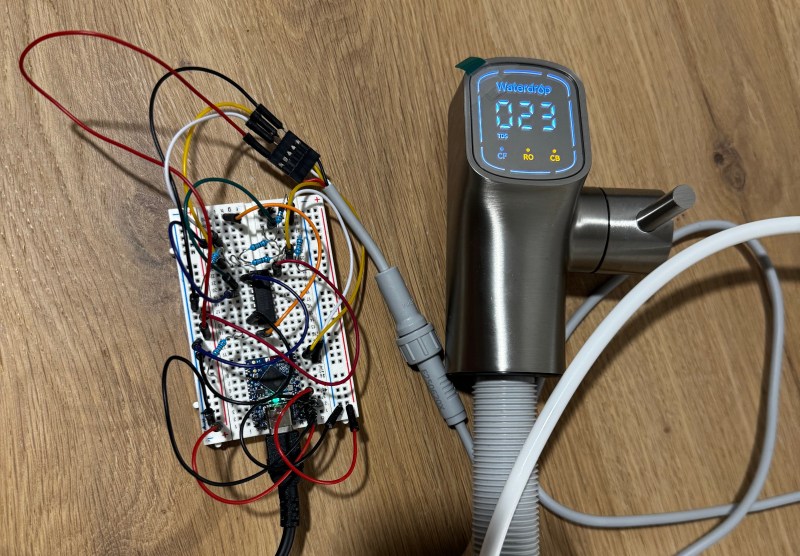
Reverse-osmosis (RO) systems are one way to ensure that you get very clean drinking water. The Waterdrop G3P600 variety that [Tomasz Wasilczyk] recently purchased is definitely among the fanciest and ‘smartest’, with the faucet having its own 7-segment display and gaggle of LEDs connected to the actual RO unit with a four-pin connector. This naturally meant that whatever protocol runs on this cable had to be reverse-engineered for science.
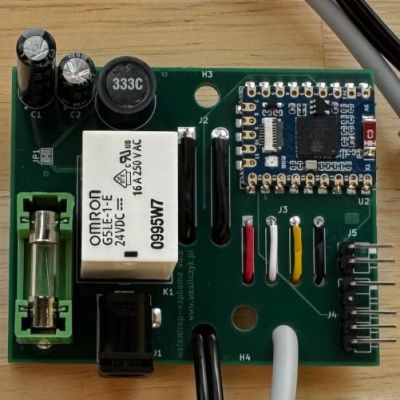
The main practical benefit here is to make the system smarter — such as plugging it into a home automation system with ESPHome support, as well as make it play nice with refrigerator lines.
What automation and monitoring options exist here thus depend on what data gets sent between the RO unit and the faucet. Fortunately this turned out to be quite extensive, ranging from filter health, the water quality and pump status as well as air temperature and faucet state.
Unsurprisingly the four-pin connector turned out to be a basic serial link, with 5 V, ground and a 9,600 baud connection. From this it was easy enough to deduce the protocol, and by looking at what lit up on the faucet, a custom PCB wasn’t far behind.
After one blown-up fuse later due to getting 24 V instead of 12 V on the RO unit when tapping off power, the unit popped to life and was able to be connected to Home Assistant, from where the entire functionality and what triggered what could be mapped out. Of course, there’s still more to be discovered and reverse-engineered in the unit, but this seems like a good place to start.












Reverse-osmosis (RO) systems are one way to ensure that you get… dehydrated by drinking water (sic!)
Please explain
This argument.
https://olympianwatertesting.com/is-reverse-osmosis-water-healthy/
Reality is always more nuanced.
Come on, I achieved a feat of dumping chip memory through a 7-segment display and you folks quarrel about water qualities? :)
See the source article.
The argument is foolish.
The same myth is used against distilled water.
If you drink nothing but reverse osmosis water,
and you consume no food containing any potassium, sodium, magnesium etc
then the clean pure reverse osmosis water or distilled water can strip your body of essential minerals that those who believe everything they read but barely comprehend think their dirty tap water is the only source of.
Impostor! Get your own username!
The public is largely unaware of the dangers of DHMO; it is a dangerous chemical spread throughout our world and can have fatal explore. Read more at
https://dhmo.org/
The irony is, when water is really pure it’s actually fairly dangerous.
Water is a great solvent, removing everything dissolved in it is effectively increasing the osmotic force gradient.
Polystyrene Divinylbenzene doesn’t seem too hard to make.
It’s fairly tempting to give making my own ion exchange membranes a go at some point.
Pure water is not dangerous.
And the increase in the osmotic force gradient is minuscule. The difference in the osmotic force gradient between tap water and pure water is virtually negligible. Pure water contains zero solutes, exerting 0 atm of osmotic pressure, while tap water typically contains only trace minerals, yielding a tiny osmotic pressure (usually <0.05 atm).
And yet RO-water is so corrosive, that RO plants add minerals back to it to reduce this.
RO water from large scale plants is mildly acidic before remineralization due to dissolved CO2 forming carbonic acid. The pH of reverse osmosis (RO) water prior to remineralization typically ranges between 5.0 and 6.5 after remineralization. typically has a pH of 7.0 to 8.5.
A pH of 5.0 is mildly acidic and is not considered hazardous or corrosive to human skin. It is comparable to the acidity of black coffee. The pH of Coca-Cola typically ranges between 2.3 and 2.7,
The issue is that Water at pH 5.0 will easily dissolve copper, lead, zinc, and iron out of pipes and fixtures.
That “so” is doing a lot of heavy lifting. The RO process can make water slightly more acidic than it was previously, since it removes dissolved calcium and magnesium compounds that act as a buffer.
But any water that isn’t pH neutral and ion-free is “corrosive”; by that metric, a lot of municipal drinking water is just as “corrosive” as most RO water (or more so). A lot of bottled mineral water is even worse. Even rainwater is naturally more corrosive.
@Menno Also, the output of a home RO system is probably not 0ppm. Mine is often like 20-30, same as spring water from the store.
But but in natural water on earth, about 1 out of every 6,400 hydrogen atoms is actually deuterium. So should we really be calling it dihydrogen monoxide when it is technically not really
Yes, because it’s still hydrogen, but no, because it’s not the idiomatic way to express water.
This is brilliant. I didn’t know this type of filter was an option. I think I found a new appliance for my kitchen. In my area, there is a ton of pollution in the drinking water from PFOA/PFOS/PFAS/GENX.
A low tech gravity filter like Berkey is a solution also
Activated carbon filters are perfectly adequate at removing PFAS / PFOA and are much cheaper to operate, don’t divert concentrated waste (RO is pretty inefficient), are much less energy intensive, and more readily available.
You will have to replace them more frequently than the manufacturer recommends though since those time frames aren’t based on PFAS removal.
However, your drinking water is likely the least significant source of PFAS / PFOA in your life. Water proof clothing, stain resistant fabric, some food packaging (this has mostly been phased out), and other consumer goods are almost certainly responsible for multiple orders of magnitude higher exposure.
A reasonable starting concentration and bypass ratio can mean not-that-bad RO waste concentration, safe for potted plants or something. And simple RO setups can definitely run on many home’s existing water pressures, no boost required.
Activated carbon is nice and all, but it’s less of a filter and more of a disposable trap, it doesn’t last that long. If your water hasn’t got chlorine or chloramine to destroy the RO membrane, it should last longer, and also you can still do more stages kind of like this commercial one does, and have the whole chain last longer working together.
I would probably go even further if I knew from tests that there was something unhealthy in my water; might even choose not to use it. Even if these particular things might also be elsewhere, finding anything wrong is an indication that something else could be there that you didn’t test for.
It might just be easier to add your own “smart” features to a “dumb” RO setup. Or at least, it would be a lot more repairable and modular. If you’re on wellwater that already hasn’t got sediment or chlorine (or chloramine) and you just want better drinking water, you don’t need to start anywhere near the price of the smart machine. Either do manual filtration or modify the setup with some controllable valves and sensors to have a perfectly decent DIY version. https://imgur.com/a/cheap-reverse-osmosis-water-dispenser-Y1twQEf
Oh, smarting it wasn’t a goal – see the linked source article. Yes, I could have built a DIY one and did one before – not as simple as the one you linked though (I have low water pressure) – this time I just wanted to slap a good and ready solution and be done with it.
And then I saw that little 4-pin connector and really wanted to scratch that reverse-engineering itch… “be done with it” came down the drain.
Makes sense now that I read the source story.
What I linked could also be reconfigured to run off one of those cheap 12v “RV” water pumps or something, so pressure isn’t necessarily hard to solve, but it’s definitely not ready to go in every environment, unlike yours, nor to be plumbed in and monitored and everything. When I did it, I actually was going to accept some more inefficiency and worse filter lifetime (since they’re cheap) and recirculate in a bucket with the pump, but then I discovered 44psi was enough to do the job a bit slowly and would let me just run it connected to a faucet so I went with that. Also lets me connect the waste drain to wherever I like, although I usually collect it to water potted plants. And of course if my water had more things to filter out, it would need a bunch of stages and no longer be simpler than this, nor would I want to water plants with the waste. But for making the water taste better and work better for bread / yeast fermentation / coffee brewing /etc it’s fine.
The most interesting (for Hackaday community) part of the project is how I dumped memory of the faucet unit through… its 7-segment display. One byte at a time:
https://github.com/twasilczyk/waterdrop-esphome/blob/main/docs/story.md
The ultimate side-channel.
Any chance you would sell one of these chips already setup?
I’m not selling them personally (it’s too much hassle beyond just manufacturing and shipping), but you can order assembled one from JLCPCB.
I’m curious though – why not do it yourself? All answers are good – I’m considering distribution models for my next project and I thought doing hand-solder-friendly one like this one would be good enough.