
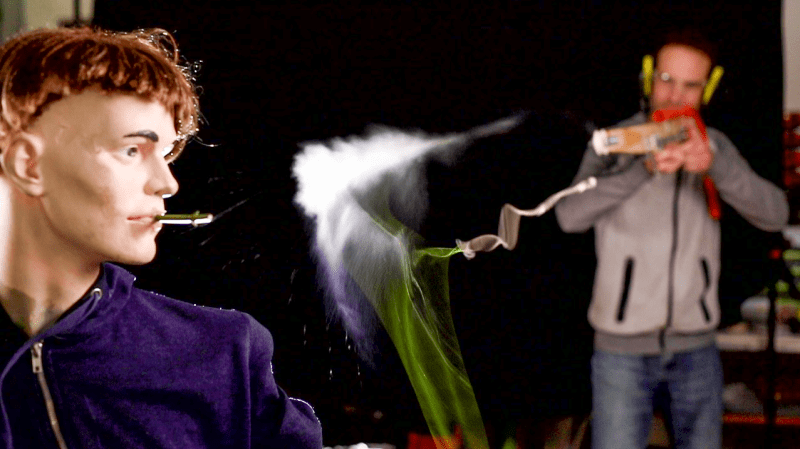
We tend to think of breaking the sound barrier as a comparatively modern accomplishment, but on a smaller scale, cattle herders have been breaking it for centuries: the cracking sound of the tip of a bullwhip snapping comes from a small-scale sonic boom. Reliably getting a crack out of a whip takes skill and practice, though, which is why [Craig Turner] built a whip-cracking machine.
The first step was to build the whip itself, which was surprisingly complicated. Bullwhips taper down toward the end of the whip. As the whip uncurls during a crack, momentum passes down the whip; since the whip becomes continually narrower and lighter, conservation of momentum means that different stretches of the whip must move progressively faster. To get this effect, [Craig] joined together a series of increasingly thin and light ropes. The heavy end of the whip terminated in an eyelet connected to a length of elastic shock cord. Stretching the whip back on the shock cord and releasing it whipped it around, resulting in a fairly reliable crack.
For greater convenience, [Craig] built this into a launcher mechanism, with the elastic cord wrapped around the end of the launcher, an electrical-conduit guide for the whip, and a spring-loaded trigger mechanism to release it. This worked even better than expected, getting a reliable crack every time. The tip of the whip could slice leaves, tear open aluminium cans, put out candle flames, knock the cap off a bottle without tipping it over, and reliably hit small targets on the first shot.
As [Craig] mentioned, this setup would make it much easier to study the cracking effect with a schlieren imaging setup.











Where’s the cheese, Gromit?
Well before humans, a dinosaur likely could, with its whip-shaped tail: Apatosaurus.
https://eartharchives.org/articles/dino-s-tail-might-have-whipped-it-good/index.html
I think the mantis shrimp can move its body parts faster than sound (but it can only break the speed of sound in air, and it lives in water where sound propagates much faster, so it doesn’t count)
the part where he syncs up with the Devo video is must-watch sasquatch
Why does he have a tub of Mermaid testicles?
I bought a whip at a garage sale (people sell their stuff out of the home driveway. Don’t know if this is only an American thing.). The seller mentioned that the whip is 22 feet long (6.7 Meters). After I got it home I watched a whole bunch of videos on how to use said whip. All the videos said “You can’t hit yourself- don’t be afraid it can’t hurt you-people never hit themselves when learning-ETC.” I promptly went to the back yard and with confidence high proceeded to try the lay it out in front of you then yank it back behind you then yank back forward again system. Don’t worry you can’t hit yourself they said. After the third yank I heard the sonic boom as the whip hit me in the right side shoulder blade. I fell to the ground screaming and have not tried the whip since!
Thank you for helping me start my Monday off with a laugh.
Never underestimate the creativity of an enthusiastic novice 😬
My pet peeve: invoking momentum transfer as an explanation sounds scientific but adds zero information. Only a force can accelerate a mass.