
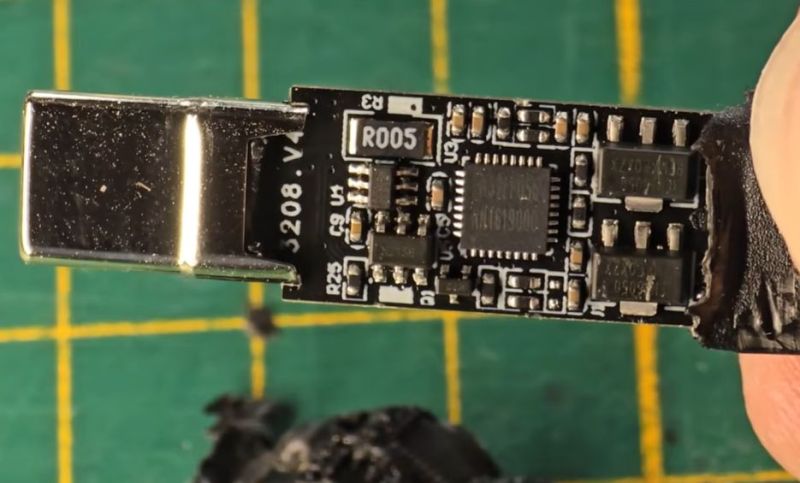
The past years we have been seeing screens pop up in many new places, but seeing them in USB-C cables is still a bit of a novel thing. Out of sheer curiosity [Aaron Christophel] recently took apart one of these, to see what’s inside and what else you can do with them beyond fondling its single touch control and watch reported voltages and current.

Naturally, these devices aren’t exactly meant to be serviced by anyone, so the biggest challenge is to get into them without too much violence. Risking a blood sacrifice to the Hardware Gods, [Aaron] first attacks the display cover of this €15, 240 Watt-rated UGreen cable with sharp utensils before just taking apart the aluminium case, which ultimately gets him inside.
After this it’s clear that attacking the display cover was the right way, just requiring knowing where to apply pressure in order to invert the assembly process. Following that it’s less clear how it was assembled, though it may have involved liberal amounts of glue after sliding in the components. Rather than bothering with applying heat, instead some side-cutters quickly take care of that pesky aluminium shell.
The tiny IPS LC display is attached via a flat flex cable to the PCB with a connector, with the PCB featuring multiple voltage regulators, a MOSFET for the backlight and other parts in addition to the EN32LF056 marked MCU. After some prodding on the exposed SWD interface, it was confirmed to be a Cortex-M0+-based MCU with 64 kB of Flash and 4 kB of SRAM, which made it easy enough to use the little display to display some video frames of everyone’s favorite artist.
Since this MCU is only wired up to measure currents and voltages it cannot use the USB interface, but with some knowledge of how to non-destructively disassemble one of these connectors at least to the point of accessing the SWD pads underneath the display it could be a fun party trick to reflash the firmware with something custom.












If you have any questions, please ask Gemini. It is now part of Google.
Claude said Gemini is about as smart as Siri!
It’s “a USB cable”, because it’s pronounced “a you es bee cable”. One only uses “an” when the following word starts with a vowel in pronunciation.
I came here for the single purpose of pointing out that exact same thing. Well done sir. To be honest, I didn’t read the article. If I get a linguistic punch in the face, I’m numb to all that follows
Information is where you find it. Failing to hunt and gather information just because you saw something icky only has the consequence of leaving you without information that was available to you. Of course, it’s up to you whether that is subjectively relevant.
most of the little factoids about English are things I learn on HaD amid people demanding to see Doom run on a 555 timer
Same thing with utility ie “a utility pole”
English is a bit weird. You can’t rely on spelling to put “an” before a vowel, you have to know how the word is pronounced. This can stump people who aren’t native or well-versed in English
English language is essentially a bastard grandchild of Latin language, they stole from many European languages (all with direct Latin root) to form English. Which boggles your mind when you also consider English is the world’s most spoken language.
English is fairly unique in that it’s not just Latin, it’s also Germanic. So we have two of every word often with slightly different nuance – beef and cow, etc. being some of the best known – but most of our words are duplicated in both romance and Germanic roots.
May I just note that something cannot be “fairly unique” ? The word “unique” is an absolute, effectively binary in usage, and therefore not capable of modification.
Something is unique or not unique in the same way that someone is dead or not dead. I understand that many English language users are trying, either through ignorance or laziness, to change the word into a synonym for unusual or remarkable, this seems to me to be pointless. We have a word which means ‘one of a kind’ or ‘singular’, why on earth change it and dilute its utility?
And, whilst we are here, I’m a little uneasy about the writer’s use of the word “nuance”. I think that the usage should be ‘nuances’ as a plural noun since it references two items, in effect a plurality. However unease is not certainty and it would be interesting to read other views.
That’s a lot of tech to put into a cable. Maybe some of the fabs producing parts for such extravagances could refocus on.. oh.. I don’t know.. producing memory?!?
Producing memory (Both RAM and NAND Flash) is highly specific, many high-end chips for that matter. While you can start setting up production lines, it may just take a decade to produce state-of-the-art memory. A cable manufacturer just doesn’t have that skill, time or capital.
Yes, I actually do know that. But… There comes a point when maybe it’s time to re-direct some resources into starting that decade long process doesn’t there? Also.. if they are cramming all of this into a connector I don’t think “cable manufacturer” is a very complete description of their skill set. Maybe they could be building some more advanced electronics than cables while someone already building that more advanced stuff can start switching towards those things we have a shortage of.
We are reaching the point where devices will need to have secure pairing with encryption on regular USB connections. Chips are getting so small someone could probably fit keyloggers or other intrusion tools within a cable undetected.
look at the omg cable.
There are already for sure. Which means that we all need an x-ray machine at home.
Which won’t help as all the cables need a chip in them if they are to support USB-C spec fully.
And a PCB with chip in the plug will look like a PCB with a chip, about the only thing everyone having home x-rays might do is force the bad actors to use a slightly more expensive bit of silicon to make their package as capable as they want in the same footprint as the ‘I’m a high power cable, and nothing else honest’ chip.
The community has repurposed the chips inside cables before, and there is no reason why these legit cables can’t be reprogrammed either. What comes to mind is a repurposed USB VGA: https://hackaday.com/2018/04/23/spoofing-cell-networks-with-a-usb-to-vga-adapter/
How are you going defend against a USB cable which is 99.9% legit, but pretends to be a keyboard, replays your credentials, and does something nefarious?
Or maybe just buy stuff from reputable companies instead of getting the cheapest stuff from AliExpress?
Rather easier said than done, as from where can you buy said stuff? As most reputable companies don’t sell to the public directly you are the mercy of the smiley box or local store, and that chain of middle men…
Also even reputable company these days tend to just order and fit those parts together from a chain of smaller specialist suppliers into their snazzy case – so a whole batch of poisoned inputs may well get shipped as long as it doesn’t actively fail whatever the validation steps they do are badly enough to notice.
Digikey, Farnell/Newark/element14, Mouser, Arrow, RS Components. They all take their supply chains VERY seriously and you are unlikely to find counterfeits from any of these vendors. Yes, you will pay more than Amazon or Aliexpress.
Of course, if what you actually WANT is a not-standards-compliant USB cable with a screen built in, then you’ll have to buy it from a shop that doesn’t care about standards. Caveat emptor.