
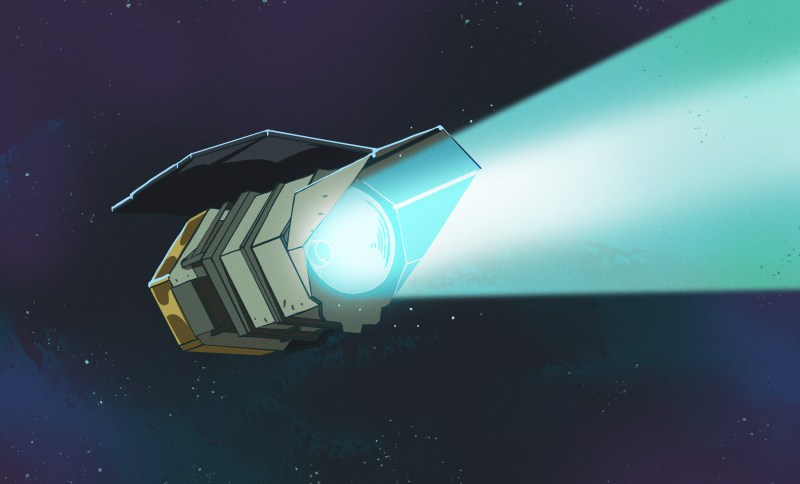
Contemplate the events that might end a space mission, and you might picture something dramatic: detonation on the pad, a dead guidance system, or micrometeoroids shattering delicate solar panels. More often, though, the ending is far more mundane. Plenty of perfectly healthy spacecraft have been retired simply because the fuel tanks ran dry. That’s why mission planners guard every kilogram of go juice so jealously, and why careful preparation in a mission is critical to long-term success.
Which brings us to NASA’s Nancy Grace Roman Space Telescope. Barely two weeks after its August 30 launch on a Falcon Heavy, the mission team announced that Roman now has enough fuel for at least 22 years of science operations. That’s well over double its original 10-year fuel budget. It’s a huge gain, so let’s explore how NASA pulled it off.
Time Extension
In mid-September, NASA announced a great victory—the Nancy Grace Roman Space Telescope would have enough fuel to theoretically stay operational for a full 12 years past initial estimates of a decade-long service life. The extra dozen years was based on predicted fuel budgets, and notably, the gains didn’t all come from one source. Three different factors contributed around four years of extra fuel margin each. First to help the cause was the fact that the spacecraft came in well under its mass budget. Then, the spacecraft’s first course correction used just a sliver of its fuel allocation, leaving more for later. Furthermore, a second burn for orbit insertion is now expected to use much less fuel, too. There were no tricky hardware hacks or clever software patches involved; it’s simply what happens when engineers budget for the worst case and then pleasantly find themselves coming out ahead.
Lighten
Savvy engineering netted NASA a spacecraft that tipped the scales far below initial expectations. A spacecraft’s mass is a moving target throughout design and build, as parts get swapped, harnesses get rerouted and margins get nibbled away. Roman’s propellant budget was therefore calculated against a conservative ceiling of 9,800 kg (21,605 lb). The finished observatory weighed in at 8,056 kg (17,760 lb), about 18% under that figure.
This is where the rocket equation earns its keep. The propellant needed for a set delta-V is directly proportional to mass. A spacecraft 18% lighter than planned burns roughly 18% less propellant on every correction, orbit insertion and station-keeping burn for the rest of its life. Small savings in weight can have big knock-on effects to fuel use down the line.
The lighter build also freed up room in the launch mass budget. Rather than loading only as much propellant as the 10-year requirement demanded, the team filled Roman’s tanks to maximum capacity. As Roman propulsion lead Alison Rao put it, the fuel budget is based on a maximum mass “so we won’t come up short,” while the propellant actually needed gets tracked against the real mass of the spacecraft through integration and testing. When the real weight number came in low, the leftover headroom went straight into putting extra fuel into the tanks.
On Target
The Nancy Grace Roman telescope is making its way to station itself on L2, as seen in this animation of the spacecraft’s trajectory. Credit: NASA

When it comes to launching a satellite, nothing leaves a rocket’s upper stage on precisely the trajectory the mission planners drew up. There are always some corrections needed after launch, so a spacecraft bound for orbit always carries some propellant to realign itself with one or more mid-course corrections. Small velocity errors early on can grow into large position errors over a months-long cruise, so corrective burns typically happen early, and fuel to achieve them is budgeted against a pessimistic launch rather than a typical one. The cost of not having enough fuel to get to the desired orbit is, typically, a total mission failure—so it pays to pack more than you think you might need.
The spacecraft’s first correction kicked off at 12:02 p.m. EDT on August 31, and ran for roughly three minutes. The team had set aside 200 kilograms (441 lb) of propellant for it, but the correction was achieved with just 18 kg (40 lb) expended. NASA says the burn was executed with better than 99% accuracy. Once at its final orbital position, the spacecraft will only need periodic burns to stay on station once every 28 days or so. Thus, those 182 kg of unspent propellant are worth around four years of extra operations on their own. It didn’t hurt that the spacecraft was significantly lighter than expected, which helped limit the fuel required to get the spacecraft on its desired course.
It’s fair to say that the final four years of additional fuel are still a forecast, not fact. Roman’s second mid-course correction was originally pencilled in for the first week of the flight, but with the first burn landing so close to the mark, there’s very little error left to mop up. That gives the team the luxury of patience. NASA’s mid-September update has it slated for late in the month, and both it and the orbit insertion due roughly 100 days after launch, are expected to come in under budget.
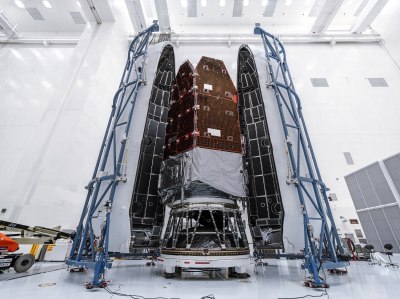
Once it arrives, Roman won’t be sitting at L2 so much as looping around it. The Sun-Earth L2 point, about 1.5 million km from Earth on the side facing away from the Sun, sits as an unstable equilibrium. It’s a point in the gravitational field where small drifts grow rather than damp out. Spacecraft there fly wide orbits around the point and give themselves a gentle nudge every few weeks to stay on track. For Roman, that means a station-keeping burn roughly every 28 days for as long as the tanks hold out, which is exactly why every kilogram saved on the way up turns into bonus months on station down the line. It’s a familiar tale in NASA halls; the James Webb Space Telescope got a similar windfall back in early 2022, when a precise orbital injection and efficient correction burns left it with enough propellant for around 20 years, roughly double initial estimates. As it turns out, conservative budgeting in spaceflight generally pays off.
Of course, propellant is only one of the things that can end a mission. Detectors age, reaction wheels fail, and a million other things besides can take out an otherwise functional spacecraft. For now, though, 22 years is a nice upper ceiling, set by the fuel left in the tanks. For a survey telescope with a field of view around 100 times that of Hubble, the prospect of it mapping the sky well into the 2040s is a very nice option to have. NASA will just have to staff the control centre twice as long to achieve it.












What a waste. We could have saved literally thousands of dollars on fuel, and instead we’re going to have to spend millions extra on the infrastructure and personnel to keep the operation running for 12 YEARS past our contracted end of life. The losses from having to allocate those resources for future ops are going to kill us on this quarter’s profit reports. Heads will roll.
Just kidding – this is awesome. Margin on the engineering side is extra science on production end. Win-win.
https://tenor.com/view/they-had-us-in-the-first-half-not-gonna-lie-gif-13620240
Same. I love the prospect of an extra decade’s worth of astronomy goodness.
https://en.wikipedia.org/wiki/Libration_point_orbit
Mathematically, the L2 point is unstable, but only in one of three principal directions; the other two are stable. There’s no Wikipedia entry for it, but those wanting to learn the orbital mechanics might look into the Circular Restricted Three-Body Problem.
Included in: https://en.wikipedia.org/wiki/Three-body_problem.
the picture shows a telescope sending out bluish light, like a lighthouse. I always thought that a telescope collects light (of course with a hight quality imaging optics).
I think the light is emitted by it’s miraculous fuelsaving electrobeam engine :)
How can you even tell which way the light is going? I think it’s going into the telescope.
But yeah. Artistic license on this one.
Light spreads from the source. To be honest, the satellite in the picture looks more like a spotlight, illuminating the universe through a dust cloud thick enough to bounce photons sideways out of the beam.
It is the light of the knowledge >!<
^^– this.
Under budget, ahead of schedule, and more than double the target lifetime.
Somebody padded the figures and was super conservative and was lucky with contingencies. Or engineered more than just a spacecraft.
Even George Mueller wasn’t that lucky with Apollo.
Still, after more than 4 gigabucks, I sure hope it works when it gets there.
It has one of two NRO mirrors given away.
I’d like to see the second one sent to Planet 9 if it exists.
If it was “under weight” but then they filled it with extra fuel it is no longer under weight. A logical fallacy the author continues to lean on.
I understand if it was 18% underweight and filling the tanks meant they were still underweight; but that isn’t even alluded to in the article and the number is not provided. It is true that as the propellant is consumed the weight (mass) will decrease, but considering they used less than 10% of what was budgeted for the first correction it will likely take years before the benefits are realized.
I guess another option is that the 18% figure is including the extra fuel load, but the paragraph about the extra fuel comes after the weight discussion and makes it sound like the reduced weight was then increased with additional fuel.
Hard numbers please.
“If it was “under weight” but then they filled it with extra fuel it is no longer under weight.”
Its dry mass was under weight by 18%. Adding fuel doesn’t change the dry mass.
Aww if we’re gonna be pedantic let’s do it for real – 18% more fuel doesn’t get you 18% more dV cause you spend some of that 18% to push the extra 18%
The rocket equation will differ with you on that assertion.
It helped that Falcon Heavy is a hoss’ of a rocket, too.
I want to see a Centaur atop Falcon Heavy just once.