
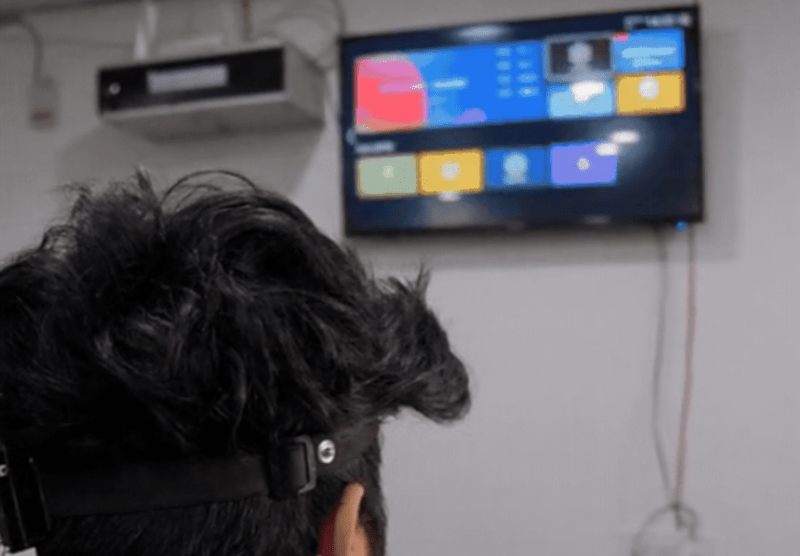
We aren’t sure we subscribe to [Upside Down Labs] description that their Neuro PlayGround Lite (NPG Lite) actually constitutes brain control in the science fiction sense. However, the package can sense biopotentials, and that lets you do things like change TV channels with a blink of the eye or a muscle gesture. That’s the gist of their project example on Instructables.
Since the NPG has an ESP32 onboard, it isn’t hard to see that coupling it to an IR transceiver would be all you need to control anything with an IR remote. The real problem is reading things like eye blinks.
The simplest way to think of the Neuro PlayGround Lite is as a 3-channel instrumentation amplifier + ADC + ESP32-C6 radio, packaged for measuring very small biological voltages. The same hardware can be used for EEG, EMG, ECG, or EOG, depending mainly on where you put the electrodes and how you filter/process the resulting signal.
It is true that you can measure EEG, so maybe it is brain control if you can learn to control your EEG output. EMC for muscles or EOG for blinking is probably somewhat more practical.
The instrumentation amplifier is where the main value is. You probably can’t just hook biosensors up to an ESP-32 analog input. The software, too, does a lot of heavy lifting for signal processing. Once you have reliable indicators that an eye or muscle moved, the rest is pretty simple.
For us, we don’t want to glue sensors to our body every time we want to watch a cat video. But we know there are legitimate reasons you might want this type of interaction, and this is as good a way to dip your toe into user interfaces that use biosignals.
We’ve seen this type of tech — strangely — used to order drinks. Not to mention games.












So much fuss when you could keep a stack of bricks near the sofa and learn how to aim them properly (direction, angle, intensity of throw – you do not want to buy a new tv each time you want to switch channels).
In my experience, you can’t hook anything up to an ESP32 analog input and expect reliable results. They’re very good almost-random number generators though.
So you’re saying it will work, it’ll just be a bit noisy
They’re using a TL074, any claims of EEG or ECG are plain fiction. EMG, maybe.
I remember their “BioAmp EXG Pill” was featured here which was claimed to be a breakout board for ECG+EMG purpose. I remember the creator/founder in the comments was also confusing the input impedance of the opamp used (TL074) being somehow responsible for protecting the patient/user. Another gold nugget, to the isolation question, they answered, “a laptop is galvanically isolated already from mains”. Again, I’m paraphrasing.
Have a read, fun stuff https://hackaday.com/2021/02/15/listening-in-on-muscles-with-the-bioamp-emg-pill/