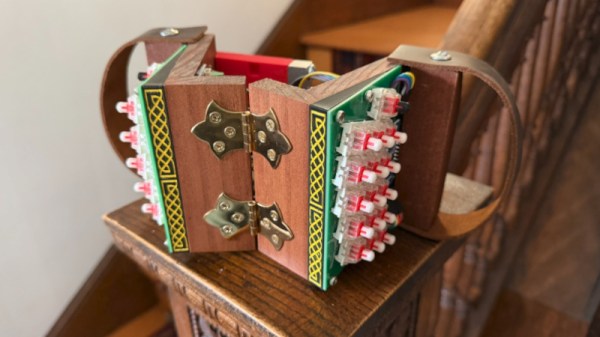
The concertina is an instrument that features heavily in European folk music, of which there are a variety of types. [Xcott Craver] has built one, an anglo concertina of the type you may recognise accompanying sea shanties, but this is no ordinary squeezebox. Instead it’s an electronic concertina, and it’s a project with a significant attention to detail.
Perhaps the most obvious thing most of us know about a concertina is that it’s an instrument with two ends separated by a set of bellows, and manipulation of the bellows lends a lot to the music it produces. This instrument doesn’t have bellows, but its innovation is to simulate them through means of a load cell. The two sides of the wooden chassis are fixed, but the force exerted on them is measured.
The keys are Cherry MX switches with custom keycaps, mounted on a pair of PCBs. Driving the whole thing is a Teensy 4.0, and to avoid unfortunate accidents with ripped-out connectors there’s a USB extension lead as a bit of strain relief. You can hear the result in the video below.
This is like no other instrument we’ve seen here, though we’ve had a few electronically enhanced conventional concertinas and accordions. We like it for its interesting design.
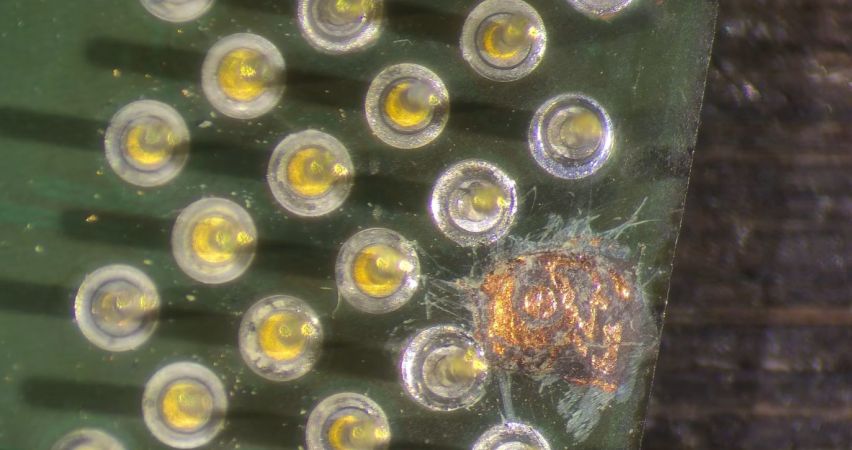
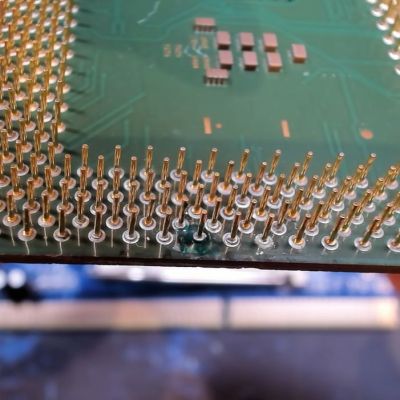 Before moving to land grid array (LGA) packaging whereby each pin on the substrate is just a copper pad, processors commonly used pin grid array (PGA) packaging, including the still highly relevant AMD AM4 socket. With PGA you get a pin soldered onto the copper pad which inserts into the ZIF socket, rather than a fragile pin on the mainboard side. Repairing a damaged PGA pin can be easy if just the pin broke off at the solder joint, or rough if the pad was destroyed, as in the case of this Pentium III CPU that [Bits und Bolts]