
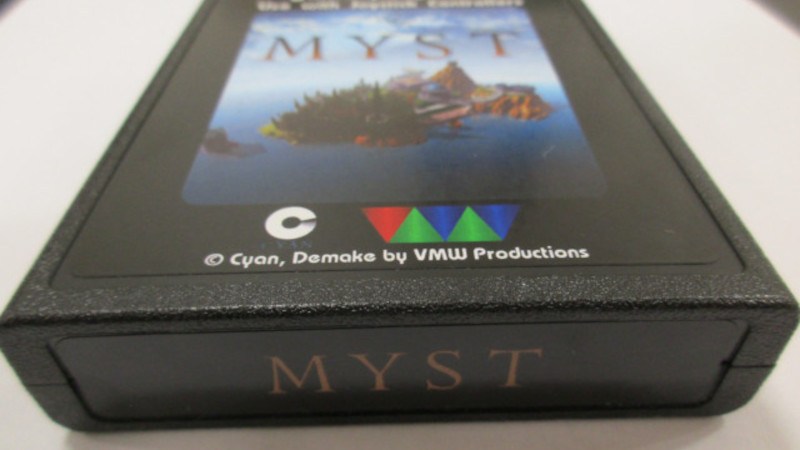
Although the Atari 2600 was a hugely popular game console in the late 70s, its hardware specs were limited, to say the least. For a dedicated game console of the era this isn’t too surprising, but things like 128 bytes of RAM meant programmers had to work hard to make games that were fun and playable (and they didn’t always succeed). Programming on this system even now is difficult, but nonetheless [Vince] wanted to get a version of Myst running on this system.
Obviously a PC game from the 90s is much to large, in many ways, to fit into an Atari cartridge or play on the 70s-era hardware. For that, there is a “demake” of Myst, a recreation of the game purposely built to run on older hardware it was never meant for. Even so, the game is running on a specialized cartridge built by [Vince] using parts from the real Atari game cartridge BurgerTime which had a bit more memory than normal. It wasn’t quite as straightforward as flashing the new game file to an old EEPROM though; [Vince] came across all kinds of timing issues and other miscellaneous problems that stretched this project out to around a three-year endeavor.
At the end of everything, though, he has a cartridge that will run Myst on the Atari, using the E7 bank switching scheme which afforded this system more memory within the cartridge. For [Vince], who is a fan of the demo scene for consoles like this, this was an interesting experiment to push original hardware to its limits. And, if you want to try this on an Atari 2600 handheld which also uses original hardware, we’d recommend using one of these.












People here like to hate on YouTube videos, but in this case, as awesome as this accomplishment is, I don’t have the technical knowhow or interest in the details to get much out of this writeup. But I would absolutely love to see some video of the game actually being played. The few screenshots here are helpful but not the full experience for sure.
At any rate, this is super cool!
Ha! Well don’t I have egg on my face. I quickly scrolled to the bottom to see pictures of it in action and completely blew past the link he put at the very top of his YouTube video showing the gameplay.
I suppose that’s what I get for skimming!
WOW!
Just WOW… the (good old) internet as it used to be…
I don’t know what I love most… is it the detailed write up? the copious amounts of nice pictures? or the fact that nobody shoves a video in front of your face (but allows you to watch said video if and when you want to)?
Ah! So nice to start your day with a project that is a labour of love eather than an algorithm satisfying exercise…
Now off to coffee and reminiscence of older projects that stand half finished and “safely placed” in the attic.
Am I missing something? This is a 3 year old story? https://arstechnica.com/gaming/2023/06/30-years-later-myst-demake-for-atari-2600-reminds-us-how-far-weve-come/
What’s new is that instead of using a dev type cart or an emulator he made a new cart that only used parts that existed back in the day (a memory mapper chip from a Burger Time cartridge and some period-appropriate EPROM and SRAM chips)
The raw pictures don’t do much justice, I think.
The experience would be much better on an 1960s or 1970s CRT TV set (from the Atari 2600 era).
Ideally, the way it was meant to be via RF connection (cable with good shielding, low interference).
Alternatively, esp. for more modern, lower end TVs without AFC capable tuner :
A Composite mod would also be fine, if done correctly
(the Atari VCS already uses CVBS internally to feed its RF modulator).
On TV side, that involves modding the TV for CVBS input or the use a quality RF modulator box to convert AV to RF.
There are good, stable ones with a DDS generator and a digital display (external boxes).
Ok, but the graphics really are hard to recognize. If you stylize the real-ish textures that much, why not redo them in a recognizable pixel-art?
The 2600 isn’t just limited to 128 bytes of ram, but that ram is mirrored between page zero (akin to a 6502 register file), page one (the stack), and pages 2-3 (data storage)
The cartridge connector only has enough address lines for 4096 bytes of memory, and there is no read/write signal to support more than just ROM.
The CPU runs about 3x slower than the CRTs electron beam, meaning a 1 cycle instruction takes the same time as drawing three “pixels” on screen. Put another way, from one horizontal pixel to the next, the CPU is not capable of finishing even one of the fastest instructions it has.
It’s these constraints that make everything seen in the game (or any game) so impressive.
The fact they even resemble something you’d label a texture is a testament to their ability to reduce everything to the devs skill.
and that’s my vcs clone runs better, jay miner would be jealous.
“i’ve never nobody route an asynchronous bus like you robert! this literally solves all teh problems of a synchronous design!”
512k of sram, avr based display list and audio, throw 8930 for mmu and get some amiga like sound out it, still runs 4k roms, 512k can be banked in to zeropage, and the 6502 (not 6507) is properly decoded…. using 2600 parts make something that looks like atari 8bit or famicom…. plug in combat it runs, plug in a special rom that knows that a13-a15 actually matters…….give 7800 a run for its specs
pat pend
I kind of like the style, looks like a mis-remembered and corrupted dream, I’d play it
https://www.youtube.com/watch?t=227&v=p-NgIn13frE
Myst started as a game on Mac using the great HyperCard environment. HyperCard didn’t exist on PC so a Mac emulator was created to bring the original Myst to PC.
Interesting! I assume that’s for the early MPC/Windows 3.1 release of Myst.
In addition, I assume Myst also used Apple QuickTime or QuickTime VR at one point.
QuickTime 2.x (1995) was often used on such type of games, I vaguely remember.
https://en.wikipedia.org/wiki/QuickTime#QuickTime_2.x
There was both a Windows 3.1x and 95 version of QT and Myst, I think.
Or maybe there had been even multiple Windows 3.1x releases using different technologies, not sure.
The Windows 3.1+Windows 95 box release of Myst has the QuickTime logo on the box, at least.:
https://www.mobygames.com/game/1223/myst/cover/group-3386/cover-345456/
This later Windows 3.1 release has it, too.:
https://www.mobygames.com/game/1223/myst/cover/group-3386/cover-345456/
Though it also features a “Making of” in QuickTime format, so maybe that’s why it has thevlogo on it.
https://www.mobygames.com/game/1223/myst/cover/group-3386/cover-345457/
Btw, a parody of Myst was called “Pyst”, by the way. 🙂
It certainly has one advantage over the original game: going from room to room is nearly instantaneous, since you don’t have to wait for the images to load from the CD.