
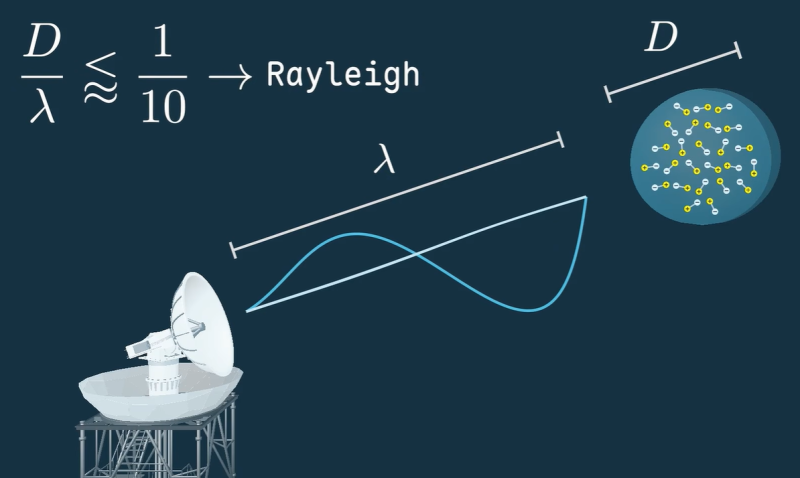
A good rule of thumb is that everything that can interact with electromagnetic (EM) radiation is an antenna, which includes our mostly-salty-water-containing bodies and also raindrops and moisture in the air. This can be both a benefit or a curse, depending on whether you’re trying to broadcast a signal in rainy weather or operating a weather radar. Here it’s essential to understand what kind of antenna a raindrop really is to optimize for either scenario, which is where a video by [Marshall Bruner] provides a solid primer.
The video focuses on the Rayleigh regime, which may be familiar from atmospheric Rayleigh scattering that also affects EM radiation in the visible spectrum, giving those of us gifted with retinas capable of color vision those nice blue skies.
As the EM radiation passes through these little droplets in the air, their neutral alignment gets disrupted and causes them to turn into dipole antennae, moving along with the incoming frequency. The backscatter part of this event is what returns to the emitter, such as a weather radar. Here the volume and permittivity of the moisture sphere determines the strength of the signal, which is great if you’re actually operating a weather radar and wants to map out the moisture in some clouds, including the presence of snow.
There’s quite a lot of mathematics involved which is covered in the video and expanded upon in a related Python notebook.












Radiowaves interact best with conductive objects of size being multiple of half of the wavelength. For an example droplet with one of the dimensions being ~3mm, that makes a resonant frequency of ~50 Ghz + all harmonics. Water also has a typical low natural conductivity which makes it a bad antenna, unless some substance make it ionized (HF radio over sea works great). So the explained phenomenon in the article is unlikely to affect you unless you work at 50+ Ghz.
Incompletely-informed claims like that omit dielectric constant and loss tangent. Wavelength of radio waves in liquid water is much shorter than in air, by a factor of 8-9, and water is essentially opaque (black absorber) in the 10-20 GHz region (depending on temperature).
Of course. But please stay on topic, instead of insulting people. Let me remind you:
– – The topic was “antennas”, not dielectric loss.
– – Liquid water is not “droplets”.
Dielectric loss in water is definitely a factor, but not for antenna function.
So, let me ask you specifically, what exact words from what I’ve written is actually wrong/misleading?
My apologies if that was interpreted as insulting — it was intended to be additional information to fill a gap: Resonant frequencies of dielectric-filled cavities (like a water droplet) is much lower than expected from dimensions alone.
A 3 mm sphere of liquid water is the same size as a half wavelength of a 50 GHz radio wave in air, but that doesn’t make it resonant, because the wavelength in water is much shorter (and I’m deliberately ignoring the Bessel function arithmetic to compute the actual resonant frequency of a spherical cavity).
A 3 mm droplet will be resonant at a much lower frequency than 50 GHz. How much lower depends on its dielectric constant (relative permittivity) at the frequency of interest. Liquid water has a strong and temperature-dependent absorption band around 10-20 GHz, where the relative permittivity changes dramatically, so it’s hard to predict the actual frequency, or its Q for that matter — it might be so heavily damped so not to be “resonant” at all.
I see, so the electrical length of the droplet is longer than the physical length, which lowers the resonant frequency. That’s a good remark.
I looked at some data online about how rain droplets change their relative permittivity with frequency, and it’s complete madness (which means predicting their resonances is completely non-trivial, at least for me). Thankfully I don’t plan to use a water antenna and will happily stick to my shitty end-fed random wire for HF.
There is a guy that works for the US Navy that built a device that uses saltwater as an antenna
https://m.youtube.com/watch?v=9tIZUhu21sQ&pp=ygURU2VhIHdhdGVyIGFudGVubmE%3D
The plural of an EM Antenna is “Antennas”, not “Antennae”.
Found the guy from Noah Webster’s Land.
Radio amateurs commonly use rain scatter for communication in the 10GHz band