
We often see scientific breakthroughs in journals or other media that’s reported on as if it’s a revolutionary technology guaranteed to reshape human existence, only to never hear about it again. A more cynical reason for this phenomenon is a certain amount of clickbait or engagement farming, but the real culprit often tends to be the discovery of a process that can’t produce the new material or effect at a scale that makes sense for mass production. One of those are MXenes (“max-enes”), a two-dimensional material first produced over a decade ago, but new research into them has developed a much more efficient way of producing them.
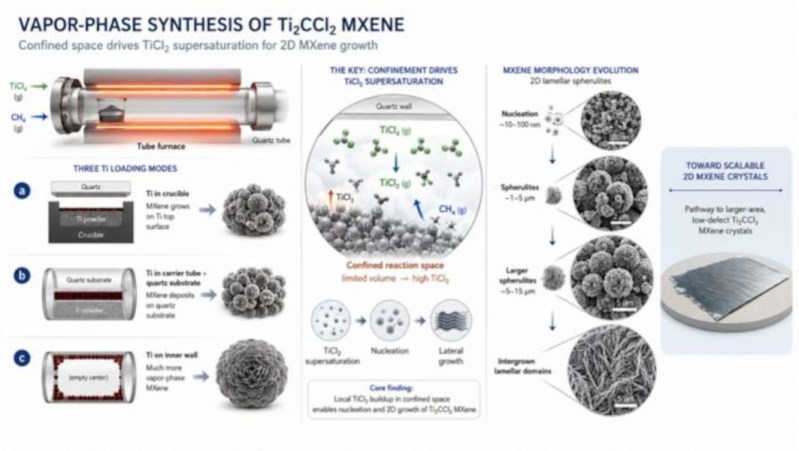
Before this discovery, these materials were produced in a convoluted process involving the MXene precursor materials, combining them with an etchant, washing them off, and then repeatedly spinning them in a centrifuge to separate out unwanted byproducts. As one can imagine, this doesn’t produce material in an industrial quantity. But the new method uses a vapor deposition process which simplifies the precursor steps using less expensive materials, as well as skips the etching step. After that, the researchers have found that the MXenes can grow in a much more controlled way, allowing for greater production amounts and higher quality.
In the intervening years since their discovery and first synthesis MXenes have shown potential for wide-ranging applications, from battery production to antennas to water purification. Another interesting application is as a switchable Faraday cage, as we’ve covered in the past. Hopefully the slow plod of scientific discovery continues and we can start seeing more of these incremental gains improving our lives, even if we don’t get a sudden technological revolution from it.












I believe that if “engagement farming” is in an academic setting, they prefer to use the phrase “publish or perish”
Can a true “two-dimensional” material even exist within the framework of a three(or more)-dimensional spacetime?
Even the atoms themselves are three-dimensional constructs. More, by some measures.
Obviously you cannot have a truly 2D object in 3D space (thickness equal of zero means that there is nothing), but being only one atom layer thick give some properties similar to a theoretical 2D object, so instead of saying “2D like material” is just “2D material”. Marketing stuff.