Two-Dimensional Material Now Easier To Manufacture

We often see scientific breakthroughs in journals or other media that’s reported on as if it’s a revolutionary technology guaranteed to reshape human existence, only to never hear about it again. A more cynical reason for this phenomenon is a certain amount of clickbait or engagement farming, but the real culprit often tends to be the discovery of a process that can’t produce the new material or effect at a scale that makes sense for mass production. One of those are MXenes (“max-enes”), a two-dimensional material first produced over a decade ago, but new research into them has developed a much more efficient way of producing them.

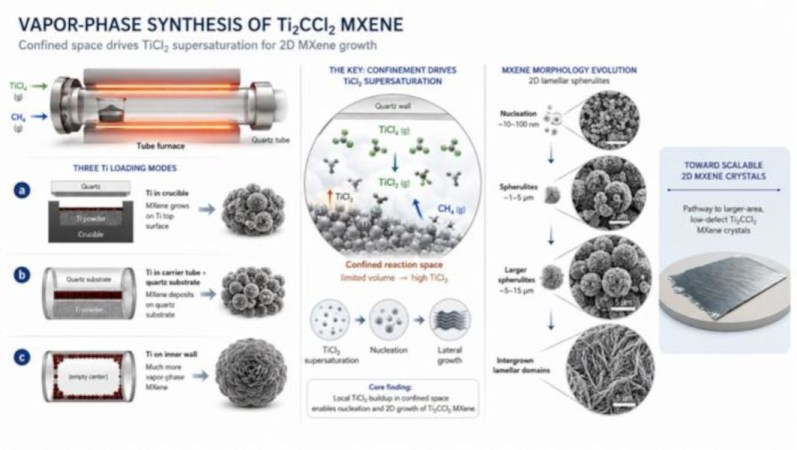
Before this discovery, these materials were produced in a convoluted process involving the MXene precursor materials, combining them with an etchant, washing them off, and then repeatedly spinning them in a centrifuge to separate out unwanted byproducts. As one can imagine, this doesn’t produce material in an industrial quantity. But the new method uses a vapor deposition process which simplifies the precursor steps using less expensive materials, as well as skips the etching step. After that, the researchers have found that the MXenes can grow in a much more controlled way, allowing for greater production amounts and higher quality.

In the intervening years since their discovery and first synthesis MXenes have shown potential for wide-ranging applications, from battery production to antennas to water purification. Another interesting application is as a switchable Faraday cage, as we’ve covered in the past. Hopefully the slow plod of scientific discovery continues and we can start seeing more of these incremental gains improving our lives, even if we don’t get a sudden technological revolution from it.
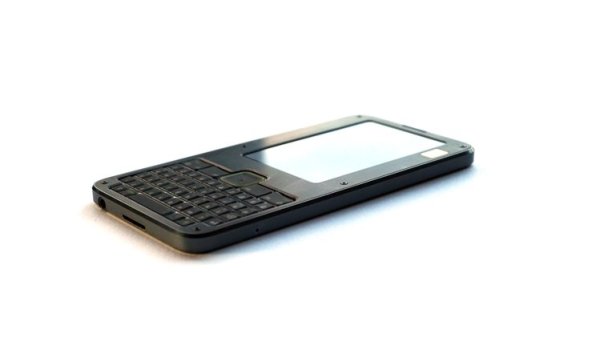
Here’s How The Precursor Protects Your Privacy

At some point, you will find yourself asking – is my device actually running the code I expect it to? [bunnie] aka [Andrew Huang] is passionate about making devices you can fundamentally, deeply trust, and his latest passion project is the Precursor communicator.

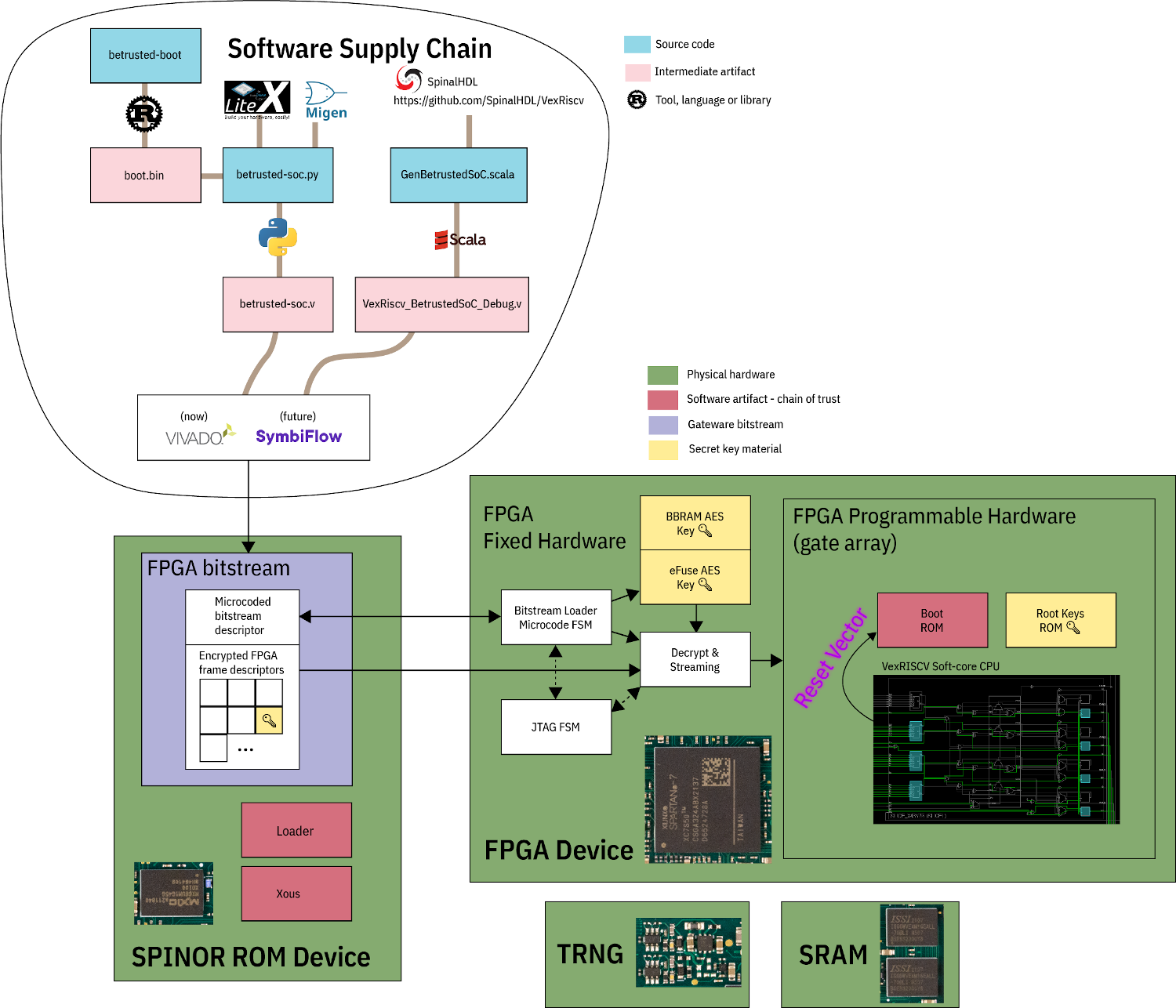
At the heart of it is an FPGA, and Precursor’s CPU is created out of the gates of that FPGA. This and a myriad of other design decisions make the Precursor fundamentally hard to backdoor, and you don’t have to take [bunnie]’s word for it — he’s made an entire video going through the architecture, boot protections and guarantees of the Precursor, teaching us what goes into a secure device that’s also practical to use.

Screenshot from the video, showing a diagram of how precursor's software and hardware components relate to each other If you can’t understand how your device works, your trust in it might be misplaced. In the hour long video, [bunnie] explains the entire stack, from the lower levels of hardware to root keys used to sign and verify the integrity of your OS, along the way demonstrating how you can verify that things haven’t gone wrong.

He makes sure to point out aspects you’d want to be cautious of, from physical security limitations to toolchain nuances. If you’re not up for a video, you can always check out the Precursor wiki, which has a treasure trove of information on the device’s security model.

As you might’ve already learned, it’s not enough for hardware to be open-source in order to be trustworthy. While open-source silicon designs are undoubtedly the future, their security guarantees only go so far.

Whether it’s esoteric hard drive firmware backdoors, weekend projects turning your WiFi card into a keylogger, or rootkits you can get on store-bought Lenovo laptops, hell, even our latest This Week In Security installment has two fun malware examples – there’s never a shortage of parties interested in collecting as much data as possible.

Bunnie’s Betrusted Makes First Appearance As Mobile, FPGA-Based SoC Development Kit

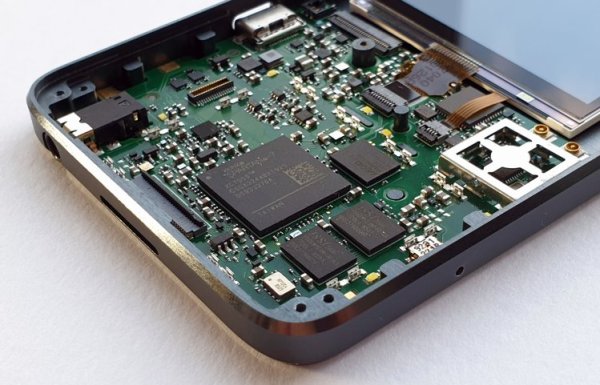
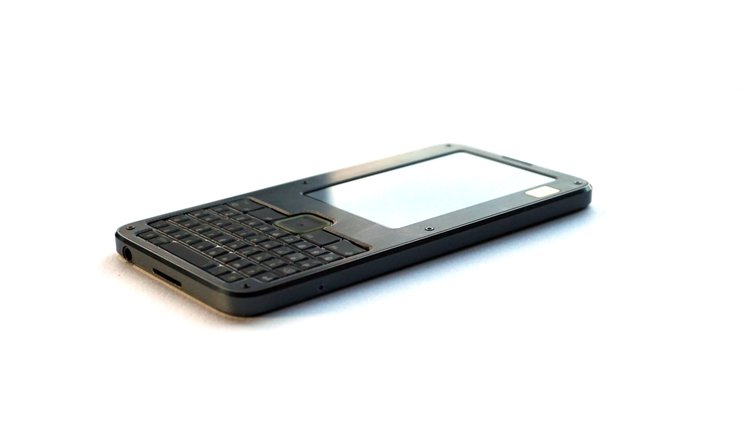
Recently, [Bunnie Huang] announced his Precursor project: a spiffy-looking case housing a PCB with two FPGAs, a display, battery and integrated keyboard. For those who have seen [bunnie]’s talk at 36C3 last year, the photos may look very familiar, as it is essentially the same hardware as the ‘Betrusted’ project is intended to use. This also explains the name, with this development kit being a ‘precursor’ to the Betrusted product.

In short, it’s a maximally open, verifiable, and trustworthy device. Even the processor is instantiated on an FPGA so you know what’s going on inside the silicon.

He has set up a Crowd Supply page for the Precursor project, which provides more details. The board features a Xilinx Spartan 7 (XC7S50) and Lattice iCE40UP5K FPGA, 16 MB SRAM, 128 MB Flash, integrated WiFi (Silicon Labs WF200-based), a physical keyboard and 1100 mAh Lio-Ion battery. The display is a 200 ppi monochrome 336 x 536 px unit, with both the display and keyboard backlit.

At this point [bunnie] is still looking at how much interest there will be for Precursor if a campaign goes live. Regardless of whether one has any interest in the anti-tamper and security features, depending on the price it might be a nice, integrated platform to tinker with.