
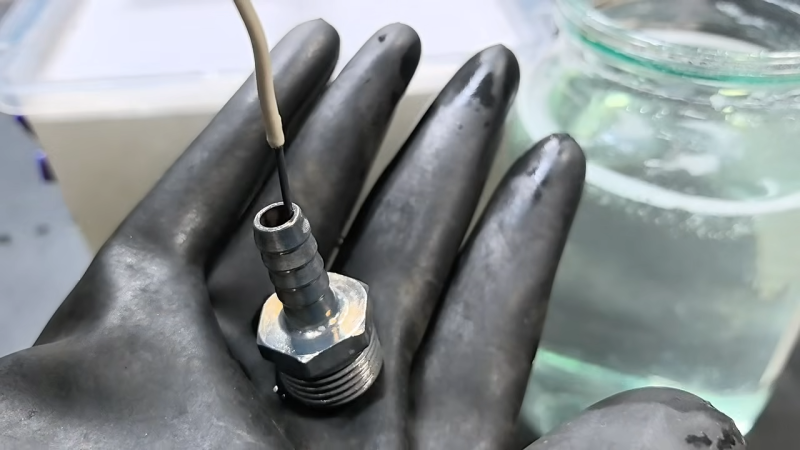
As useful as steel and iron are to the modern world, their tendency to rust is a major downside. There’s a spectrum of ways to prevent it, from quickly slapping on a coat of paint to alloying, chromizing, or physical vapor deposition. For a middle ground accessible to the home shop, galvanizing is a go-to method of rust prevention that deposits a layer of zinc onto the metal instead, but even this generally involves the use of strong acids. This method makes galvanizing accessible without any acids. (Spoiler alert: substitute strong bases.)
Although the acids are omitted, the solution is caustic, so similar safety measures are still advised. The first step in the process is to dissolve sodium hydroxide into a container of distilled water. Metallic zinc can then be dissolved in the solution, with a bit of sugar and liquid soap to improve the finished quality of the coating. An electric current is applied to the solution, using a graphite plate at the anode and the part to be electroplated as the cathode. After some time, the part will be uniformly coated in a layer of zinc, which can then be brightened in a solution of only-mildly-acidic citric acid if needed.
One of the benefits of using a strong base to galvanize a metal part, beyond the preference of avoiding strong acids, is that this process can be better at plating parts that are non-uniform in shape, so things with deep crevices or other odd shapes that might coat unevenly in acid. If there’s a preference for electroplating with acid, there are some ways of producing one’s own using various methods.












Let’s be a bit pedantic:
Metallic zinc doesn’t dissolve in the solution, metallic zinc undergoes oxidation and the Zn2+ ions dissolve in the solution.
As a retired chem prof, I’d have no problem using “dissolving” to describe the process. :-)
The Wicked Witch in Wizard of Oz … “Help me, I’m dissolving!” =))
How difficult is it (in practice) to galvanize with molten zinc? Die-cast zinc alloys are pretty easy to find in scrap. Zinc melts at a fairly low temperature; in my foundry period I cast zinc parts in a homemade furnace with a good bed of charcoal, using a cast-iron pot. An air assist from a small blower helps. Undoubtedly the part needs to be cleaned first (in acid? :-( ) But I don’t know the specifics.
People do this… look up hot dip galvanization which is exactly what you described l. I dont know squat about it other than what I saw when Edd China had it done to a range rover frame on his YouTube channel
To add to KDawg’s note, go down to your local hardware/big box store and buy a pack of hot-dip galvanized nails to inspect. The upside is that hot-dip galvanized items are really well protected against corrosion, better than with other forms of galvanizing. The downside is that the zinc coating is thick and often somewhat lumpy, so you lose dimensional accuracy.
I suspect the issue is that you need to create and maintain a bath of molten zinc large enough to fully dip your item in, which quickly becomes quite a lot of zinc, requiring quite a lot of therms to keep molten.
There’s the obvious safety issues but also non-obvious ones like any cavities that could trap air can create a problem either through not allowing zinc to flow in, or by exploding and throwing molten zinc in your face when dipped. The opposite problem is accidentally filling a cavity with a solid mass of zinc that can’t flow out – you need to drill extra (quite large) holes in any hollow parts to allow zinc to get in & out again.
The heat of the process can warp any thin/delicate parts – even big lumps of old cars can warp if dipped without care and extra supports / bracing.
Also hot dip can be quite thick & lumpy so not ideal for small parts.
You need very clean iron (or whatever) and a flux. Just like any soldering or brazing process.
So, remove mill scale with acid or sanding/grinding. Wash with detergent.
Both base metal and zinc are oxide-coated at working temp, so this is just to make things easiest once the heat is on.
The flux is zinc chloride, which has a nearby melting point, and partially decomposes at that temperature, providing a source of acid that converts other oxides, carrying them away in a salt melt. Probably coat the workpiece first, or float a layer on top of the zinc.
ZnCl2 is best at soldering temps (tin and lead), and will be more volatile at molten-zinc temps; work quickly (but not so quickly that moisture gets trapped and combined with a pool of molten metal..!).
Soldering paste flux might work, but beware most have an organic base that’s fine for tin-lead alloy, but may decompose (carbonize) at this temp, blocking metal surface contact. If it just evaporates (waxes, light glycols?), it’s probably fine. Avoid anything that contains solder particles (although I guess tin is okay, Sn-Zn alloys are reasonable — might not be as good galvanize in that case though?; Pb isn’t very miscible with Zn and, beyond a little that does dissolve, will sink to the bottom).
Speaking of alloys, low Pb is preferred, as that’s the cause IIRC of potmetal crumbling over decades. Al is generally a good combination with Zn and I suppose would be fine in galvanizing (both are anodic) but I’d want to look up some articles on this first, if it’s something that needs to be long-term reliable (maybe the Al-Zn couple corrodes itself faster, or Al-Fe intermetallics are worse than Zn-Fe). (Aluminizing can also be done (popular in automotive parts), I assume working fast enough to avoid substantial intermetallic growth; this would use a NaCl-KCl-CaCl2 salt cover, probably with some KF to improve solubility of iron and aluminum oxides. Also a good flux to loosen aluminum oxide, for those of you practicing foundry. Salvage all that goopy dross!)
You can make ZnCl2 from the metal and acid, but mind it doesn’t dehydrate simply like NaCl; the hydrated and anhydrous salts are different beasts (the underlying reason (covalent bonding, Lewis acid character) is also in part why its melting point is usefully low) and you’ll end up with a mixed hydroxide mush. It’s still functional enough as a flux; just not pretty. Or just buy fresh — get the anhydrous stuff.
A chrome wrench is pictured above. I don’t think ZnCl2 is strong enough to flux chromium oxide (the protective oxide of plating, stainless steel, etc.), for which you probably need some nasty shit like potassium bifluoride (mixed with others, maybe a KF-NaCl-KCl eutectic..?). An electrolytic bath is probably the better choice. The surface oxide might reduce under given conditions; worth a try. Plate on a thick enough layer and try to knock it loose; solder another piece of galvanized steel on and see where the layer peels off from, examine the joint. Might also be that the surface oxide can be etched off by anodizing in NaOH (without Zn, making a little chromate in solution), or washing in strong HCl (rinse off briefly then transfer while still wet). The better question is, why are you galvanizing something already chrome-rich, though :^)
Strong bases can be just as bad as some strong acids. Any time you’re off that happy nominal median of pH, chemistry wants to happen.
A strong base (high pH) is even more damaging to tissues than a strong acid (low pH), since it quickly saponifies fats. Get NaOH solution on you, and it turns your skin to soap. (There are some acids such as HNO3 and H2SO4, or even weak HF, that have their own dangers besides pH, though.)
If you must try this experiment, wear a full face shield, gauntlets and plastic overalls, and keep a bucket of weak citric acid or plain vinegar handy for immediate use!
Would a flask of weak lemon drink suffice?
The actual first aid is just to rinse it with plenty of water for half an hour. If you introduce acids, the reaction between the two produces heat and gases and salts in the affected tissue, so you’re just adding injury to injury.
10% NaOH solution is strong enough that it can do some real damage, but not instantly. You don’t need to panic, but don’t let it stay on you because it will burn you.
People have been using lye solutions to wash their clothes for ages, by hand, and while it’s a little rough it’s not exactly melting your skin off.
The most immediate danger is getting the dry NaOH powder onto wet skin or into your eyes. Then it’s most concentrated and it heats up tremendously when it dissolves, so you get a thermal burn as well as a chemical one.
Sodium carbonate is VERY different from hydroxide. It doesn’t (or anywhere near as quickly) saponify, or attack proteins. I can’t recommend soaking your hands in the stuff (or concrete, which does have some free Ca(OH)2 so is a bit stronger) but you won’t lose skin super fast in it. Fine for a few minutes, problematic for occupational exposure (or sensitive skin).
NaOH solution, more than a few percent I think, splashed in the eyes, is very likely to cause loss of that eye, even if washing is administered promptly.
I’ve heard of eyeballs surviving a droplet of nitric acid before — a layer of converted (yellow, nitrated!) skin eventually sloughs off — but there’s no natural neutralization or structural protection against alkali.
Acid is surprisingly easy for biology to deal with; not that the human body has external parts evolved to handle that, but there are bacteria in acid mine drainage at low pH (<1?). There are extremely few things that live in alkaline lakes, and those are limited to pH 11 or so by atmospheric CO2. Literally nothing survives at pH 14.
Nobody’s talking about sodium carbonate. Lye is NaOH.
This gives me an idea for a funny terrorist attack. Fill a 100 ml syringe with strong NaOH solution, hop on an e-bike and go for a ride in the park. Someone sitting on a bench better wear goggles or it’s joever for their sight. At first the victim will think it’s some kind of a prank. Once they realize what’s happening it’s gonna be too late to react properly. Awesome!
“Animal fat soap smells” NO. It does not. I was given a chunk as a kid by a neighbor’s maid (housekeeper to the picky).
Actually, it depends on whether the kike took a final bath before he underwent saponification procedure.
People have been using lye solutions and animal fat to make soap to wash their clothes for ages
Animal fat soap smells, and lye was cheaper to use as-is, especially back in the 40’s and 50’s. After that, laundry detergents became cheaper and more available.
There were accidents, often with little children drinking the concentrated lye solution.
For a safe demonstration, pour some Chlorox or other chlorine bleach into a vessel, dip your thumb and first two fingertips in it. Rub those fingertips together. Feel that? That’s what it feels like when the sebum on your skin is saponified.
From a biological perspective, strong bases can be significantly more hazardous than strong acids. While direct exposure to either strong acids or strong bases is likely to cause tissue damage, strong bases often do it far faster.
For example, if you get strong acid solution (like HCl) in your eye, it’s going to be a bad day but if you immediately flush your eyes with copious amounts of water there is a decent chance of limited vision damage. Strong acids tend to cause everything to clump together serving as a sort of protective barrier (limiting penetration)
Get a strong base solution (like lye) in your eye and the cornea will turn milky almost immediately as the strong base denatures the proteins in the cornea, resulting in substantial permanent vision loss. This is because unlike acids, which can form a bit of a protective layer, bases do the opposite. Due to the presence of lipids in the cell membrane and various other structures in the body, strong bases will rapidly and readily degrade (aka liquify) everything they contact. As a result, they can penetrate quite deeply into the tissues allowing to the to do far more damage in a shorter amount of time. A classic example of this liquification is rubbing a small amount of lye solution between your fingers. It will fill slippery and soapy as the lye breaks down the fatty acids in the dead skin cells on the surface of your skin, turning them into soap.
Oh good I feel much safer with my plastic tub of lye and zinc oxides now that I know there’s no scary acid involved :D
Apparently I’m not allowed to write that this youtube channel is obviously a traditional lure for button presses of a mechanical rodent, with all the videos titled appropriately.
As such, it’s highly likely that the methods or procedures presented may be inaccurate or ineffective and the presented results may be fabricated. The viewer should be aware of this.
Seriously. The automatic moderation is getting obnoxious again.
It’s as if they’re actively defending that which shall not be mentioned by name, but can be described as predatory attention capture for information collecting and advertising purposes.
It’s clickbait. If they delete your comment just post it again lol.
It seems if you do that, they put you on a shitlist and then none of your comments go through.
“basically”
“without acid”
Heh. :)
A true litmus test of quality humor! 😂
I recently zinc plated a pair of rusty multigrips and some bolts using vinegar, salt and sugar. I cant remember the exact mixture (got it off the internet somewhere). Worked very nicely and was quick.
What’s the explanation of the base solution being better at getting down into nooks and crannies than acid? Seems like both work on irregular surfaces, but I could be wrong. Why would you want to avoid acid but not avoid a very strong base?