

If you’re interested in aerospace, there’s an excellent chance you’ve heard the rumor that NASA is trying to get its SR-71 flying again. Or at the very least, they are interested in what exactly it would take to bring the iconic Mach 3+ spy plane back online.
The story started a couple of weeks ago when NASA Administrator Jared Isaacman announced the agency would be reinvesting in their famed “X-Plane” experimental aircraft program in an effort to get “back in the business of flying high and fast again.” Not long after, keen-eyed observers noted that the SR-71 that had been sitting on the tarmac at the Armstrong Flight Research Center in California had been moved to an unknown location. Several individuals who worked on the plane while it was operational have since claimed NASA representatives contacted them about potentially refurbishing it.
 So will the Blackbird fly again? Almost certainly not. It would be hard enough getting even a normal plane airworthy after sitting dormant for nearly three decades. But when you’re talking about a bird as rare and secretive as the SR-71, the challenges would be almost insurmountable. Of course, that doesn’t mean there aren’t some valuable lessons to be learned by studying the idea, and we imagine that’s what NASA’s really after.
The SR-71 is one of the fastest planes ever built, but it’s got nothing on an orbital spacecraft like the SpaceX Crew Dragon, which earlier this week set the record for the fastest rendezvous with the International Space Station by an American vehicle. The Crew-13 mission lifted off from Cape Canaveral Space Force Station at 11:10 AM Eastern and docked with the orbiting laboratory at 7:05 PM — a total elapsed time of just under eight hours.
While the crew was more than happy with the relatively speedy commute, their trip was still considerably longer than that of their Russian counterparts. The Soyuz capsule can reach the ISS in around three hours under ideal conditions, and even when it uses the slower rendezvous profile, docking takes place about six hours after launch. Counterintuitively, this doesn’t mean the Soyuz is actually faster or more capable than the Crew Dragon. Instead, it’s down to logistics with a sprinkling of the arcane magic that is orbital mechanics.
At the other end of the speed spectrum, Christie’s is currently running an auction for one of the printed packets sent via carrier pigeon by the Bergen Linux User Group in Norway in 2001. It is one of nine such physical packets that were sent as a real-world demonstration of RFC 1149, A Standard for the Transmission of IP Datagrams on Avian Carriers.
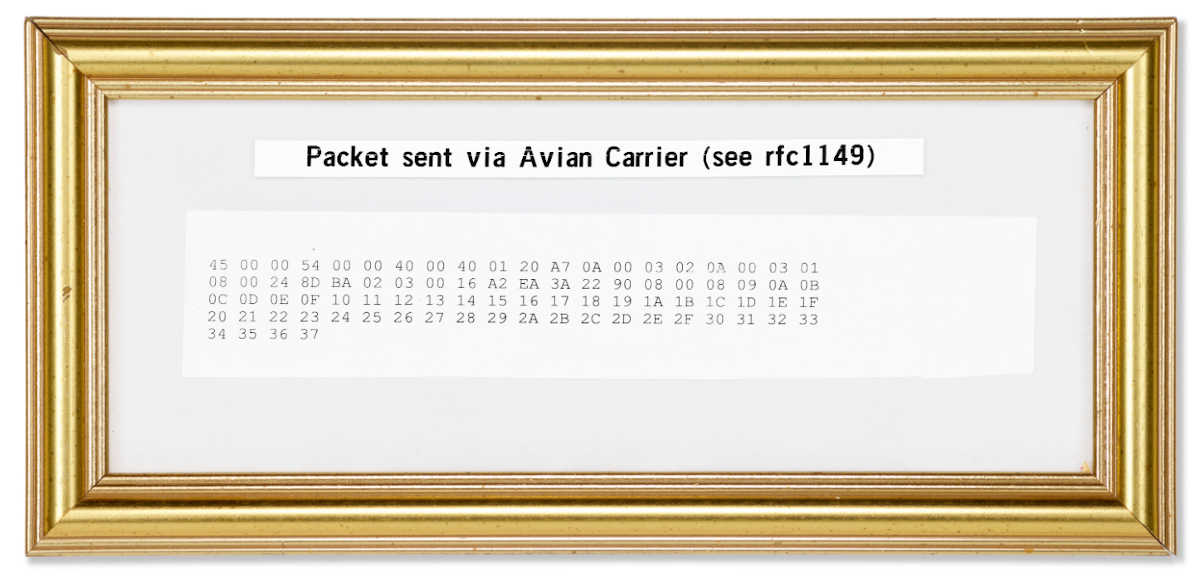
This packet in particular was later presented to the author of RFC 1149, David Waitzman, and comes in a golden frame befitting such an auspicious datagram. As of this writing, the auction still has nine days to go, and the high bid is sitting at $2,600 USD. We’ll keep an eye out and let you know what it sells for in the end.
We saw an interesting article on PCWorld a couple of days back about a player getting banned from Valorant once they tried running the game on a used CPU. After contacting support, they found out that the Ryzen 7 5800X3D in question had been blacklisted by the game because it was previously used by a cheater. In addition, as the system had now detected it being used in a different computer, the identifiable components of that machine had also been added to the block list.
If you’re building a gaming machine on a budget, this is something of a nightmare scenario. But if this becomes more common, it strikes us that there’s some potential here for those of us interested in buying used hardware for more practical purposes. If you’re on the hunt for a good deal on a high-end CPU so you can crank out builds faster, the fact that it might be banned from the latest loot shooter isn’t really a problem. It’s a bit like looking for a phone with a bad ESN because you want to use it on WiFi or need some of its parts.
Finally, we’ll leave you with a fun little diversion: Hole Punch. This game tasks you with steering a spacecraft around various obstacles to reach a target location. Sounds easy, until you realize that you’re not the one flying the thing. Instead of having direct control over the vehicle, you play as an omnipotent creator who can create and place black holes at will.

Placing a black hole creates a gravitational field that will curve the spacecraft’s trajectory as it goes by, so by adjusting the size and placement of the holes, you have an indirect method of controlling the craft. Creating a black hole consumes matter, and you only have a finite amount to work with, so use it wisely. Let us know how far you get in the comments.
See something interesting that you think would be a good fit for our weekly Links column? Drop us a line, we’d love to hear about it.












It is basically a Mach 1 plane if they can not get the special fuels and refueling systems with inert gas pressurization. It is allowed to refuel with stuff used by the fleet only in an emergency to save the airframe.
I think someone placed a blackhole near the SR-71.
i gave up hole punch at sector 8 the white holes are too complex for me.
Fusion path
https://phys.org/news/2026-10-path-fusion-ignition-fuel.html
I was finally able to solve Hole Punch Sector 8 (on my own) with a lot of trial and error. Working on Sector 9 now. Great game!
Ahhh … typo … I cleared Sector 9 already. Meant to say working on Sector 10 now. :-)