
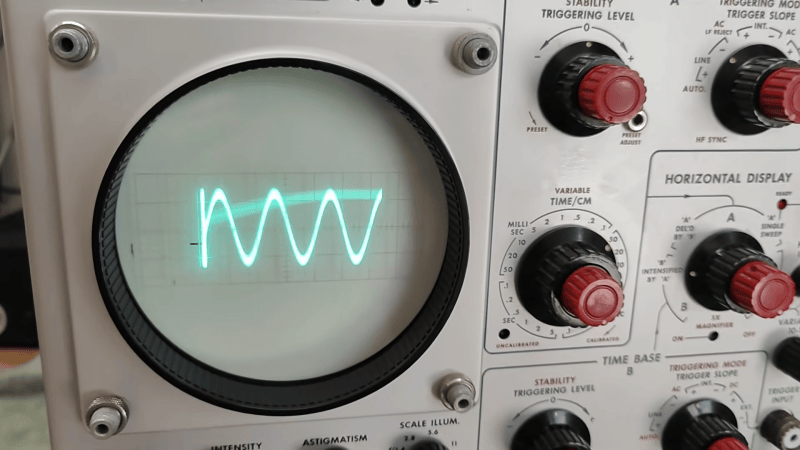
When [Thomas] showed his 1960s-era Tektronix 545A oscilloscope in a recent video, it made us both nostalgic and happy. Nostalgic because we miss the days when our oscilloscopes were “mainframes” that could take plug-in modules. Happy because we noticed the two handles on top to manage hauling the almost 70 pounds of tubes, transformers, and glass around if you didn’t have the requisite cart.
Not only did old scopes have plugins so you could reconfigure them, but there were also handy plugins and racks that could power them so you could build different test setups easily. This scope was an early version of that idea, but it only accepted a vertical section plugin. The mainframe part of the scope has 75 tubes, and the plugin, a type D, has six tubes, too. The power consumption was about 500 watts!
If you’ve used a scope like this before, you’ll probably remember a lot of the oddities mentioned in the video. If not, you’ll gain a new appreciation for your modern, sophisticated, and lightweight scope. Of course, the old boat anchor wasn’t working. Apparently, these scopes had ceramic points that didn’t like regular solder, so there was a spool of silver solder inside the unit for repairs.
[Thomas] made a lot of progress, although it still needs work to get it working perfectly. We have no doubt he’ll get it working in time. Even the graticule on these old scopes was an issue.











Nothing like those good old times when even basic test & measurement equipment was available only to corporate, universities and greyharied bitter old men. It should be forbidden by law for a 19 years old university freshman to buy his own Rigol 1052E, 0-30V 5A PSU and STM32 dev board to study and gain experience at home instead of waiting another week to test his code in class (assuming it even compiles and works).
Why am I thinking of four Yorkshiremen?
We ‘ad to grow our own forest, harvest t’ trees, pulp them, turn them into cards, build a punch and put the holes in t’ right place, and if you were lucky then it would compile.
IYKYK – and if you don’t, why not? There’s a language you’re probably using named after them.
…and when we got to University, the lecturers would kill us and dance about on our graves singing Hallelujah!
Yeah, I remember a time when I was studying engineering and worked as a consultant at the same time, where a customer — a small startup literally working in the basement and without any advanced instruments — had a problem with a motherboard he was putting together and we had to take it to the university lab to get things sorted out on their very expensive scopes … We got it fixed. 😁
──────────
PS: I’m not the Mr. T I’m responding to
Huh? When I was in school, I had a scope. Heathkit. Still have it, in fact. Some assembly required, of course. Still works, but I do need to recap, as some of the original were, shall we say, of the day.
Actually had the second one before I got out. Tektronix unit out of Eli Heffron’s. Manageable on a grad student budget, though not with the exact configuration I wanted. I think I ended up getting one module from BNF (IIRC. I think they were up in Lynn, or maybe Peabody? Young’s was in Salem, but more mechanical stock than electronics… Might have been one of the flock out in Natic and Needham and… Most all provided mail order, as well. Plus the California set. And the Chicago set. And, of course, the Manhattan set, some of which survived the Trade Center in the late 60’s/early 70’s), in the end. (If you know those names, your beard is (or would be if you had one) faded past gray)
Next was the $10 HP scope. 130C. Nominal was 500KHz, but actual was closer to 16MHz, with allowance for linearity and frequency response curve. MIT swap meet maybe the first year or two. Also bought a Fluke 8000A there, from my then boss. Bas***d wouldn’t just let me take it when he took it off inventory. “That a valuable piece of test equipment!” Paid peanuts, since, by that time, they were sorely outdated and no one else even looked at it, but for a general purpose at home bench meter, it was fine for me. Collectable now, I am sure. 8030A was my carry around at that time (I still have both. Both still kick butt. The 8030A has been rebatteried with NiMH nee the NiCd)
Equipment was VERY available going back to the 1940’s (the post-war surplus was before my time a little, but set the tone for the high tech surplus and second hand market), and, like today, the price for one or two generations out was affordable even to students. Today, you can buy two gen out gear new, for basically peanuts. Then, it was, shall we say, mature. But still fine. Need 5GHz today? Good luck. ‘Taint cheap. 50GHz? Higher? Good luck as a college student without a trust fund.
Lived in Boston around those times – familiar names… BNF was in Lynn – Pete Boniface and Frank Fink. I was there shopping and one of them handed me a 555 and a data sheet and said that this was a really fun chip.
They were also into electronic music and came out with their Aries modular Synthesizer.
Don’t forget John Meshna – he did a lot of military electronic surplus.
American Used Computers was in Kendall Square – they sold and maintained IBM mainframe clones to businesses. Sonny Grinker (?) then opened a retail outlet for IMSAI and other single board computers – worked there for a few years.
I can’t remember my own name half of the time anymore. Most of the Rt128 loop has left the building, so to speak.
Abbott still sticks in my head (really nice people. I still have a box of gang contact pushbuttons with mechanical flag indicators from them. Negotiations were involved, and the full lot cost less than the 30ish I needed at tag price), and one that was in the same complex as one of the building 19 stores in the 1980’s. There were maybe a dozen just out there. Plus several kendall square/MIT region- I never had the lettuce to even talk to AUC, but did at one point work on a machine that may have come from them. Sperry, maybe? The north region was it’s own world, with several in Salem and Lynn, and in the mid 1980’s, several places in Peabody, Lynnfield, and even up into Lowell.
I picked up a Computek vector terminal from one or another of them, again for grad student money, for the 10bit high linearity DAC’s, with a bonus Tek611 storage display in it. All long lost to many, many changes of address.
I do miss that retail world. Nothing like it anymore.
And let us not forget the wonders on Laval/Montreal, like the Madison. C’est jours la me manquent vraiment.
Well, it’s not a Hameg 312 but more advanced than my humble Trio CO-1303D..
Elmhurst college, Elmhurst Illinois, USA. I would hang out at a particle accelerator lab that they had there when I was about 13 years old. The accelerator was called a Kevitron and it came from the University of Chicago. The students that were there were absolutely awesome. I learned more about electronics from the year or so that I hung out there than almost any other time in my life. One day I was garbage picking at a camera shop that was downtown Elmhurst and pulled out a Tektronics scope camera. The next day I went and visited the lab and talked to Ken who was a student there. I showed him the camera and asked if they were interested in it. He promptly took me to Dr. Swallows office and I showed him the camera. His eyes lit up and asked what I wanted for it and my reply was an oscilloscope. He took me to the storage room and gave me a glorious gigantic Tektronics. I don’t remember the model but it was similar to the one pictured with no interchangeable modules and the service and owners manuals with it. It was military surplus donated to the college in the late 70’s. Going through the calibration procedure showed it to be in good working order. You could calibrate the scope using the scope! It also had the roll of silver solder in the back of the chassis. On cold winter nights I would turn on the scope and it would warm my bedroom! Great times!
We had one when I was a kid, from MARS. it was a dual trace of this 545 with plugins. It always made a smell after while, not in a good way. We discharged it fully and took off the cover and found a dessicated mouse in the fan exhaust ductwork.
My father worked as a technician at Tektronix from 1966 until 1996. He helped me get a 545A ‘scope that I got at a Hamfest around 1978 or so to work. I was 16 at the time. Over the years I bought mutliples of 545 and 535 (The lower bandwidth model, 15MHz instead of 30 MHz) ‘scopes, repaired them and sold them at Hamfests.
I was still using a 545A well into the 2000s. I also used it as a space heater in my shack when it was cold out.
I use a boring digital ‘scope nowadays. But I can easily hold it in one hand.
With a drawer full of tubes, our shop 67B on the USS Tidewater repaired those scopes on a daily basis. Calibration was fairly easy, and Teks unique manufacturing and assembly in “rows of components” made troubleshooting, replacement a breeze. Don’t forget the little reel of silver solder. (:-)..