
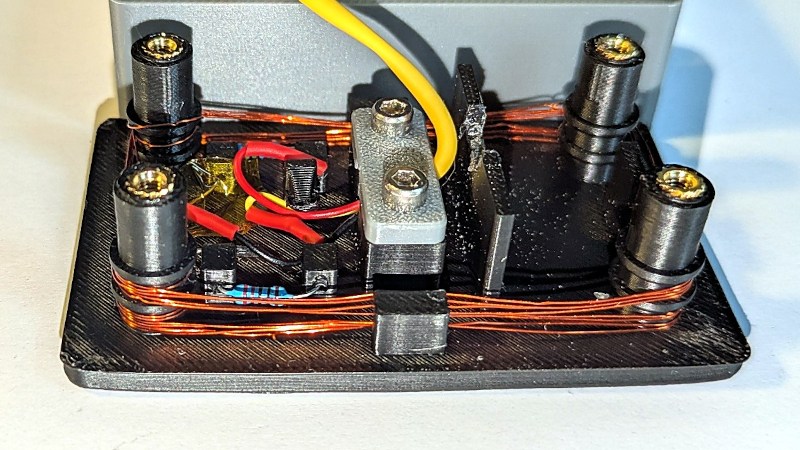
As the legacy AM broadcast bands fade away, what happens to the millions of devices built to receive them? Many of them will go into e-waste, but with a century of radios to choose from, some of them are collector’s items. Vintage tube radios like the ones [GarethDaviesLondon] has would go silent, so he’s made a small AM transmitter to keep them alive.
At its heart is an ESP32-S3, which takes an online radio stream and transmits it through RF generated with a pulse chain on a GPIO. Generating analogue signals from radio to video with a microcontroller is nothing new, but perhaps the more interesting part of this one comes in how he radiates enough from that pin. There’s a 3D printed box with stand-offs designed to take a widely spaced wire coil, which is enough for the vintage electronics to pick up. He makes the point that it may not be legal, but at that power we doubt anyone will notice.
The output on this one is 200kHz for the European long wave band, but we’re guessing a higher medium wave frequency could also be generated. Meanwhile if you are curious about AM, we’ve featured someone having a closer look at it.








Many years ago, the analog version of this was called a “Phono Oscillator” You fed audio from any source you wanted to it, and it served as a small AM transmitter. They were actually legal if they followed the specified rules about power input and, I think, antenna size.
In the US, the limits are 100 mW input power to the final and a 3 meter antenna (including the feedline and ground). The output has to be clean though. This thing has no filtering so it’s going to be spewing harmonics well up into the VHF range.
N.B. the creator notes that this is illegal in most countries, and will stomp over many other services at harmonics of the fundamental.
The creator notes he has not bothered to test it with a spectrum analyser!
I woldn’t call this thing a “transmitter” as it has no real “antenna”. The loop is untuned and is just an additional coil on the radio’s loopstick. Electromagnetic radiation will be negligible, Induction cookers and wireless chargers are worse by orders of magnitude. The only nasty thing here is that PWM harmonics will kill the MW-band on radios placed near the coil.
It doesn’t matter what you call it. Don’t get into the “there’s no such thing as a true antenna” trap https://en.wikipedia.org/wiki/No_true_Scotsman Maybe you think EMI doesn’t happen because the generator doesn’t have an antenna per sec? The creator knows they could have used a spectrum analyser to assess the power, but chose not to.
I have done something similar but without the illegal transmitter air gap; using an FM modulator made for car radios without aux input. it plugs in directly into the FM antenna input of my tube radio! Well not directly directly, full setup is wifi > Chromecast audio with 5V power > FM modulator with 12V power> Balun bringing antenna impendance from 75 Ohm to 300 Ohm > tube radio. Not to mention the variety of 7 types of plugs, but it works! Dreaming of building V2.0
wifi > SDR > tube radiosome time.Edit: Wow md works here! Updated comment: I have done something similar but without the illegal transmitter air gap; using an FM modulator made for car radios without aux input. it plugs in directly into the FM antenna input of my tube radio! Well not directly directly, full setup is
wifi > Chromecast audio with 5V power > FM modulator with 12V power> Balun bringing antenna impendance from 75 Ohm to 300 Ohm > tube radio. Not to mention the variety of 7 types of plugs, but it works! Dreaming of building V2.0wifi > SDR > tube radiosome time.How is this news worthy? There have been hundreds of these projects over the years. Most of them much better.
Any link to at least one of them ?
Search for BH1417F fm transmitter and you’ll turn up the usual suspects to sell a kit to you. 15mW typical power output, so if you stay away from the existing frequencies, nobody will even notice your transmissions unless they’re in the house as well.
I have an old 1930s console radio that has been in my family since new. It has a lot of restoration needed before it can be used. One day I will get to it.
Anyway.. I obtained the schematic. It included instructions for adding a phono socket. I guess it was a standard thing to take it to the shop and get this socket added if one wanted to connect a record player. I think that makes this mod original enough to still be period correct does it not?
Anyway.. for this mod as-described one uses an octal socket. I suppose those were pretty common back then since so many tubes used them. And, what it does is it breaks the connection between the demodulated audio from the radio and the audio amplifier stage sending it out one pin and back in another.
But.. several pins of the octal socket are unused.
My plan.. when I get to it…
• Also send filament voltage and ground out to a couple of the extra pins.
• Wrap a wire around something in the if stage, somewhere in the circuit that is good too add a BFO for CW/SSB and connect that to another unused pin.
That second part… once I get it working.. I want to check and see if turning up the gain causes it to oscillate like a regen even though this is a superhet.. might not need that bfo.
But anyway.. I am thinking I can build a little set top box with a bypass switch to actually use the radio but also include one of those cheap and dirty bluetooth receiver/usb/sd card reader/mp3 player modules. The one I have lying around even includes an FM receiver. I can power it via that filament line so no batteries or extra power wires. And.. if I need it I can have a BFO in that box for CW/SSB reception, all with one cable going to one period-correct octal socket.
I bet a lot of radios had such an option. I think that might be the way to go for this project.