
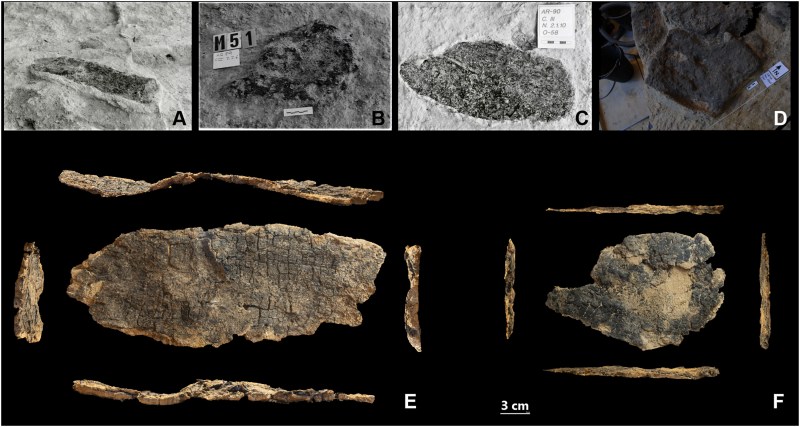
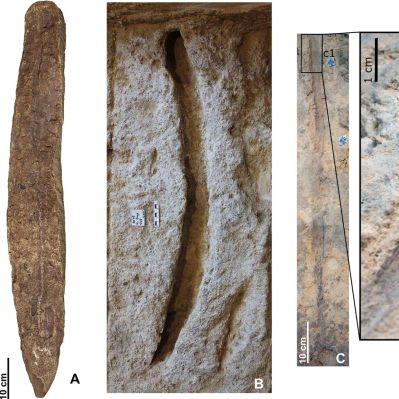
 The Abric Romaní site in Spain is rather unique in archeology for one simple reason: the caves in its limestone-rich cliff have seen humanoid occupation for thousands of years. A thick layer of calcium carbonate-based travertine deposit has, over time, covered and largely preserved tools and other implements, including those made of wood. Over many decades of archeological exploration, 597 wooden imprints have been uncovered, with a recent research article by [Palmira Saladié] et al. detailing these findings.
Wood is one of those archaeological artefacts that are very elusive due to their fragility, even though we know that wood has been used pretty much everywhere from the first day that a humanoid critter discovered that branches make great clubs and spears, and can also easily be shaped to make them even more useful.
The wooden imprints and some larger remains of wooden implements were found, ranging from wooden spears and clubs to trays (see heading image) and tripods. With enough of the wood still present, researchers were also able to determine which types of trees were used to make these tools, and sometimes which part of the tree.
These finds date back to between 62,000 and 40,000 years ago during the Middle Paleolithic era. This would have been around the time that Homo sapiens began to move into Europe, with both species of humans living side by side for thousands of years. These days, the only active traces of this can be found in our DNA, which retains bits of H. neanderthalensis.
The supplemental materials PDF breaks down some of this site’s more recent history. The sole reason that this crucial archaeological site was discovered was that the landowner in the early 20th century expressed a profound interest in archaeology and other natural sciences.
Thanks to this lucky find, we gained some insight into how our ancestors would have learned how to create crude wooden implements, before eventually moving on to smelting metals and eventually sand in order to make it into computer chips.












humanoid? humanoid critter ? you´re plain disgusting.
Don’t clutch your pearls so tightly-the string will break!
Humanoid (adjective): “Having the appearance or characteristics of a human.”
With ‘critter’ used in the affectionate sense, naturally.
You’re welcome :)
This makes me realize how rare it is that we make tools ourselves these days.
I only did a handful really, for the rest it’s all bought stuff.
Bootstrapping civilisation from first fundamentals is definitely not easy. We take so many things for granted today, including metallurgy and getting tools from the local DIY store, but as an early humanoid sticks, rocks and flint were all you had to work with.
Definitely a testament to ingenuity that we worked our way up from those basics, courtesy of individuals trying out some fresh hacks to see what it’d do :)
To borrow from an old joke: country A digs until they reach 3000 BC strata and find copper wire bracelets: “clearly our ancestors had wired networks”, country B digs down to 5000 BC strata and finds glass jewlery: “clearly optical fiber was used”, country C digs down to 10000 BC, finds nothing and declares: “clearly our ancestors were using wifi”.
We talk about the stone age, copper, bronze, iron but there was a wood age. We used wood everywhere and it wasn’t until metal got cheaper and we had plastics.
They had lots of wood tools and we should include that when we speculate about before, during and after the other ages. I’m glad there is a street light over these wooden tools, because we’ve been looking under the ones that had metal.