
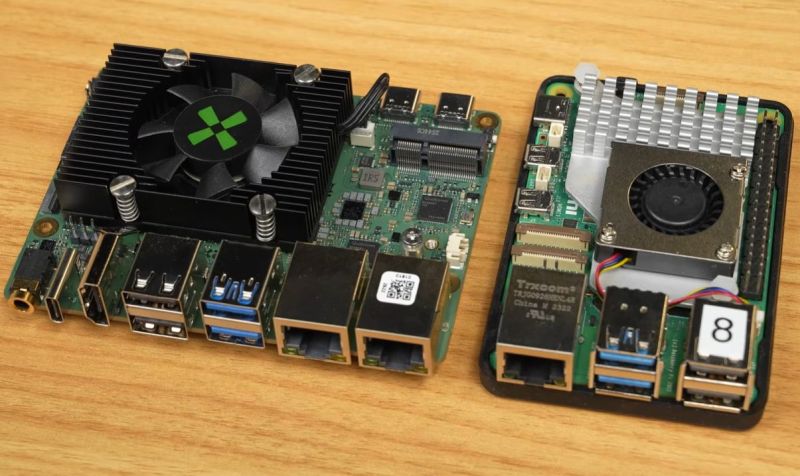
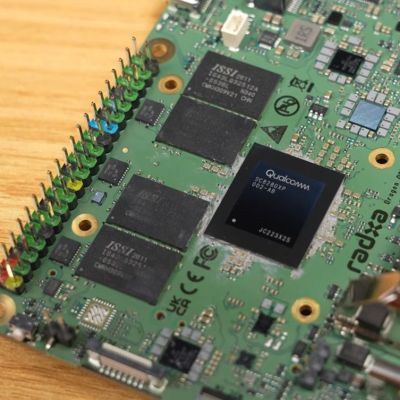
 Although the asking price of $209 plus shipping seems high for the Radxa Dragon Q8B, featuring the Qualcomm SC8280XP and 8 GB of LPDDR4X, this is 2026, and amid the RAMpocalypse, even the 8 GB LPDDR4X-equipped Raspberry Pi 5 now costs $175. This, to [Jeff Geerling], makes it fair to directly compare the two to see whether you may want to consider this board for more intense computing purposes.
There’s also a written summary of the results and details in a GitHub issue, though the direct comparison with the Raspberry Pi 5 is in the video.
Although this Qualcomm SoC isn’t new, its primary use is for Windows laptops, which gives somewhat of a hint as to what its performance may be like, tempered by the fact that it was announced in 2021.
The Dragon QXB offers about 2x everything over the RPi5, plus Windows and UEFI support. For Linux, it appears that you still need customized images, which seems perplexing in light of the UEFI aspect. You also have to pick between different Linux images from Radxa and use their Rsetup update tool, making it a less than newbie-friendly offering.
The Radxa-provided Linux experience is somewhat choppy. Raw performance in e.g., Geekbench 6 multi-core shows why you’d want to use this SBC, as it triples the RPi5 score. Power efficiency is also better, with [Jeff]’s HPL efficiency showing 3.73 Gflops/W versus 2.75 for the RPi5. There are twin 2.5 Gbit Ethernet ports and more PCIe too, all of which can really be used by the raw CPU power.
This means that there’s a lot to like about this Q8B SBC. [Jeff] expresses his appreciation for it, despite issues with the Radxa UEFI BIOS. It feels like Radxa is still trying to work out the BIOS-related kinks, which might even allow for the installation of generic OS images, rather than their own images.
Per the documentation, the SBC comes in a range of RAM sizes, from 4 to 32 GB, so you can still get a cheaper version too, if you can find one for sale. As noted in the video, these SBCs are still pretty scarce, and as the AI-induced personal computing and SBC collapse continues, this situation is unlikely to improve.











“making it a less than ewbie-friendly offering.”
We’re letting sheep do software development now?
baaaaaad joke :D Article has been fixed already
Radxa may get a lot right on the hardware side, but they get a lot wrong on the software side.
Par for the course for almost all ‘Raspi killers’, and why the Raspberry Pi still reigns supreme. Their software support and documentation is unparalleled.
^ this is it – I design Pi CM’s into things not because they are the most performant for the money but because they’re easy to design in, well supported with documents, updates, and a knowledge base of users, and I know we’ll be able to buy a batch in 3 years time.
My desire to spend valuable developer time learning how to bring up a new platform and iron out the quirks of their custom Linux build is minimal especially if there’s a nonzero chance of it becoming abandonware in a year or two.
Yet another board that needs a custom linux build. And does it poorly.
At this point if it isn’t supported by armbian, it doesn’t exist as far as I’m concerned.
A used mini PC or thin client is the better option for many use cases. They are cheaper and don’t need any special images like almost every ARM board does.
Contrary to what the article says, the board actually is supported by Armbian. So as far as I can tell, the only major downside of this board is its lack of Wi-Fi, which I find rather strange, considering that the Qualcomm SoC appears to support Wi-Fi 6.
at this point most of the downloads listed by armbian are “vendor” ones. there’s exactly one that isn’t, an “edge” one. so all bets are off whether you’re going to get decent support without vendor help.
Also how does this hardware fit the Laptop usecase? And on top of that the stripped-down Windows nobody wants.
Raxda hardware might be great value, but their software support is truly awful. They only ship horribly bloated, out-of-date vendor images and do nothing to support new Linux kernels (and good luck if you want BSD). Their documentation is bare-bones as well. I own an E24C as a server/router and would not go with them again.
These, and some research I did with AI, was the kind of info I wanted after I read “For Linux, it appears that you still need customized images, which seems perplexing in light of the UEFI aspect.”
Wish that was fleshed out more in the article.
This is something still being worked on by Radxa; sadly a lot of discussion happens on Discord, so it can’t easily be tracked elsewhere, but I did open this issue, which has two updated BIOSes posted so far: https://forum.radxa.com/t/usb-issues-in-bios-on-q8b/31582/9
Thank you for that info and opening that issue.
It’s really quite annoying that such important detail is hidden away in a proprietary platform like Discord, instead of being out in the open for a board being sold to the average Joe.
The problem with Radxa is their EOL policy which is basically “whenever we feel like it”. I had a X2L (intel + rp2040) on evaluation for various use cases – it simply disappeared. The alternative X4 – same story. Then I took a deep dive into their product history and it is that all over and over again.
Radxa has nice toys, they look great on paper and YouTube or if you have one in your hand. But never expect anything professional even short term. As a reference point: We can still buy the best value-for-money SBC, the RPi3, brand new and in volume until at least 2028 with an official obsolescence message, too.
I wonder if armbian will be able to pick up support. Probably comes down to kernal support…
I definitely wouldn’t expect Raxda to make up the difference; but this also seems like a bad start on the chipset side. The 8xc Gen 3 is the cheaper, less loved, PC option vs. the “X1 Elite” which, despite some vaguely supportive noises and very beta debian and ubuntu releases, is not in anything particularly close to a generally usable state. Some people have had some luck with some models; but Tuxedo Computers had to formally abandon their X1E attempt despite that being an own release where they presumably would have been able to file off at least any firmware bugs that came down to PC OEM indifference rather than Qualcomm engineering choices.
Raxda is probably even worse than some other options for this chip(in line with strong cultural imperatives I know that a fair bit of effort went into trying to get Linux playing nice on the Thinkpad x13s with the same chipset; because running linux on thinkpads is in the nature of things); but in their defense this is one part where basically no good implementations exist, not one where they don’t care enough to ship the one that isn’t broken.
Qualcomm alleges that the X2E will get actual love; we’ll see; but it’s been honestly a bit puzzling, from the outside, how bad the situation is despite MS demanding substantial PC platform equivalence from Qualcomm rather that doing a bunch of NT HAL customization.
If you just told me that Adreno was a no-go without a brittle proprietary driver tied to a specific kernel version I’d believe you; but when something is supposed to be full UEFI/ACPI firmware and Tuxedo says “a viable approach for fan control is missing at this stage” something has gone pretty badly wrong.
It’s especially unfortunate, and puzzling, when “do UEFI and API” is basically the official ARM ‘Server Base’ approach for vendors looking to make generally-usable ARM server gear(implicitly mostly for linux users; other OSes not specifically excluded). Obviously both UEFI and ACPI can be quite a mess, and clearly they were here; but, especially with power management on mobile being pretty non-negotiable and servers being a major market it seems almost impressive how badly Qualcomm managed to not support linux that boots on UEFI/ACPI systems while delivering one that fit NT requirements.
I do wonder if an AI could be coaxed into doing a comparison between a standard image and a modified image to see what’s been changed and then try to apply that to another image.
I wonder how easy it is to use the gpio, etc. with windows or how well it copes with running older versions of Windows or perhaps even DOS.
The PI has the pin Header that is used for projects and expansion, so the Radxa is not really a drop in replacement.
The Radxa does have the pin header.
From the article “If you’re feeling ascetic”
❤️❤️❤️❤️
Ok, that thing can run Linux slop, but what about self-booting software written for Raspberry Pi?
Using cute words/terms like “RAMpocalypse” detracts from the real evil being done.
Don’t make it palletable.
Don’t be a part of their ‘spin’ to normalize their behavior.
This is engineered scarcity.
They are buying promises for RAM to build datacenters full of servers to host services no one needs or wants.
Often times they are securing the RAM specifically so competitors can’t buy it to build things (that we still don’t need/want).
If I pay milk producers so they won’t sell you milk I’m not creating a “shortage”in anything but the most technical weasel word way.
This kind of behavior should be condemned at every opportunity, not smoothed over with inoffensive language and a shrug.
i love it! language is so fun!
rampocalypse is definitely hyperbolic. i don’t think there’s any denying that. in my opinion, it over-dramatizes. apocalypse apparently means ‘revelation’, but most people these days think of it only in an eschatalogical context: an ending, a finishing. to me, it is very obvious that the ram prices are a symptom of a bubble which will pop…more like a transient glitch than like an end point. and i don’t feel even the slightest panic about it…we’ve had various shortages before and sometimes i have to buy during the shortage (good bye, dollars). and sometimes i can wait out the cycle and i buy in the time of reactive over-supply immediately after the crisis. a big shrug from me!
and you seem to suppose that by being so hyperbolic it has gone all the way around to being “cute” and under-selling the current crisis! and i figure, we’re both right.
the thing is, i actually agree with you that it’s all symptomatic of what a lot of people call “end-stage capitalism”, or i would tend to call “the crisis of the ultimate victory of financial capital over productive capital.” it’s a small part of a process that is ultimately going to lead to a great war and the fall of an empire. so it really is a little apocalyptic from a certain point of view. it’s just, when i’m thinking bout the genuine apocalypse, ram prices are the last thing on my mind :)