
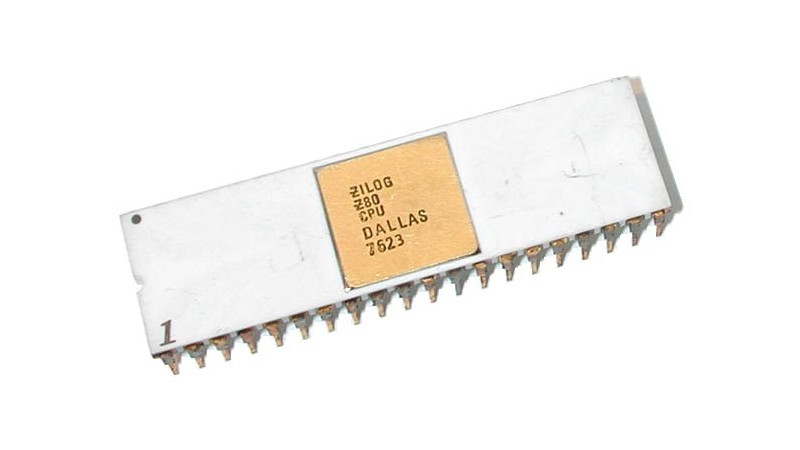
Although the demise of the Zilog Z80 processor has long been predicted, it would seem that this moment has finally arrived. The owner of the Zilog name – Littelfuse – recently sent out PCN ZAC26-0074, notifying customers that they will be taking final orders for the eZ80 and all other microcontroller lines that they currently own.
Over at Mouser, eZ80 parts have correspondingly all been marked as “End of Life”. This comes a few years after the original Z80 and its peripherals were discontinued, with the eZ80 still being an alternative until now.
Any potential sellers will have to put in their orders today, with orders still accepted until December 21 2026, with final deliveries taking place throughout 2027 as Littelfuse winds down its MCU manufacturing. This means that for commercial customers are least this is pretty much the end of the road for any circuit that still uses the eZ80 or similar.
Many of us have fondness for the Z80, which also has led to a potential way that the Z80 can live on. This includes both the many open source cores that are compatible with the Z80, as well as real silicon courtesy of the TinyTapeout project.
Thanks to [Techokami] for the tip.












Maker community should invest time and skills to develop way to make our own chips at home because looking at the way things are going in future everything from simple 8-bit MCUs to 64-bit gaming CPUs will be available only in the cloud and ordinary people will not be able to run their own code without approval of Google, Amazon, Apple or Microslop.
What? Only Microsoft gets a pet name? What about Crapple, Cramazon, and Sploogle? There may be other favorites.
Youre mistaken. FPGA is not the answer we’re looking for because it’s expensive AF and it’s probably going to get locked too.
The artix 7 has quite a long guaranteed production date and you can pivot to another. But yeah, likely costs more
FPGA, in it’s current form, is not a good answer.
You need a configuration file in VHDL or Verilog, software to implement & test it, etc. Even then, most FPGAs don’t run at 5V, so extra hardware may be required. Oh, and don’t forget the power budget: FPGAs tend to run hot.
Math / DSP functions have become easier, thanks to dedicated 18×18 multipliers being added to the fabric. If more such blocks were designed, and the overall block count reduced, you could make any CPU – from Z80 to 6809 to ARM. In a smaller, more power efficient package.
Mind you, plenty of designers would want to add peripherals to the same chip . Which risks bringing you right back to conventional FPGAs.
FPGA in its current form is almost 2 decades out of date
The illusion that its some from of magic bullet is based from 1980’s tech to reduce logic chips from damn near 100 chips to 20 down to 1 simulated gates. IRL you only see it apear in very old legacy designs
The Goog. Scamazon.
Bitchcom for those old VMware heads still raging in 2026
Or Qualcomm
RIP the eZ80 (2001-2026), successor to the Z80 (1974-2024)
The WDC6502 (1983-Present), the successor to the MOS6502 (1975-2001), I just hope does not get similarly discontinued next year.
These and the pre-x86 Intel CPUs were the foundation of todays integrated CPU markets, and probably the most well known of such devices from history.
I hope the z80 IP continues to live on at least. There were rumors the core might get released to the community, which would be lovely to become official. An open license would be wonderful of course, but I’d even settle for not enforcing protections.
The Z80 IP has been “open” for decades. The inner workings of this chip, including all of it’s quirks, have been extensively documented in thousands of books, dissertations, blogs, etc. And the design is more than 50 years old now, all related patents have expired a long time ago.
Sad. The Z80 was the first CPU I learned to program (on a ZX Spectrum). It was certainly easier than the 6502, but I enjoy programming both these days, second generation 8-bit pioneers in their own way.
Pretty sure an OSH version will get released at some point.
I learned assembly language on a TRS-80 Model 1 in 1978. It’s said to see it being discontinued.
Microsoft…
Micro$oft?
Microshite
Microshaft…
Gemini says:
   ____________________________________

  |

  |             HALT / NOP

  |

  |       Here rests the eZ80,

  |   Last Sentinel of the 8-Bit Era.

  |

  |   Born from the fires of 1976,

  |   Wired into the hearts of millions

  |   From Arcades to Calculators,

  |   From the Game Boy to the Stars.

  |

  |   You stretched 8 bits into 24,

  |   But Time has called a final JP.

  |

  |         DI ; Disable Interrupts

  |         HALT

  |____________________________________
Everything Z80, I salute you. You helped raise a lot of the little techies in us ♥️
Can’t we just emulate it on a Pi Pico?
It’s probably illegal if you don’t own chip’s license.
Lol try and stop me
I guess the Agon Light SBC will be discontinued TI-84 https://www.thebyteattic.com/p/agon.html
For new designs, a 6502-6800-8080-Z80 chip is pointless. With modern tech, a system-on-chip can take up less area than the smallest Z80 ever made, and run faster.
We know… but the audience here are rarely interested in new production designs. We tinker. We are nostalgic.
Modern tech has no standard, it’s a so-called “moving target”, young man.
There are 40+ years of documents, code and projects for these classics.
And they are simpe enough still that their internal working can be fully (!) understood on paper/in the mind of programmer.
Subsituting that for some random modern tech that will be outdated in less than ~20 years, even, makes little sense in this context.
Sometimes, it’s better to freeze development at a certain point than to re-invent it over and over again.
Let’s take modern Morse telegraphy (Gerke alphabet). It’s perfect the way it is.
Same goes for the bicycle, which in its basic design from late 19th to early 20th century is a timeless classic.
Personally, I think it would be better to re-implent a pin compatible Z80/6502 using newest technology (die shrink, new materials, post-transistor technology, optical i/o).
So that old documents are still describing same thing.
That they would become immortal, being still available in 50, 100, 500 or 1000 years.
That would be a great contribution for generational development and sustainability. Let’s think about it!
Isn’t there a project for open source z80 hardware. I think this should have been mentioned in the article:
Something called FOSSi Z80 or something like that
https://github.com/rejunity/z80-open-silicon
The RabbitCore RCM2000 is apparently (mostly?) Z80 compatible and still available. Never used them myself though.
The last time I worked with the Rabbit (2012?), it was an extension of the Z80.
So is that the end of the Zilog Z80 family altogether then? Are any other variants like the Z180 still in production? Second source manufacturers maybe?
You could probably order slop from china salvaged from e-waste computers.
Z180 is part of the Z80 family and was discontinued a while ago :(
I don’t know. I wonder what happened to the U880, though.
The Z80 compatible from former East Germany, which was widely used in former Eastern Bloc.
It was quite compatible and had slightly better specs than the original, even,
because the GDR engineers took the Zilog specs literally.
https://en.wikipedia.org/wiki/U880
If you just want to play with the ISA, the Renesas RL78 family should look fairly similar.
Did TI get rid of the TI-84 plus?
I feel like they were still being produced new even a few years ago, not just the NSpire and newer calcs, since the 84 plus was a standard.
Those are Z80 based, no?
What happens to them?
Looked it up.
1) TI84plus CE (the newer 84s with the backlit LCD) uses the eZ80
2) The CE is still (as far as I can tell) still being made
It’ll be interesting to see how TI handles this chip deprecation.
Perhaps they’ll retire the 84 for good, or maybe they’ll buy out the Z80 design and manufacture them themselves, since it is TI afterall