
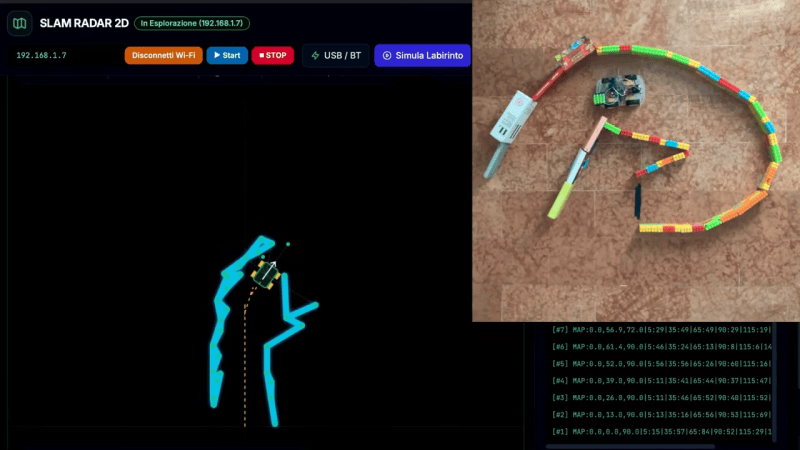
There are plenty of “robot” projects out there that are really just a small remote control platform of some sort. We often like to think of robots of having some sort of autonomy though. [Luca Fagioli] demonstrates a great example of this with his explorer robot that uses Simultaneous Localization and Mapping (SLAM) to navigate its environment.
The robot is a built on a small plastic chassis, with one gear motor per drive wheel. Running the show is an Arduino Uno R4 Wi-Fi, paired with the Sensor Shield 5.0 and an L298N motor driver board. There’s also an HC-SR04 ultrasonic sensor module onboard, mounted atop an SG-90 servo motor so it can be panned around. The ultrasonic sensor determines the range between the robot and surrounding walls, and a map is constructed at the same time as the robot is localizing itself within it. There are also infrared sensors on the bottom of the robot for detecting tape marks on the floor for checkpointing purposes.
Often, SLAM mapping is done with advanced laser rangefinders or time of flight sensors, but there are many ways to go about it as this project demonstrates. We’ve even seen it done in a distributed manner with coordinated drones combining their efforts. Overall, it’s a highly useful technique for robot navigation and wayfinding.









Claude write me a robot.
At this point you might as well buy a Roomba since you don’t know anything about “your” code anyway.
I did not see a any reference to AI, what did I miss here?
Anyway, no matter how it was done, I’m pretty sure it was fun doing and it really does look cool to see it run and draw/adjust the map.
There is enough research by now to show that the right usage of AI can lead to better understanding of a topic, but if you use AI as an answer machine that takes away anything that you could learn from exploring yourself. But even in the last scenario AI is capable of generating remarkable output, so the way you use it depends on what you’re after.
That the author doesn’t know anything of the code produced is an assumption and we all know what they say about assumptions.
i think i know what they say about assumptions: that there is no “i” in “team”