
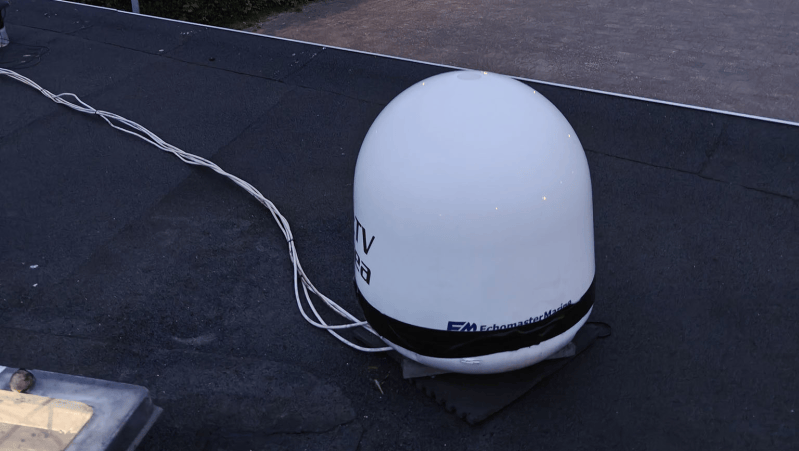
Having watched some fun videos on repurposed satellite dishes on YouTube, [Melan] wanted to get in on the action, managed to source an Intellian i4 — a dish built for marine use — and set about hacking it.
[Melan] first needed to convince the antenna that it was still on a boat by using an RP2040 microcontroller and an RS-422 module to send NMEA sentences. This was necessary to tell the i4 the “heading” of the “boat”, even though [Melan] was really using the rig stationary on land. From there, a simple email to the company itself sufficed to get the Intellian software running on the antenna.
But could it be controlled without the software?. Sniff the communications between the software and the Antenna Control Unit, and decompile the code. This done, it was relatively straightforward to put together a protocol description and figure out how to command the antenna where to point simply by issuing commands for azimuth and elevation.
We’ve featured other great bits of satellite equipment before, like this truck tracker teardown from a few years ago. If you’ve got some nice equipment on the bench that listens in on (or transmits out to) birds in space, don’t hesitate to let us know on the tipsline.











I believe that in this case the Melan is a he :-)
For some reason my correction was deleted? Anyway I know Melan in person – the picture is taken on the roof of NURDspace.
As another member of NURDspace (who is herself trans), the correction from Folkert is true (at least as far as i know).
We have no idea! Melan has no info about preferred pronouns, and an ambiguous profile. I’ve updated the post to reflect our lack of info. Anyway, it’s not relevant for the satellite receiver hack, which is really the point here.
Identifies as a Touhou fan. Good enough!
I love how a project like this always sends you down a rabbit hole, in this case, how does marine equipment communicate with one another on a boat. Interesting!
The sub reflector doesn’t correct the signal, it’s to detect the movement of the ship. The reflector is not centered and therefor wobbles and that causes the signal to continuously vary in the same pattern when there is no movement. When the ship moves in one direction, it senses this in the varying pattern and is able to calculate the necessary corrections of the dish.
I owned one to use for satellite HAM radio but sold it to someone for a lot of money but in the meantime I figured this out. Not entirely, there is more to it but you get the idea of it.
Sure about that?
With the motor and a single axix I get the impression it just spins and uses gyroscopic forces to stay in plane and thus “wobble out” smaller waves.
Only larger waves force the disk so far out of plane that some sensor registers it and actuates the actual dish motors.
Is that ^^ (similar to) what you were saying? I don’t get the “wobble” pattern VS. movement of ship at all.
There is not some sensor to detect anything, the documentation stated that the spinning disc (which spins slowly, by far not fast enough to be a gyroscope) causes a correction signal:
https://rfessentials.com/resources/rf-glossary/conical-scan-satellite/
Ah, okay I think now I get it.
Thanks.
Guess I was way off on that.
So it is quite similar to the military application of tracking planes?
eg. https://pic2.zhimg.com/v2-2f7ee4e2c827c56c4118997413c7afb9_1440w.jpg
more: https://duckduckgo.com/?q=conical+scan+satellite&ia=images&iax=images
That’s a clever trick. Antennas always have the most interesting little tricks hidden away in them. Where do you find one of these cheap for HAM? Junkyard? Just get lucky?
For posterity, here is a slightly more in-depth explanation of how the conical scan function works to keep the dish locked onto a satellite despite the ship rocking in the waves:
https://rfessentials.com/resources/rf-glossary/conical-scan-satellite/
Often the antenna control unit speaks OpenAMIP, but this one didn’t
That reminds me of an experiment on a Royal Navy ship a few years ago: after (what they thought was) diligent planning they turned their GPS receiver off to check that the bridge officers could still function without it: only to find that the primary radar promptly stopped working.