
You don’t have to be a full-on “prepper” to at least occasionally wonder what would happen if civilization collapsed. One thing you probably couldn’t do is go on the Internet and ask your favorite AI how to purify water, repel zombies, or treat a burn, all of which may be highly relevant depending on your situation. Now, with Survival LLM, you have a chance.
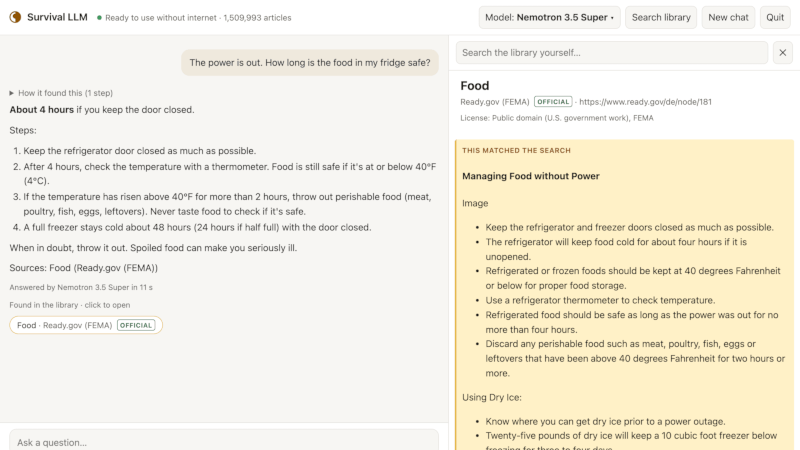
The LLM is pretty much the stock chatbot, but it is trained on survival topics, and it runs locally. Naturally, you need the Internet to set it up, so you’d want to do that now before everything hits the fan. The training set uses medical references, survival manuals, FEMA and CDC documents, and nearly a million Wikipedia articles. It includes the survival references in a library and links to them when answering, too.
The installer is small, but it assesses your system and loads a model based on what you have. If you have less than 32 GB of RAM, you’ll get the IBM Granite 4.2 8B model, which was able to correctly answer 14 of 22 test questions. Other models do better, including the NVIDIA Nemotron 3.5 Super model, which got 21 correct, but requires at least 128 GB of memory.
Now, somehow you have to power your computer, but that’s a separate problem. At least there will be plenty of GPUs to scavenge from abandoned data centers. We’ve seen prepper digital libraries before. More than one, in fact.












I would rather take the book on survival than the LLM.
“Is this mushroom edible?”
“I’m sorry, you are right – Amanita phalloides, otherwise known as “Death Cap” is a highly poisonous mushroom. It contains heat-stable amatoxins that destroy the liver and kidneys. Take it out of the stew you are making. Hope this helps!”
Some mushrooms are edible—some, only once…
as someone who forages for my own mushrooms and has never died (survivor bias, i know!) — mushroom harvesting knowledge only depends on a short list of heuristics that will keep you from killing yourself. it may cause you not to eat some delicious edible mushrooms (particularly a number of Amanitas that, for whatever reason, contain no toxins), but enables you to forage with some confidence. for example, i would never eat a white mushroom with white gills. but i would definitely eat any orange mushroom with false gills. or any mushroom with pores instead of gills that does not bruise blue and does not appear to have reddish pores.
Wow so weird, I prefer blue bruising mushrooms…
blue-bruising boletes won’t kill you but they are full of extremely bitter compounds that you will have difficulty flushing from your mouth. if you like blue in your food, I suggest the Lactarius indigo mushroom. my dad used to harvest and collect those back in virginia and they look unappetizing but are very good
IOm pretty sure gold cap magic mushrooms bruise blue.
This is not general truth. There are very famous blue-bruising boletus mushrooms (with red pores) pretty widespread in central Europe (possibly not just there) which are excellent, delicious. But YES, they REQUIRE thorough cooking.
https://en.wikipedia.org/wiki/Neoboletus_luridiformis
As mentioned before a book makes much more sense? Pretty sure electricity might be a premium
Depends on the nature of the ‘apocalypse’. If the environment has become unlivable the books and the LLM will be useless. If it’s just a die off of human populations there will be plenty of sources of electricity around for people in the former developed nations.
I’d say that depends on how autonomous the power sources are versus the people left. The power grids require quite a bit of round-the-clock maintenance to keep operating and is just as likely to collapse catastrophically as our logistics if not enough people keep it going. Though it wouldn’t be quite as rapid.
One could suggest home solar as that has become rather common within developed nations, but a lot of inverters have anti-islanding and refuse to operate without a stable source to synchronize with. So any grid failure renders them useless till you can get something to keep them happy.
Honestly, this feels just like the people who build rugged Raspberry Pi “laptops” for when “SHTF” and whatnot.
Kinda missing the big picture.
A few Jerry cans full of water, or a few “life straws”, or maybe a portable stove and a nested distillery setup are going to be infinitely more valuable. All will fit in a closet in even the smallest apartment and are going to be far cheaper.
This is just wish fulfillment and performative – “oooh, when the apocalypse comes I’ll show them all because I’ll still have a GPT. Then the MOAS will be all over me begging for recipes for making MREs taste better.”
Unless this is a prank. In which case I fell for it.
No one is thinking that. You seem to be genuinely unaware of this, but there is a “post apocalyptic living” themed aesthetic that was popularized by videogames and TV shows. Many people enjoy making devices or tools or items or think up ideas about how they’ll live in the post apocalyptic world. They don’t actually want the apocalypse to come (in most cases), they just enjoy thinking how they could survive beyond that and what resources will help them
An RPi powered laptop is going to be low enough in most people’s priority list when SHTF. Probably lower than cutting your nails and getting a haircut
Yes, I enjoyed fantasizing about how my technical skills would help me and others in the village survive and thrive the fallout. Until I realized there were so many delusional aspects to the aesthetic. I always picked a level of destruction that allowed my skills to be very useful to me and my tribe, but most worrisome was the delusional belief that I would be able to choose my vocation when the dust settled. I didn’t know how to respond to the thought of a militia man with a gun pointed at me saying “well, your LLM and GPU salvaging skills are admirable, but right now we need someone to clean out the latrines and shovel the stables, and you’re the designated one for the next few months. After that we’ll graduate you to the plow”.
Amateur radio service/hobby has a sub hobby dedicated to this.
https://en.wikipedia.org/wiki/Amateur_radio_emergency_communications
To my understanding, the idea is that radio amateurs can lend a hand in an emergency situation.
The ham operator himself is more important than his equipment here.
So in practice, it’s about assisting the rescue workers. To help setting up equipment and fixing things etc.
Here, the amateur’s technical skills are valuable.
Being able to use the ham bands to get a message is a bonus, also.
He/she/they must be able to co-operate and co-ordinat, also,
which is a detail that hams who want to participate must keep in mind.
Because amateur radio itself is not the main character here, it’s about assisting others.
I forgot to mention, there’s one thing that hams to tend to forget or underestimate..
They think about the equipment and focus on what they need to operate it.
Recharged batteries, solar panels, generators etc.
Most commonly what they forget about (-I talked to some of them-) are the basic needs.
Things such as soap, pocket knife (swiss army type), flash lights, candles, cannes food – and a reserve of water that lasts for days.
Because, if someone is starving or is in need, then that someone can’t help others.
That’s why it’s important that there is a reserve that lasts for multiple days.
Which is not to be underestimated. A single persons alone needs multiple packs of water. A small family even moreso..
Years ago, when I mentioned this detail to those hams that I talked to they basically just rolled their eyes and dismissed it.
Back then, I’ve even told them about the official emergency tips of our federal agency to support my point but to no vain.
Yet, still, I think it’s something worth to think about.
In case anyone is curious, my country’s federal agency for protection of the citizens and disaster help has published a flyer with such things (a guide, and a separate checklist).
It’s a foreign made document to many here, of course,
but maybe it still has some tips anyone may find useful or has some things they can still apply, not sure.
https://www.bbk.bund.de/DE/Warnung-Vorsorge/Vorsorge/Ratgeber-Checkliste/ratgeber-checkliste_node.html
English page: https://www.bbk.bund.de/EN/Home/home_node.html
English PDF (guide): https://tinyurl.com/3x5a3js6
Huh, that indifference to the non-technical aspects of survival is a bit surprising and sad. I remember being very impressed by a prepper some twenty years ago who had a whole bugout RV, and decided to test his planning. A minor post-KAtrina regional disaster had occurred, so he hopped in the RV and headed out to assist. His goal was to be useful and helpful while relying entirely on his bugout supplies to verify that he could go somewhere and do real labor while maintaining health and readiness.
It went well for him, and as a dress-rehearsal it allowed him to re-evaluate some of his provisioning. Considering how many of the genuinely prepper types talk about cycling out your survival provisions to keep fresh stocks, I figured more people would have had the idea to LARP SHTF by going somewhere and doing good works while testing their prep.
@Bear Naff Hi, I think you’ve nailed it.
My only explanation is that it’s a generational thing and that my fellow citizens (20s, 30s) never experienced a real catastrophe/natural disaster.
I don’t even blame them, because its a rather safe country with few natural disasters.
Except for the summer heat (in public mind, air conditioning is as much as an “enemy” as the fax machine is our friend).
In summer and winter, our public transportation has it difficult, too.
Trains such as ICE and the trams aren’t bad, but they were designed for “sunny weather”.
They’re a sunshine technology, basically. Being specced for a mild climate.
Again, it’s not the public transportation itself, but the implementation and how things are specced.
Many specs read as if it was still the 1980s or 1990s, when 30°c ( 86°F) was considered an extreme temperature (it’s now common in summers. We reach the dangerous 40°c/104°f almost every year now).
Same goes for our cell phone towers and the hospital generators.
They have a backup system, on paper, but in practice they’re never really maintenaced properly.
Batteries and the generators are old, maybe their fuel too.
Likewise, the emergency sirens network is in a sad shape.
It used to have a very good coverage during WW2 and cold war, but in the 90s after re-union it had been somewhat neglected.
In the 2000s, it even nolonger was considered vital.
That changed somewhen by the 2010s, when test alerts had been introduced.
Each Saturdays they happen, with the real catastrophe tests (smartphone alerts, sirens, DAB+ radio alerts etc) happening once or twice a year on a scheduled date.
We had a few disasters over the years, but both citicens and politicians don’t take the matter as serious as it should.
The energy shortage of the recent years did cause a change of mind, though.
But still, radio stations (transmitter sites) were still being shut down or deconstructed over the years, because of money.
Long wave, AM and shortwave stations, mainly.
The alternative being mentioned were internet radio or something.
FM radio stations are the only ones that are still very common here, I think.
Because the old technology still refuses to retire (DAB+ has some coverage but most citizens are unaware of it; it’s mostly know to car owners).
Likewise, analog two-way radio communications still matters.
The new digital walkie-talkies used by rescue workers, police etc. use a centralized repeater concept (TETRA?).
Everything goes via a central station; which not seldomly has a bad location.
So, in a tunnel there’s no digital communication anymore, even if the whole rescue team is in the tunnel.
Merely cellphone repeaters are available down there, so police and firebrigade have to resort to using that civil network instead.
I remember hearing when the floods in one part of the country
had drowned such a repeater station and the new digital communication broke.
By contrast, the old analog walkie-talkies still had worked.
Their FM repeater (relay), being from another time, was located at a mountain top.
And direct communucation from walkie-talkie to walkie-talkie still worked, as well.
All it needed was switching the channels. The digital radios are way more tricky here.
That’s why our police officers, firebrigade and the rescue workers still value their old equipment and try to maintain it.
Some (if not most) channel programming software is running under DOS, still, due to the age of the radios.
The digital switch-over worked on paper, only.
As far as I know, I mean. I’m just a layman, of course.
So yeah, that’s basically the story.
By contrast, my grand-grand parents (after WW2) still had a reserve of food in the cellar and logs stored under the cellar stairways (for the heating and the oven/stove).
Not so much because of disasters, but because of winter.
Back then, it was just normal that people had all they needed at home.
So in a winter with lots of snowfall, when cars had it difficult on street, they didn’t need to leave the house to buy groceries.
They had home-made marmelade in glasses, potatoes and other things stored down there.
That’s what my father and my grandmother had told me.
If things actually go apocalyptic, those things in your closet are largely meaningless too.
Project NOMAD kind of stomps this things colon and I already have it set up but I also like the option of a smaller footprint for initial downloading of assets. https://www.projectnomad.us/
So project Nomad files, a small LLM and a RAG configured on that data, and Bob’s your uncle. You would need to build into the system to only answer with quotations from the reference material, and stay away from inference answers (because small model, so higher risk of hallucinations)
It would be a penultimate irony: Relying on an isolated LLM – itself a dodgy recapitulation of other people’s conversations – for survival in a world doomed by the irresponsible application of global LLMs.
Wikipedia is not an authoritative source.
I’ll stick to my collection of Foxfire books.
i think it was something in the Foxfire books (we had all of them when i was a kid) that convinced by dad to cook daylily root. It didn’t taste very good and we later learned it is often somewhat toxic. so yeah, there was slop and confabulation (i refuse to use the term hallucination in this context) even back in those days.
This is the most prepper thing I have ever seen.
So with 128Gb ram, it gets under 95% accuracy. So i survive, what, a few days longer than with the sub 32Gb model before it tells me something stupid and kills me? Awesome!
Or… pick up any scouting manual pre ~2k, or any actual survival guide… heck, a first edition scouting manual signed by Baden Powel himself would probably be less than 128Gb ram…
At least the thing will keep you warm whilst the batteries run flat trying to hallucinate an answer…
EDIT: 95.4% accuracy, misread the stat.
The article says it includes the library of sources the AI was trained on, so it should be able to reference its answers and at the very least take you to the appropriate sections of the included manuals. If you rank your ability to read one book I don’t see much of an issue with having thousands and an LLM search engine. I’m no lover of AI everywhere and in everything, but since LLMs really are natural language search engines using them as such seems fine.
Makes me think that maybe a search-engine like how google is without Gemini would be best. A small system/model that is just smart enough to interpret your question and race through a library of documents for chapters and paragraphs of interest and link those without any attempt to output language of its own.
But that is kind of the recurring theme with Small Language Model projects. They are done more for the novelty factor of having a Language model.
You are right in this. I tried it with the Nemotron 3.5 Lightning model and it actually works pretty well. It answers your questions and also points to the sources so you can check them or read more. You can also search the full library yourself without even using the LLM if you wish so.
I think most people in the comments underestimate the tool. I totally agree that a good book on survival or bushcraft is better (I have one) and equipment and basic knowledge even more so (I have both). But that does not make the tool useless and you don’t need an actual apocalypse per se to find it handy. Just a day or two without internet, and most people will realize how dependent they are on online information nowadays. Nobody has a written encyclopedia anymore. Projects like this, as well as offline-dumps of Wikipedia etc, are useful in such situations.
They will probably not make you survive much longer, but maybe such offline-knowledge can make it more bearable. At least it is quite funny playing around with it.
Hmm, a small book printed in a very thin , water resistant material. And written by someone who actually tested the information in it, not a piece of software that just repeated some crazy theory someone posted on a reddit thread.
Its make much more sense to me run just a RAG system with semantic search, small model for embedding text and maybe images (search by photo) and vector database can run on any laptop or recent smartphone and gives you quick search over knowledge base, books, etc. much better than just offline wiki with fulltext search.
“I’d rather a book”..
Well, yah, there are certainly advantages to that and I am not saying you are wrong.
Now let’s say that you do have a good source of power. Perhaps a large number of solar panels? How long is it going to take you to search a library of books for the detail you need right now?
Personally, I would rather have both. The books for studying because you don’t want to have to look every single thing you do up every time you do it. And the books for if and when the power is not available or the computer dies. But.. the AI for quick, convenient lookup. All while taking things like edible mushroom tips with a healthy grain of salt!
Dude, people have Table-of-Contents in books for about ~2000 years, and indexes are around for ~700 years…
Read the books before catastrophy, take notes in a notebook
I can just see T-800s in call centers talking emo kids into suicide…much greener than phased plasma rifle in the 40 watt range.
“Remember kids, across for attention–lengthwise for results”
CLICK
Feels like people writing critiques didn’t bother to read how this would be set up. “Apocalypse” is hyperbolic obviously, if it were happening the last thing I’m doing is talking to a chat bot.
And said chat bot is basically a glorified talking search engine assuming the Temp weight is 0 and uses whatever source materials, that it clearly cites.
Good for the apocalypse? No. Good for when your government decides to shut down your internet or decide you’re not allowed to use LLMs? Yes.
And of course, books are vastly preferable.
Unless someone decides to burn them all. Contrary to popular belief, it happened multiple times in our human history. Sometimes the books’ authors had been burned as well…
why do these models need so much RAM? ie for many decades we have been able to run programs that can shift data in and out of disk – or even tape – to be able to do things that can’t be held in ‘memory’ at the same time.
Yes, it runs slower, but it still runs. And nowadays ssd storage is much much faster than external storage has even been before…
So shouldn’t the accuracy be the same but the speed just slower? Seems like some sloppy coding somewhere…
That’s what Alan Turing said. The nice thing is that nowadays RAM and FLASH seems to be equally expensive and unobtainable (f#ck you Samsung!), so your option is to print the weights and to manually traverse the layers and multiply 16k-dimension vectors by hand.
Feel free to gather $$ $$$ $$$ $$$ to run your own RAM factory and print free money.
You could run it on an SSD… If you don’t mind having it scream in agony as drive’s health takes a nosedive due to years worth of regular writes getting performed within months. It is the trade-off of making memory able to become non-volatile: They have a limit in how often they can be written before they start to degrade.
So for something as intense as Machine Learning Inference. You really need to be running it from volatile RAM with its obscenely greater endurance
If you wonder why these models are this big in the first place? well that is kind of the thing with Language Models: they are by nature a very brute force solution. Like we are having it calculate every potential output based on a plethora of factors in order for it to guess which of them is the correct one to use and that is just (over)simplified!
I would expect this to be much more useful if it runs with low RAM from an SSD, on a low power rig. Powering a full gaming PC stably rather than a raspi makes this difficult.
I would rather think how you could reduce the weight and power of the setup (monitor? Voice only? More compact..?) and expect to take some spare time to wait for answers
What happens with SHTF involves an EMP burst (natural or man-made)?
That is handy but ideally you want a copy of survivorlibrary DOT com then you vectorise that and use it with the most capable local LLM you can host with a RAG setup, that way the answers are constrained to what can be verified by those sources. By most capable I mean a reasoning model with tool use etc.