
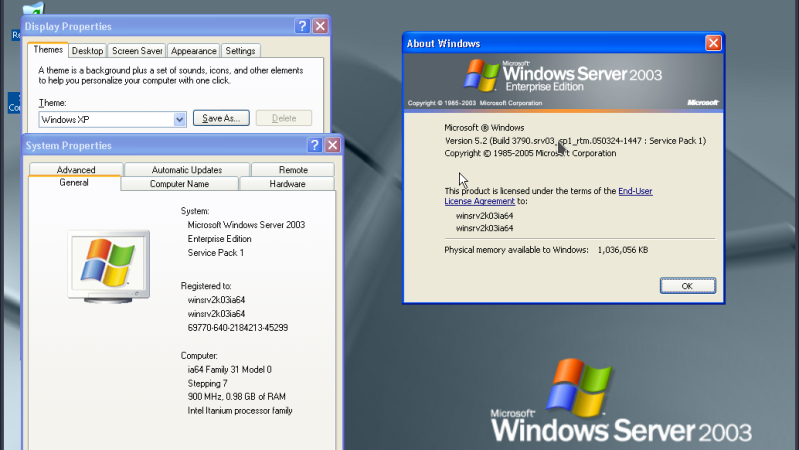
Intel’s Itanium architecture was an interesting experiment, but it has gone down in history as one of the chip giant’s bigger flops, so much so that it earned the name “Itanic” in the tech press. This is perhaps unfair, considering it did limp on until a quiet EOL in 2020. We didn’t know anyone missed it, but perhaps it was more the technical challenge than nostalgia for obsolete server hardware that led [Yufeng Gao] and [gdwnldsKSC] to spin up an instruction-set translator for the late, lamented, IA-64 architecture.
Note that it’s very much in alpha, version 0.1, so don’t expect all the things. Neither HP-UX and OpenVMS will boot, which is a pity since Itanium’s great success was arguably winning those OSes and thereby killing the bespoke architectures HP and DEC had at the time. Gentoo can get to a shell, as long as you use Kernel 6.6 or older, and Windows Server 2003 and XP-64 both apparently boot.
It’s not incredibly performant, with 486-level speeds when running on Ryzen 5000 series hardware, but then, it is a 64-bit hardware being emulated here, and pretty weird hardware at that. Itanium’s Very Long Word Instruction architecture was notoriously hard to program well. Specifically, it was hard to compile optimized programs for, so we expect optimizing an emulator is going to be similarly difficult. That’s why this is so impressive, even at this early stage.
The late, unlamented Itanium is probably one of the few systems not in the Virtual OS Museum, but perhaps eventually this project will change that.
via Raymii.org









I wish there was a port of Tibia for Itanium CPUs when their were popular. Sadly CipSoft was so incompetent back then.
I remember being on the test team for RHEL 4.3 on IA64. I wonder if it will boot on this emulator….
x86 is cursed; somehow, Intel and AMD will surpass Apple and Qualcomm’s ARM processors in both battery life and performance, and they’ll still be around 30 years from now. This isn’t wishful thinking, it’s a prediction.
Provided that Intel doesn’t try to etshablish another X86S.. 😟
Intel already did take away BIOS compatibility by writing CSM out of UEFI specification.
Once 8086/80286 compatibility, Segmentation Unit (MMU), Rings 1&2, V86 Mode and Real-Mode instructions are removed from silicon,
it will be even more difficult to run classic x86 software without using full emulation.
X64 OSes (X86_64) and 32-Bit applications (-Win32 EXE files on Windows x64-) might still run, but not something such as Windows 98 or XP anymore.
(They can still be run by running an external BIOS layer payload from UEFI.)
https://www.tomshardware.com/pc-components/cpus/intel-terminates-x86s-initiative-unilateral-quest-to-de-bloat-x86-instruction-set-comes-to-an-end
https://www.intel.com/content/www/us/en/developer/articles/technical/envisioning-future-simplified-architecture.html
https://www.phoronix.com/news/Intel-Legacy-BIOS-EOL-2020
I have one of the Itanium development systems. It was definitely a good platform, but failed to gather momentum. If anything it shows how difficult getting critical mass can be.
HP – not Intel – developed the Itanic, to persuade customers there was an upgrade path fron the very successful PA-RISC series. Look at the instruction set and virtual memory architecture, and you will see the correspondence.
HP realised that, unlike the PA-RISC chips, they could not fabricate the IA64 chips in house. So, in order to keep existing customers on board, HP gave Intel the rights to sell the chips, with HP having “most favoured partner” status.
Itanic was doomed for a traditional reason: hardware engineers presumed that it would be possible to develop compilers that could take advantage of the parallelism. Oops.
That makes sense, thanks a lot! 😎
Btw, I think we should also not forget that the idea for an x86 successor wasn’t new at the time.
A few years earlier, in the 90s, there were several RISC platforms being around.
Alpha AXP, MIPS R4000, PowerPC..
And Windows NT 3.5x and NT 4 had ports to those platforms.
OS/2 Warp had an unfinished PowerPC port, too, if I remember correctly.
There also was the PowerPC Alliance trying to establish a PC standard (WinNT, MacOS etc).
The Handheld PCs (HPCs) and Pocket PCs (PPCs) running Windows CE 2.11 and up had ports to MIPS, SH3 and StrongARM (pre XScale).
SH4 was supported by Windows CE 6 or something.
I don’t mean to sound smart or something, but this wasn’t exactly mainstream knowledge, I think.
The average user rather knew about Intel PCs running Windows, PowerMacs with MacOS and PDAs (PalmOS, Windows, niche OS).
So in retrospect, to many users it may look like as if there was always x86 until Itanium suddenly appeared out of thin air in early 2000 for no apparent reason.
That’s why I’m mention it. To PC fans or developers, that’s old news, likely.